
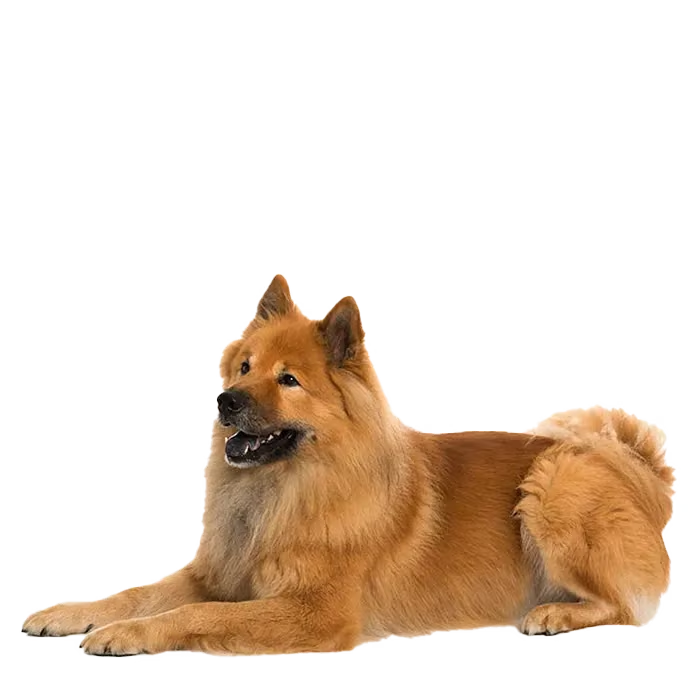
Eurasier
The Eurasier is a calm, dignified companion breed devoted to its family while remaining reserved and discerning with strangers.
- Size
- Medium
- Lifespan
- 11–13 years
- Origin
- Germany
- Temperament
- Calm
- Standard colors
- Black, Grey and Liver and 4 more
Characteristics
Coat and grooming
How the Eurasier coat is built, and what that means when you groom it.
- Coat layers
- Double coat
- Coat texture
- Plush
- Coat length
- Medium
- Shedding
- Seasonal shedding
Grooming guidance
Critical: A Eurasier should not be shaved.
The undercoat keeps heat out as well as in, and the outer coat shields the skin from sun and insect bites. Clipping the whole coat off removes both. It often grows back patchy, soft or a different colour, and in some animals the guard hairs never return properly. Brush the undercoat out instead of cutting it off.
Information: A Eurasier drops its undercoat in heavy bursts.
The undercoat comes out in heavy bursts over a few weeks. An undercoat rake, or a bath followed by a proper blow-dry, clears it far faster than daily brushing. Clipping the coat down is not a shortcut for this.
Eurasier colors and patterns
What each club's breed standard says about every Eurasier color and pattern. Point at a ruling to see the club's own wording.
Breed standards describe the Eurasier in Black, Grey, Liver, Tan, Red, Cream and Fawn. Standard patterns: Solid, Bicolour, Sable, Agouti and Tan point.
| Color or pattern | FCI | AKC | UKC | KC |
|---|---|---|---|---|
| Black | Standard (“all colours”) | Standard (“Black”) | Standard (“all colors”) | Standard (“Black”) |
| Grey | Standard (“all colours”) | Standard (“Wolfgray”) | Standard (“all colors”) | Standard (“Grey”) |
| Liver | Standard (“all colours”) | Standard (“Liver”) | Not recognised (“with the exception of ... liver”) | Not recognised (“liver ... unacceptable”) |
| Tan | Standard (“all colours”) | Standard (“Black & Tan”) | Standard (“all colors”) | Standard (“Black & Tan”) |
| Red | Standard (“all colours”) | Standard (“Red”) | Standard (“all colors”) | Standard (“Red”) |
| Cream | Standard (“all colours”) | Standard (“Cream”) | Standard (“all colors”) | Standard (“Cream Black Mask”) |
| Fawn | Standard (“all colours”) | Standard (“all colours and colour combinations are permitted”) | Standard (“all colors”) | Standard (“Fawn”) |
| White | Disqualifying (“pure white”) | Disqualifying (“White”) | Not recognised (“with the exception of pure white”) | Not recognised (“pure white ... unacceptable”) |
| Albino | No ruling | No ruling | Disqualifying (“albinism”) | No ruling |
| Patterns | ||||
| Solid | Standard (“all colours”) | Standard (“Black”) | Standard (“all colors”) | Standard (“Black”) |
| Bicolour | Standard (“colour combinations”) | Standard (“colour combinations”) | Standard (“combinations of colors”) | Standard (“Red & Black”) |
| Sable | Standard (“colour combinations”) | Standard (“colour combinations”) | Standard (“combinations of colors”) | Standard (“Red Sable”) |
| Agouti | Standard (“colour combinations”) | Standard (“Wolf Sable”) | Standard (“combinations of colors”) | Standard (“colour combinations”) |
| Tan point | Standard (“colour combinations”) | Standard (“Black & Tan”) | Standard (“combinations of colors”) | Standard (“Black & Tan”) |
| Piebald | Disqualifying (“pied colouring”) | Disqualifying (“Pinto”) | Not recognised (“with the exception of ... white patches”) | Not recognised (“white patches on body ... unacceptable”) |
| Merle | No ruling | No ruling | No ruling | Not recognised (“merle, which are unacceptable”) |
| Double merle | No ruling | No ruling | No ruling | No ruling |


| Color or pattern | FCI | AKC | UKC | KC |
|---|---|---|---|---|
| Dark brown | Standard (“dark”) | Standard (“dark”) | Standard (“dark in color”) | Standard (“dark”) |
| Color or pattern | FCI | AKC | UKC | KC |
|---|---|---|---|---|
| Black | Standard (“black pigmentation”) | Standard (“black pigmentation”) | Standard (“black pigment”) | Standard (“black, medium sized nose”) |
What the rulings mean
- Standard
- Described by the club's breed standard.
- Disqualifying
- The club's breed standard disqualifies an animal of this colour or pattern.
- Not recognised
- The club does not accept this colour or pattern for the breed.
Color changes
How a Eurasier's colors can change over its life.
Blackchanges toRust
Coat · With body condition · can change back
Blackchanges toGrey
Coat · Progressive
Blackchanges toBrown
Coat · In the sun · can change back
Tan pointchanges toSaddle
Coat · With age · from 6 to 156 weeks
Blackchanges toSnow nose
Nose · With the season · can change back
Blackchanges toPink
Nose · With the season · can change back
Pinkchanges toBlue-black
Tongue · With age · from 8 to 26 weeks


Sources
Each ruling comes from the club's published breed standard or color list.
About the Eurasier
A medium-sized Spitz-type dog from Germany, the Eurasier is a steady, devoted companion at home and standoffish with people it doesn't know. Average lifespan runs 11 to 13 years.
Germany gave the world the Eurasier, a medium-sized companion breed built on Spitz lines: wedge-shaped head, pricked ears, and a dense double coat. Breeders set out in the 1960s to produce a steady family dog, and that original brief still shapes the breed today. A Eurasier settles close to its household, often trailing an owner quietly from room to room rather than demanding attention.
Temperament sets this breed apart from most companion dogs. A properly bred Eurasier is level-headed and self-possessed rather than easily wound up. It's warm with its own family but keeps strangers at arm's length, weighing up a visitor before deciding whether to approach. That wariness is typical of the breed and shouldn't be read as timidity or a bad temper.
Among Spitz breeds, the Eurasier is one of the quieter ones. It barks when there's a reason to, not for the sake of it, and settles into whatever routine the household keeps. Because the breed picks up on tension and tone so readily, early socialisation and calm, consistent handling from puppyhood matter more than they might for a less sensitive dog.
| Attribute | Detail |
|---|---|
| Origin | Germany |
| Size | Medium |
| Lifespan | 11 to 13 years |
| Group / role | Spitz-type companion dog |
| Good with | Family members, including children, when socialised early |
Who the breed suits
This is a dog for a household that wants a calm, devoted companion and is happy to fold it into everyday life. Owners who are around most of the day suit the breed best, since a Eurasier left alone for long stretches doesn't cope well. Because of its reserve with strangers, it isn't the dog that greets every stranger at the park like a long-lost friend, so anyone after that sort of instantly sociable pet should think twice. Owners with patience, a gentle hand, and no interest in harsh correction get the best out of this breed.
History and origins
Julius Wipfel developed the Eurasier in 1960s Germany, crossing the Keeshond (Wolfspitz) with the Chow Chow, and later the Samoyed, to breed a settled family companion.
As dog breeds go, the Eurasier is a young one, and its history is well documented. Julius Wipfel developed it in Germany through the 1960s, working alongside a small circle of breeders and drawing on ideas from the ethologist Konrad Lorenz, whose writing on dog behaviour shaped the breeding goal. The target was a well-balanced family dog with the classic Spitz look but a steadier, more people-focused temperament.
The founding cross paired the Keeshond, known too as the Wolfspitz, with the Chow Chow, and the first-generation dogs went by the name Wolf-Chow. Breeders brought the Samoyed into the mix later on, widening the gene pool and fine-tuning both temperament and coat.
Recognition came in 1973, when the breed was named Eurasier, a nod to the European and Asian breeds behind it. The Fédération Cynologique Internationale accepted it in the same decade, filing it under the Spitz and primitive types group.
The Eurasier has stayed a relatively uncommon breed worldwide and is still bred chiefly as a companion rather than for work or competition. Breed clubs internationally, and Dogs New Zealand closer to home, keep the focus on health testing and temperament selection, holding the dog close to Wipfel's original intent rather than letting popularity reshape it.
Appearance and breed standard
Medium-sized and well-balanced, the Eurasier carries the classic Spitz look, with a wedge-shaped head, erect ears, a dense double coat, and a tail curled over the back. Coat colours span a wide range.
The Eurasier is medium-sized with a harmonious build, slightly longer than it is tall. The head is wedge-shaped with a moderate stop, the ears stand erect and well apart, and dark eyes give the face an alert, settled expression. Tail carriage is high, curled or arched over the back. Nothing about the dog should look exaggerated. The overall impression is one of strength without bulk.
| Trait | Standard |
|---|---|
| Height | Males 52 to 60 cm; females 48 to 56 cm at the withers |
| Weight | Males 23 to 32 kg; females 18 to 26 kg |
| Coat | Medium to long double coat: dense undercoat beneath longer guard hairs, shorter over the muzzle, face, and front of the legs |
| Colours | Wide range accepted, including fawn, red, wolf-grey, black, and black-and-tan; liver and pure white are faults |
| Eyes | Dark, medium-sized, not protruding |
Coat and colours
The Eurasier's thick double coat is built for cold conditions. Underneath sits a soft, dense undercoat; over the top run longer, looser guard hairs, with feathering along the tail, the backs of the legs, and round the neck. The coat sits fairly loose on the body rather than standing straight out.
Nearly every natural colour is allowed under the standard, bar liver and pure white, and a tongue that's fully or partly blue-black turns up often thanks to the Chow Chow in the breed's background. White patches on the body count against a dog in the show ring, though they make no difference to a Eurasier kept purely as a companion.
Temperament and personality
With its family the Eurasier is calm, devoted, and even-tempered; with strangers it turns reserved, even aloof. It's a quiet, sensitive dog that bonds tightly with its own household.
Quiet and dignified, the Eurasier builds its whole character around its family. It's affectionate and steady with the people it lives with, often camped nearby or resting in the same room, though it isn't needy about it. What it wants is to be part of things, not shut out of them.
Strangers get a different reception. A Eurasier will typically size up a new person from a calm distance before deciding whether they're worth approaching. It isn't a guard dog and rarely turns aggressive, but trust has to be earned rather than given freely. Push a greeting and the dog tends to dig its heels in further, so the better approach is to let it come forward in its own time.
Within its own family the breed is usually gentle and patient with children, particularly if raised alongside them, and it typically gets on fine with other dogs and household pets when introduced to them early. Harsh tones and a tense household don't sit well with a Eurasier. It reads the mood of a home closely, and an unsettled house will unsettle the dog too.
| Trait | Rating |
|---|---|
| Affection (with family) | 5 |
| Energy | 3 |
| Trainability | 3 |
| Vocalness | 2 |
| Shedding | 4 |
Care and grooming
Regular brushing of that double coat, a solid daily walk, and plenty of family contact are the Eurasier's basic requirements. Long stretches alone don't suit this breed.
Overall the Eurasier sits in the moderate-maintenance bracket. Coat upkeep, a steady daily walk, and a genuine place in family life cover the essentials. Built for the cold, that double coat means the dog feels the heat more than most, so on warm days exercise is best kept to the cooler parts of the morning or evening.
Grooming
- Brush once or twice a week to clear loose undercoat and head off mats, paying particular attention to the neck, behind the ears, and the backs of the legs.
- Through the two big seasonal moults, brush daily. There's a lot of undercoat to shift during these stretches.
- Bathe only when the dog actually needs it. The coat sheds dirt on its own, and washing too often strips its natural oils.
- Trim nails every few weeks and keep the hair between the paw pads clear.
- Clean the ears and keep an eye on the teeth as part of the regular routine.
Exercise
- Aim for around 45 to 60 minutes of activity a day, split between walks and free movement.
- Mix in scent games or light training so the dog gets mental work as well as physical.
- Where there's a safe, enclosed spot, let the dog off lead for a run.
- Hold off on hard, repetitive exercise for young pups. Their joints are still developing and don't need the strain.
Environment
A house with a secure garden suits the Eurasier well, though it can manage in a smaller home provided it gets proper exercise. What matters more than square metres is company. This is a breed that bonds hard to its people and struggles with long hours alone, so it fits best with a household where someone's usually around, or where the dog can simply come along.
Nutrition and feeding
A complete, balanced diet matched to life stage and activity keeps a Eurasier in good shape. Measure portions rather than free-feeding, since this breed puts on weight easily.
A Eurasier does best on a complete, balanced diet suited to its age, weight, and activity level. Most owners go with a good-quality commercial dog food, though a home-prepared or raw diet can work too if it's put together with veterinary input. This is a moderately active breed that piles on weight if overfed, so portions want measuring out rather than left down for free access.
| Life stage | Amount per day | Meals |
|---|---|---|
| Puppy (2 to 6 months) | Per puppy-food label for projected adult weight | 3 to 4 |
| Junior (6 to 12 months) | Per label, tapering towards the adult portion | 2 to 3 |
| Adult (1 to 7 years) | Around 200 to 350 g of quality dry food, depending on size and activity | 2 |
| Senior (7+ years) | Slightly reduced calories; monitor weight | 2 |
Treats and supplements
Keep treats to roughly 10 percent of daily calories and factor them into the overall ration so the dog's weight doesn't creep up. A properly balanced complete diet covers what a healthy dog needs, so supplements aren't necessary for most of them. A vet might suggest joint supplements or omega-3s for an older dog or one with joint issues. Fresh water should be available at all times.
Health and common conditions
Generally a healthy breed, the Eurasier typically lives 11 to 13 years. Responsible breeders screen breeding stock for hip and elbow dysplasia, eye conditions, and patellar luxation.
The Eurasier is, on the whole, a healthy and sound breed, helped along by breed clubs that keep health testing front and centre. Typical lifespan runs 11 to 13 years. As with any breed, a handful of conditions crop up more often than in dogs generally, and going with a breeder who screens their stock cuts the odds of inherited problems turning up.
| Condition | Signs | Note |
|---|---|---|
| Hip dysplasia | Stiffness, reduced activity, difficulty rising | Hip scoring is recommended for breeding stock |
| Elbow dysplasia | Front-leg lameness, especially after exercise | Screened through formal elbow grading |
| Patellar luxation | Skipping or hopping on a hind leg | Turns up more often in smaller individuals |
| Hereditary eye conditions | Cloudiness, vision changes | Eye testing recommended before breeding |
| Hypothyroidism | Weight gain, lethargy, coat changes | Confirmed by blood test; managed with medication |
Preventive care
- Stay on top of routine vaccinations and parasite control for fleas, ticks, and worms.
- Book an annual vet check, moving to twice a year once the dog's a senior.
- Keep the dog at a healthy weight to ease the load on its joints.
- Brush the teeth on a regular basis and keep up with dental care generally.
- Pick a breeder who can show hip, elbow, and eye test results for both parents.
Training and socialisation
The Eurasier is intelligent and willing to learn, but sensitive and somewhat independent-minded. Calm, reward-based training works best, and early socialisation is essential.
The Eurasier learns readily enough, but its sensitive, slightly independent streak means drilling or force get nowhere with this breed. It's a dog that thinks before it acts, and it switches off fast if training turns repetitive or heavy-handed. Calm, patient handling, with sessions kept short and upbeat, gets the best results. Given the breed's natural reserve, early and varied socialisation carries real weight: puppies should meet plenty of people, places, and situations, kept low-key, through those first few months.
Basics
- Start socialisation early, introducing the puppy gently to new people, dogs, sounds, and surfaces.
- Teach the core cues: responding to its name, sit, recall, and walking on a loose lead.
- Keep sessions short and finish while the dog's still keen, not once it's bored.
- Reward with food, praise, and play rather than reaching for correction.
- Get a reliable recall solid before any off-lead freedom.
- Practise in different spots so the behaviours hold up away from home too.
Breeding and raising young
A Eurasier reaches breeding maturity at around two years. Litters average four to six puppies after a roughly nine-week gestation, and responsible breeding depends on health testing and temperament selection.
Eurasiers mature later, both physically and mentally, than plenty of other breeds, so responsible breeders generally hold off until a dog is around two before breeding it, giving time to finish health screening properly. Mating, pregnancy, and whelping follow the usual pattern for a medium-sized dog: gestation runs about 63 days, and litters commonly land somewhere between four and six puppies, though it varies.
How the litter is raised shapes the breed's character as much as anything. The dam typically raises the puppies with plenty of human contact close by, and early handling is what builds the confident, even temperament the breed's known for. Puppies are usually weaned by seven to eight weeks and head to new homes from about eight weeks onward. Since the Eurasier was bred from the outset to be a stable family companion, reputable breeders weight temperament heavily alongside hip, elbow, and eye health in the parents. Breed clubs keep registers going to back careful, planned litters over high-volume production.
| Metric | Value |
|---|---|
| Breeding maturity | Around 2 years |
| Gestation | About 63 days (roughly 9 weeks) |
| Average litter size | 4 to 6 puppies |
| Weaning | About 7 to 8 weeks |
| Typical age to new home | From about 8 weeks |
Registering a Eurasier in New Zealand, microchip and all
Alongside council registration, a free United Pet Club record keeps a live phone number behind your Eurasier and its chip.
Eurasier registration and microchip registration in New Zealand
Adding your Eurasier to the registry is a ten-minute job at most: name, date of birth, photo, contact details, save. The profile is free for life and works whether the chip is already in or booked for the next vet visit. Dog registration is the place to start.
A scanned chip is only ever as useful as its record. Pop your Eurasier's fifteen digit number into a free United Pet Club account and the record does the rest: free updates after every move, every brand accepted, searchable day and night. Microchip registration first, account alongside.
How do I register my Eurasier in New Zealand?
Setting up a free United Pet Club account, adding your Eurasier's details and a photo, and saving is all it takes. The record stays free for the dog's whole life, chip or no chip.
How do I register my Eurasier's microchip?
Just add the fifteen digit number to your free account along with your current address and phone. Under the lifetime plan there is nothing to pay for the registration or any later update.
Does my Eurasier need a microchip in New Zealand?
Dogs registered for the first time since 2006 need one under the National Dog Database rules, working farm dogs aside. The council record and your United Pet Club profile do different jobs, and the second one is free.
What does registering a Eurasier cost?
Nothing. The free lifetime plan carries the profile, the chip record, and every update, and no renewal notice ever arrives.
Frequently asked questions
Common questions about the Eurasier touch on its size, temperament, grooming, lifespan, how it fits family life, and how easy the breed is to track down.
How big do Eurasiers get?
It's a medium-sized dog. Males stand roughly 52 to 60 cm at the withers and weigh about 23 to 32 kg; females run a bit smaller, around 48 to 56 cm and 18 to 26 kg.
What's the Eurasier's temperament like?
Calm, devoted, and even-tempered with its own family, reserved or aloof with anyone it doesn't know. It's a quiet, sensitive dog that bonds tightly with its own household rather than being friendly with all and sundry.
Is the Eurasier high maintenance?
It sits somewhere in the middle. The double coat wants brushing once or twice a week, and daily through the two seasonal moults. Beyond that, the dog needs around an hour of activity a day and, more than anything, regular company.
How long do Eurasiers live?
Usually 11 to 13 years. Picking a breeder who health-tests the parents, and keeping the dog at a healthy weight through its life, both help towards a long, comfortable run.
Is the Eurasier a good family dog?
Yes. The breed was developed specifically as a family companion, and it's typically gentle and patient with children in its own household when introduced to them early. It suits a home where someone's usually about, since being left alone for long periods doesn't sit well with this breed.
Does the Eurasier bark a lot?
No. It's quiet as Spitz breeds go, and tends to bark for a reason rather than nonstop, which suits most home settings.
Are Eurasiers easy to find in New Zealand?
Not really, no. The breed stays relatively uncommon here, and litters are planned carefully around health and temperament rather than turned out in volume, so puppies tend to come only through dedicated breeders and Dogs New Zealand's breed contacts. Because New Zealand's biosecurity rules make importing a dog a serious undertaking, most buyers wait for a local litter rather than looking overseas, and a waiting list is the norm.
From the community
Ask about the EurasierNo questions about the Eurasier yet. Be the first to ask.
Browse Dog breeds