
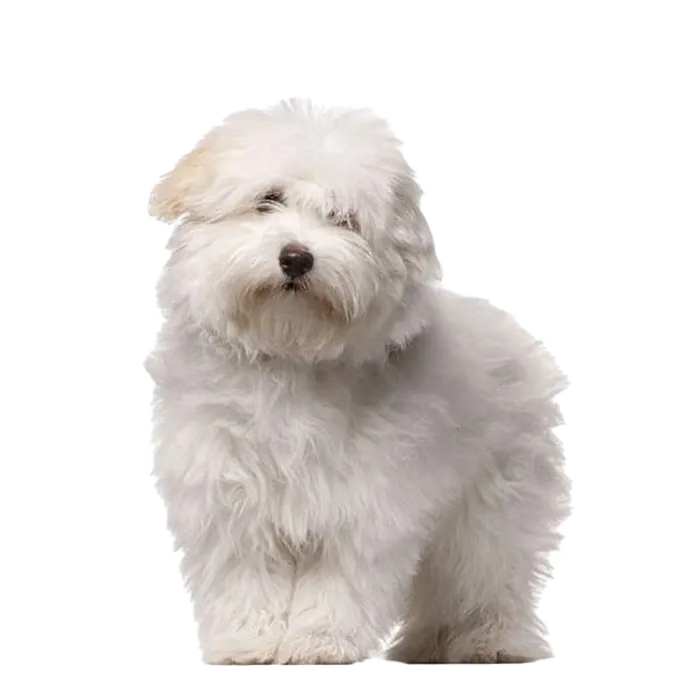
Coton de Tulear
The Coton de Tulear is an affectionate, playful companion breed from Madagascar with a soft cotton-like coat and a sunny, people-loving personality.
- Size
- Small
- Lifespan
- 15–19 years
- Origin
- Unknown
- Temperament
- Affectionate
- Standard colors
- White, Grey and Brown and 4 more
Characteristics
Coat and grooming
How the Coton de Tulear coat is built, and what that means when you groom it.
- Coat layers
- Single coat
- Coat texture
- Silky, Wavy
- Coat length
- Long
- Shedding
- Low shedding
Grooming guidance
Caution: A Coton de Tulear coat mats easily.
Fine or long hair tangles at the base of the coat, out of sight, where the mats tighten and pull on the skin. Brushing has to reach right down to the roots in sections, not just skim the surface.
Information: A Coton de Tulear needs clipping every few weeks.
This coat keeps growing rather than shedding out, so it has to be trimmed every few weeks. Left to grow it mats down against the skin and traps moisture, dirt and heat.
Coton de Tulear colors and patterns
What each club's breed standard says about every Coton de Tulear color and pattern. Point at a ruling to see the club's own wording.
Breed standards describe the Coton de Tulear in White, Grey, Brown, Tan, Chestnut, Lemon and Fawn. Standard patterns: Solid and Roan.
| Color or pattern | FCI | AKC | UKC | KC | KUSA |
|---|---|---|---|---|---|
| White | Standard (“Ground colour: White”) | Standard (“White”) | Standard (“Ground color: White”) | Standard (“Predominantly white”) | Standard (“Ground colour is white”) |
| Grey | Standard (“slight shadings of light grey colour (mixture of white and black hairs)”) | Standard (“Gray Markings”) | Standard (“slight shadings of light gray color (mixture of white and black hairs)”) | Standard (“slight shadings of light grey”) | Standard (“slight shadings of light grey (mixture of white and black hairs)”) |
| Brown | No ruling | Standard (“Puppies ... may have the acceptable colors of light tan, light brown, dark brown”) | No ruling | Standard (“White & Brown”) | No ruling |
| Tan | No ruling | Standard (“light tan (mixture of white and light tan hairs)”) | No ruling | Standard (“White & Tan”) | No ruling |
| Chestnut | No ruling | Standard (“Puppies ... may have the acceptable colors of ... chestnut or grey”) | No ruling | Not recognised | No ruling |
| Lemon | Standard (“red-roan appearance - lemon”) | Fault | No ruling | Standard (“White & Lemon”) | Standard (“red-roan appearance - lemon”) |
| Fawn | Standard (“red-roan (mixture of white and fawn hairs)”) | Fault | Standard (“red-roan (mixture of white & fawn hairs)”) | Standard (“slight shadings of ... fawn/apricot”) | Standard (“red-roan (mixture of white and fawn hairs)”) |
| Black | Disqualifying (“any marking of a definite black”) | Disqualifying (“Black”) | Disqualifying (“Any black marking on the coat”) | Not recognised | Disqualifying (“any marking of a definite black”) |
| Patterns | |||||
| Solid | Standard (“Ground colour: White”) | Standard (“Coat color is white”) | Standard (“Ground color: White”) | Standard (“Predominantly white”) | Standard (“Ground colour is white”) |
| Roan | Standard (“red-roan (mixture of white and fawn hairs)”) | No ruling | Standard (“red-roan (mixture of white & fawn hairs)”) | No ruling | Standard (“red-roan (mixture of white and fawn hairs)”) |


| Color or pattern | FCI | AKC | UKC | KC | KUSA |
|---|---|---|---|---|---|
| Black | No ruling | Standard (“dark brown or black”) | No ruling | No ruling | No ruling |
| Dark brown | Standard (“dark”) | Standard (“dark brown or black”) | Standard (“dark”) | Standard (“dark”) | Standard (“dark”) |
| Light brown | Fault (“Eyes: Light”) | Disqualifying | No ruling | No ruling | Fault (“Eyes: Light”) |
| Blue | Disqualifying (“wall eyes”) | Disqualifying | Disqualifying (“Wall eyes”) | No ruling | Disqualifying (“wall eyes”) |
| Color or pattern | FCI | AKC | UKC | KC | KUSA |
|---|---|---|---|---|---|
| Black | Standard (“black”) | Standard (“pigmented in black”) | Standard (“black”) | Standard (“Nose black”) | Standard (“black”) |
| Liver | Standard (“brown is tolerated”) | No ruling | Standard (“dark brown”) | No ruling | Standard (“brown is tolerated”) |
| Pink | Disqualifying (“Total lack of pigment on eyerims, nose or lips”) | Disqualifying (“Total lack of pigment on the nose”) | Disqualifying (“Lips, nose and eye rims completely lacking in pigmentation”) | No ruling | Disqualifying (“Total lack of pigment on eye rims, nose, or lips”) |
| Patterns | |||||
| Butterfly nose | Fault (“discoloured nose, with unpigmented areas”) | No ruling | Fault (“nose ... partially lacking in pigmentation”) | No ruling | Fault (“discoloured nose, with unpigmented areas”) |

What the rulings mean
- Standard
- Described by the club's breed standard.
- Fault
- Named by the club's breed standard as a fault: the animal can be shown but is penalised.
- Disqualifying
- The club's breed standard disqualifies an animal of this colour or pattern.
- Not recognised
- The club does not accept this colour or pattern for the breed.
Color changes
How a Coton de Tulear's colors can change over its life.
Whitechanges toRoan
Coat · With age · from 2 weeks
Blackchanges toSnow nose
Nose · With the season · can change back
Blackchanges toPink
Nose · With the season · can change back

Sources
Each ruling comes from the club's published breed standard or color list.
About the Coton de Tulear
A small, cotton-coated companion dog from Madagascar, sociable and people-focused, well matched to New Zealand homes with time to spare for company.
The Coton de Tulear is a small companion breed with ties to Madagascar, and its name nods to the port city of Tulear (Toliara) on the island's southwest coast. The "coton" part is French for cotton, a reference to the soft, fluffy texture of the coat.
Cotons were never bred to work. They were bred to be company, and that shows in the temperament. They are affectionate, sociable, stick close to their owner, and usually get on fine with children, visitors, and other pets. Playfulness carries well into adulthood, and the breed responds readily to attention and gentle handling.
Adults typically weigh only a few kilograms, so the Coton suits a flat in the city or a lifestyle block out of town just as well. The white coat asks for regular grooming, though this is not a breed with the exercise needs of a working dog. A reported lifespan of 15 to 19 years puts it among the longer-lived small breeds, so bringing one home is a decision for the long haul.
| Attribute | Detail |
|---|---|
| Origin | Madagascar (exact origins unknown) |
| Size | Small |
| Lifespan | 15 to 19 years |
| Group/role | Companion dog |
| Good with | Children, families, other pets, visitors |
Who it suits
The Coton de Tulear fits households that can offer regular company. It suits families, people living alone, and older owners who want a small, affectionate dog and do not mind the coat upkeep. The breed does not cope well with being left alone for long stretches, so it suits people who work from home or can arrange company during the day. Anyone who finds regular brushing a chore should think twice, since the coat needs frequent attention.
History and origin
The Coton de Tulear developed on Madagascar as a small companion dog; its early origins were never properly recorded.
The Coton de Tulear traces back to Madagascar, the large island off Africa's southeast coast, and to the port city of Tulear in the island's southwest. Its exact origins were never properly recorded, and accounts of how the breed's ancestors reached the island differ from one source to the next.
One common account links the breed to small white ship dogs that landed on the Madagascan coast and crossed with local dogs already there. Over generations, a small, white, soft-coated companion type took hold on the island. Because early records are thin, much of this history is pieced together rather than documented with any certainty.
The Coton settled into life as a household companion and lapdog rather than a working dog. Later, dog enthusiasts outside Madagascar took an interest, and the breed spread to Europe and North America through the second half of the 20th century.
As the breed entered the wider purebred world, kennel clubs in a number of countries recognised it and published standards covering size, coat, and temperament. Dogs New Zealand lists the breed in its non-sporting group, and any Coton entering the country, whether as a living dog or as frozen semen for a breeding programme, must clear Ministry for Primary Industries biosecurity checks, since New Zealand holds to strict import and quarantine rules to protect its rabies-free status. The white, cotton-textured coat and the friendly nature remain the two features every description of the breed comes back to.
Appearance
The Coton de Tulear is a small white dog with a soft, cotton-textured coat, a compact build, and dark, round eyes.
The Coton de Tulear is small and lightly built, with a level back and a tail carried over the back when the dog is alert. The overall picture is of a compact companion dog wrapped in a soft, profuse coat. The head is fairly broad, the muzzle short, and the eyes dark, round, and set well apart.
| Trait | Description |
|---|---|
| Height | Roughly 23 to 30 cm at the shoulder |
| Weight | About 3.5 to 6 kg |
| Coat | Long, soft, cotton-textured; not coarse or wiry |
| Colour | Predominantly white; some markings permitted in places |
| Eyes | Dark, round, set wide apart |
Coat and colours
The coat is what defines the breed. It is soft and dense, with a texture often likened to cotton wool, and it stands away from the body rather than lying flat. White is the dominant colour, and a clean white coat is what most breed descriptions call for. Faint shading or light markings sometimes show up, particularly around the ears or on puppies, and some of this can fade as the dog grows up. The coat grows long and needs regular grooming to stay free of mats, worth factoring in during New Zealand's damper months, when a wet coat takes longer to dry out properly.
Temperament
The Coton de Tulear is friendly, affectionate, and playful, bonding closely with its household and usually getting on with children and other animals.
The Coton de Tulear is a companion dog through and through, and the temperament reflects that. Dogs of this type form close attachments to the people they live with. They tend to follow their owner from room to room and like being included in whatever is going on.
Around family, the Coton is gentle and playful, and that playfulness usually carries on well past puppyhood. With strangers, the breed tends to be sociable rather than wary, though individuals differ and some hang back a little at first meeting. The Coton is sharp and watches its owner closely, and reads mood well as a result.
Most Cotons get on well with children who handle them kindly, and with other dogs and household pets. Because the bond runs deep, the breed can struggle with long stretches alone and may become unsettled if left isolated for much of the day. Early socialisation helps it stay confident around new people, places, and animals.
| Trait | Rating |
|---|---|
| Affection | 5 |
| Energy | 3 |
| Trainability | 4 |
| Vocalness | 2 |
| Shedding | 2 |
Care and grooming
The Coton de Tulear needs regular coat care and moderate daily exercise, and suits indoor living close to its people.
The main ongoing job with a Coton de Tulear is coat care. The soft coat tangles easily and needs frequent brushing to keep it free of mats. Outside of grooming, the breed has moderate exercise needs and settles well into indoor life.
Grooming
- Brush several times a week, and daily once the coat grows long, to keep it mat-free
- Bathe as needed, then dry the coat properly and brush it through
- Trim hair around the eyes and paws so the dog stays comfortable
- Check and clean the ears regularly and keep nails trimmed
- Some owners clip the coat shorter to cut down on daily brushing
Exercise
- Give a daily walk plus some active play
- Use indoor games and toys to keep the dog occupied
- Watch for overheating on warm days, since the dense coat holds heat
- Add short training games for mental stimulation
Environment
The Coton de Tulear suits both flats and houses and does not need a big section. What matters most is company. New Zealand's temperate climate suits the breed well, though the damp can mean extra coat-drying after wet walks. The breed prefers staying close to its people and does not do well spending long days on its own. A calm indoor space, access to the household, and regular handling keep it settled and content.
Nutrition and feeding
The Coton de Tulear does well on a complete small-breed diet fed in measured portions across two daily meals.
The Coton de Tulear does well on a complete and balanced dog food matched to its size and life stage. Small breeds have small stomachs and comparatively high energy needs for their weight, so a quality food fed in properly measured portions matters. Because the breed is small and easy to overfeed, keep an eye on body condition and adjust amounts to keep the dog lean.
| Life stage | Amount per day | Meals |
|---|---|---|
| Puppy (2 to 6 months) | Per food label, split into small feeds | 3 to 4 |
| Junior (6 to 12 months) | About 70 to 110 g | 2 to 3 |
| Adult | About 60 to 100 g | 2 |
| Senior | Adult amount, adjusted for activity | 2 |
Treats and supplements
Keep treats to a small share of daily calories, around ten percent, so they do not throw out the diet or add weight. Plain options such as small pieces of carrot work well for training. Fresh water should be available at all times. A dog on a complete commercial diet usually needs no extra supplements; check with a vet before adding any, particularly for puppies or older dogs.
Health
The Coton de Tulear is generally a healthy, long-lived small breed, with a reported lifespan of 15 to 19 years and a handful of conditions worth watching.
The Coton de Tulear is generally a sturdy small breed and ranks among the longer-lived companion dogs, with a reported lifespan of 15 to 19 years. As with any breed, certain conditions show up more often than in the general dog population, and responsible breeding along with routine veterinary care cuts the risk of several of them.
| Condition | Signs | Note |
|---|---|---|
| Patellar luxation | Skipping steps, occasional hind-leg lameness | Kneecap slips out of place; common in small breeds |
| Hip dysplasia | Stiffness, reluctance to jump or run | Joint malformation; screened by responsible breeders |
| Progressive retinal atrophy | Loss of night vision, eventual blindness | Inherited eye disease; DNA tests available |
| Luxating patella related arthritis | Long-term joint stiffness with age | Can follow untreated kneecap issues |
| Dental disease | Bad breath, tartar, sore gums | Small mouths are prone to crowding and build-up |
Preventive care
- Keep vaccinations and parasite control current
- Book annual vet checkups, more often for older dogs
- Brush the teeth regularly and arrange dental cleans as advised
- Keep the dog at a lean weight to protect the joints
- Choose breeders who screen for knee, hip, and eye conditions, and check Dogs New Zealand records where available
Training
The Coton de Tulear is intelligent and eager to please, and responds well to consistent, reward-based training.
The Coton de Tulear is intelligent and tuned in to its owner, and generally enjoys the back-and-forth that training brings. The breed responds best to reward-based methods and short, upbeat sessions. Harsh corrections tend to backfire with a sensitive companion dog and can make it nervy. Consistency from everyone in the household helps the dog work out what is expected.
Basics
- Start socialisation early, introducing the puppy to people, places, and other animals
- Teach a reliable name response and basic cues such as sit, down, and come
- Set up a house-training routine with frequent, scheduled trips outside
- Build up alone time gradually so the dog does not get distressed when left
- Practise calm handling and grooming so coat care becomes second nature
- Reinforce learned cues in new settings so they stick
Breeding
The Coton de Tulear is a small breed with modest litters, and breeding stock benefits from health screening.
Breeding the Coton de Tulear calls for the same care given to any small companion breed. Dogs should reach full physical maturity before being bred, and responsible programmes screen breeding stock for the knee, hip, and eye conditions known in the breed before any pairing. Mating is planned around the female's heat cycle.
Gestation in dogs runs to roughly two months. Being a small breed, the Coton tends to produce modest litters. Whelping needs watching, and a vet should be consulted if the dam shows signs of trouble, since small dogs can run into complications during delivery.
Raising the pups comes down to warmth, good nutrition for the nursing dam, and gradual weaning. Early, gentle handling and exposure to everyday household sights and sounds help pups grow into the confident, sociable adults the breed is known for. Litters normally stay together until the pups are old enough to head off to new homes. Breeders working with Dogs New Zealand register litters through the club and follow its code of ethics, which sets minimum ages for mating and standards of care for the dam and litter.
| Metric | Value |
|---|---|
| Sexual maturity | Around 6 to 12 months (breed only once fully mature) |
| Gestation | Approximately 58 to 68 days |
| Average litter size | About 3 to 5 puppies |
| Weaning age | Around 6 to 8 weeks |
| Health screening | Knees, hips, and eyes recommended |
Registering a Coton de Tulear in New Zealand, microchip and all
Alongside council registration, a free United Pet Club record keeps a live phone number behind your Coton de Tulear and its chip.
Coton de Tulear registration and microchip registration in New Zealand
The National Dog Database has required chipping of newly registered dogs since 2006, and council registration sits alongside that rather than replacing a proper contact record. Holding one with United Pet Club is free for your Coton de Tulear's whole life. Registering your dog takes a few minutes, with nothing to renew afterwards.
Getting the chip implanted was the vet's job; giving the number somewhere to point is yours. Registering the microchip with United Pet Club costs nothing on the lifetime plan, suits any brand a Kiwi vet reaches for, and keeps the record searchable at any hour from anywhere. Creating a free account ties the profile and the chip together.
How do I register my Coton de Tulear in New Zealand?
Setting up a free United Pet Club account, adding your Coton de Tulear's details and a photo, and saving is all it takes. The record stays free for the dog's whole life, chip or no chip.
How do I register my Coton de Tulear's microchip?
Just add the fifteen digit number to your free account along with your current address and phone. Under the lifetime plan there is nothing to pay for the registration or any later update.
Does my Coton de Tulear need a microchip in New Zealand?
Dogs registered for the first time since 2006 need one under the National Dog Database rules, working farm dogs aside. The council record and your United Pet Club profile do different jobs, and the second one is free.
What does registering a Coton de Tulear cost?
Nothing. The free lifetime plan carries the profile, the chip record, and every update, and no renewal notice ever arrives.
Frequently asked questions
Common questions about the Coton de Tulear cover its size, temperament, care needs, lifespan, and suitability as a pet.
How big does a Coton de Tulear get?
It is a small breed, typically around 23 to 30 cm at the shoulder and about 3.5 to 6 kg.
What is the Coton de Tulear's temperament like?
Friendly, affectionate, playful, and sociable. The breed bonds closely with its people and generally gets on with children and other pets.
Is the Coton de Tulear hard to look after?
Care is moderate overall, but the soft coat tangles easily and needs frequent brushing. Exercise needs are modest, and the breed settles well into indoor living.
How long do Coton de Tulears live?
The reported lifespan is 15 to 19 years, putting the breed among the longer-lived small companion dogs.
Is the Coton de Tulear a good family dog?
Yes. It is gentle and playful with children and visitors, and suits families, people living alone, and older owners who can offer regular company.
Can a Coton de Tulear be left alone during the day?
Better not to, if it can be avoided. The breed bonds tightly to its household and can become distressed when left alone for long stretches, so company during the day helps.
Where does the Coton de Tulear come from?
It is linked to Madagascar and the port city of Tulear, though its early origins were never properly recorded.
From the community
Ask about the Coton de TulearNo questions about the Coton de Tulear yet. Be the first to ask.
Browse Dog breeds