

Basenji
The Basenji is a clever, catlike African breed known as the barkless dog for its unique yodel and independent nature.
- Size
- Small
- Lifespan
- 13–14 years
- Origin
- Congo
- Temperament
- Independent
- Standard colors
- Black, White, Tan and Red
Characteristics
Coat and grooming
How the Basenji coat is built, and what that means when you groom it.
- Coat layers
- Single coat
- Coat texture
- Smooth
- Coat length
- Short
- Shedding
- Low shedding
Basenji colors and patterns
What each club's breed standard says about every Basenji color and pattern. Point at a ruling to see the club's own wording.
Breed standards describe the Basenji in Black, White, Tan and Red. Standard patterns: Bicolour, Tricolour, Brindle and Reverse brindle.
| Color or pattern | FCI | AKC | UKC | KC | KUSA |
|---|---|---|---|---|---|
| Black | Standard (“Pure black and white”) | Standard (“Black & White”) | Standard (“pure black”) | Standard (“Pure black and white”) | Standard (“Pure black and white”) |
| White | Standard (“The white should be on the feet, chest and tail tip”) | Standard (“Black & White”) | Standard (“all with white feet, chest and tail tip”) | Standard (“The white should be on feet, chest and tail tip”) | Standard (“The white should be on the feet, chest and tail tip”) |
| Tan | Standard (“black and tan, and white with melon pips and tan markings”) | Standard (“Black Tan & White”) | Standard (“tricolor (pure black, chestnut red and white)”) | Standard (“Black, tan and white with tan melon pips and mask”) | Standard (“black and tan, and white with melon pips and tan markings”) |
| Red | Standard (“red and white”) | Standard (“Red & White”) | Standard (“chestnut red”) | Standard (“Red and white”) | Standard (“red and white”) |
| Blue | Not recognised | Alternate (“Blue Cream & White”) | Fault | Not recognised | Not recognised |
| Mahogany | Not recognised | Alternate (“Mahogany Tan & White”) | Fault | Not recognised | Not recognised |
| Cream | Not recognised | Alternate (“Cream & White”) | Fault (“Creams”) | Not recognised | Not recognised |
| Albino | Not recognised | Not recognised | Disqualifying (“Albinism”) | Not recognised | Not recognised |
| Patterns | |||||
| Bicolour | Standard (“Pure black and white; red and white”) | Standard (“Black & White”) | Standard (“all with white feet, chest and tail tip”) | Standard (“Pure black and white; Red and white”) | Standard (“Pure black and white; red and white”) |
| Tricolour | Standard (“black and tan, and white”) | Standard (“Black Tan & White”) | Standard (“tricolor (pure black, chestnut red and white)”) | Standard (“Black, tan and white”) | Standard (“black and tan, and white”) |
| Brindle | Standard (“brindle: red background with black stripes”) | Standard (“Brindle & White”) | Standard (“brindle (black stripes on a background of chestnut red)”) | Standard (“Brindle and white: red background with black stripes”) | Standard (“brindle: red background with black stripes”) |
| Reverse brindle | Standard (“brindle: red background with black stripes”) | Standard (“Brindle & White”) | Standard (“brindle (black stripes on a background of chestnut red)”) | Standard (“Brindle and white: red background with black stripes”) | Standard (“brindle: red background with black stripes”) |
| Sable | No ruling | Alternate (“Sable & White”) | Fault (“shaded”) | Not recognised | No ruling |


| Color or pattern | FCI | AKC | UKC | KC | KUSA |
|---|---|---|---|---|---|
| Dark brown | Standard (“Dark”) | Standard (“Dark hazel to dark brown”) | Standard (“dark in color”) | Standard (“Dark”) | Standard (“Dark”) |
| Hazel | No ruling | Standard (“Dark hazel to dark brown”) | No ruling | No ruling | No ruling |
| Color or pattern | FCI | AKC | UKC | KC | KUSA |
|---|---|---|---|---|---|
| Black | Standard (“Black nose desirable”) | Standard (“Black greatly desired”) | Standard (“A black nose is greatly desired”) | Standard (“black nose desirable”) | Standard (“Black nose desirable”) |
What the rulings mean
- Standard
- Described by the club's breed standard.
- Alternate
- Registrable with the club but not described by its breed standard, such as an AKC alternate colour.
- Fault
- Named by the club's breed standard as a fault: the animal can be shown but is penalised.
- Disqualifying
- The club's breed standard disqualifies an animal of this colour or pattern.
- Not recognised
- The club does not accept this colour or pattern for the breed.
Color changes
How a Basenji's colors can change over its life.
Blackchanges toRust
Coat · With body condition · can change back
Blackchanges toGrey
Coat · Progressive
Blackchanges toBrown
Coat · In the sun · can change back
Whitechanges toRoan
Coat · With age · from 2 weeks
Blackchanges toSnow nose
Nose · With the season · can change back
Blackchanges toPink
Nose · With the season · can change back


Sources
Each ruling comes from the club's published breed standard or color list.
Meet some of our Basenji
A few of the Basenji profiles members have added to United Pet Club.

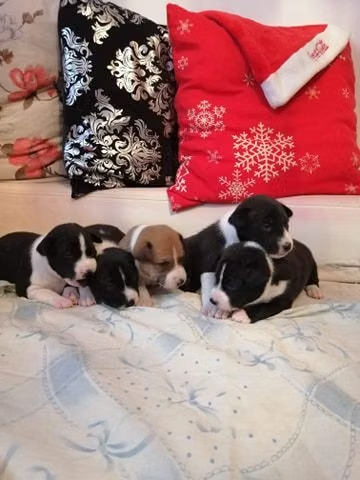

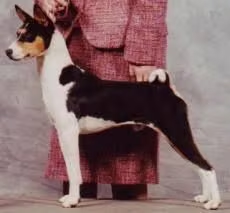


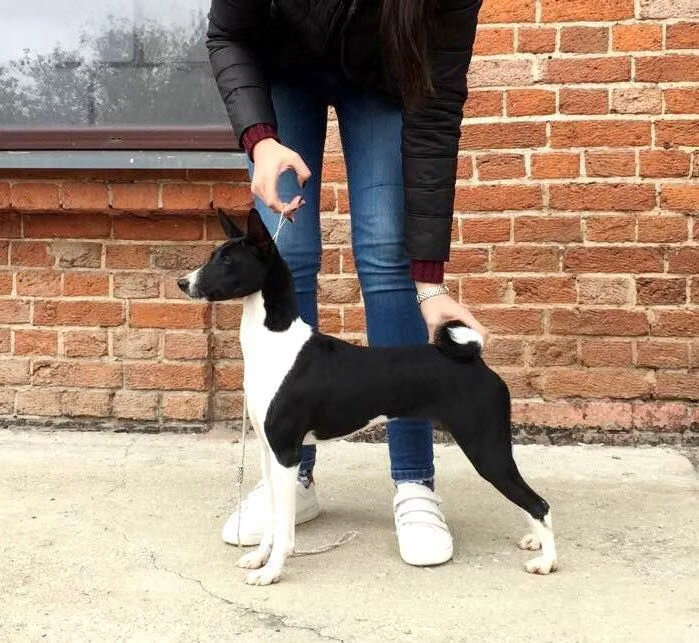
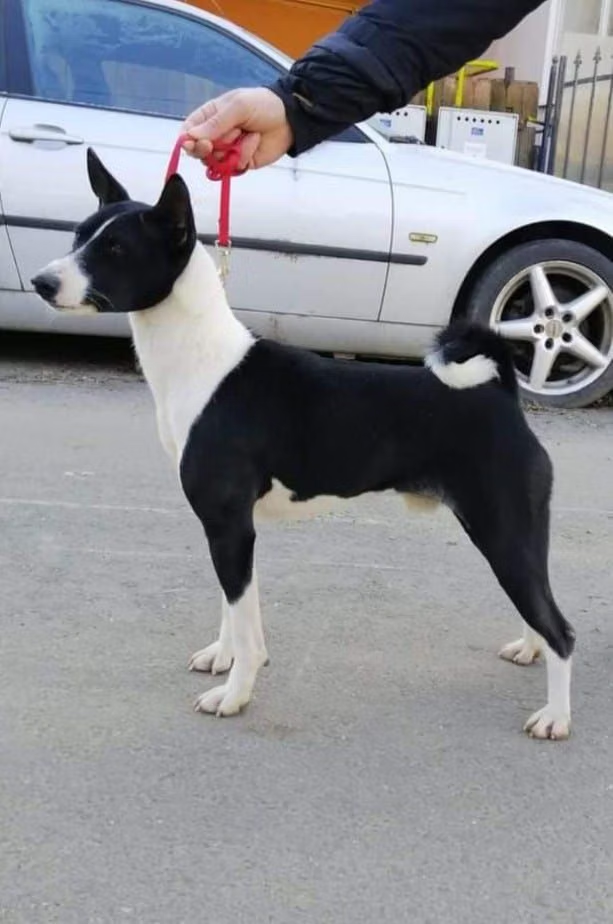



About the Basenji
The Basenji is a small, short-coated hunting dog from Central Africa that yodels instead of barking and keeps itself as clean as a cat.
The Basenji is a small hunting dog that started out in Central Africa, built along sighthound and scenthound lines. A grown dog stands about 41 to 43 cm at the shoulder and weighs around 10 to 11 kg, with a tail that curls tightly over the hip, ears that stand bolt upright, and a forehead that wrinkles when the dog is paying attention. People call it the barkless dog because its voice box produces a yodel or a chortle rather than the woof most dogs manage.
Basenjis aren't silent, just quiet in an unusual way. They groom themselves like cats, keep tidy habits around the house, and tend to size up strangers before warming to them, while staying properly affectionate with their own family. Owners who have lived with one describe a dog that thinks for itself, which changes how training and day-to-day handling need to go.
The hunting instinct hasn't faded. A Basenji will take off after a rabbit, a hedgehog, or anything that moves fast, so a secure section and a lead that actually holds matter here as much as they would on a farm. Anyone after a low-odour, low-shedding dog with plenty of character tends to get on well with the breed, provided the fencing is sorted first.
| Attribute | Detail |
|---|---|
| Origin | Congo, Central Africa |
| Size | Small (about 10 to 11 kg) |
| Lifespan | 13 to 14 years |
| Group/role | Hound; small-game hunter |
| Good with | Older kids and adults; watch closely around small pets |
Who it suits
The Basenji suits owners who can commit to a daily walk, a properly fenced section, and calm, consistent handling. It is a good match for people who like an independent dog and do not need constant obedience from it. Households running cats, rabbits, or chooks should think hard about the breed's prey drive before bringing one home. First-time dog owners can manage a Basenji well enough if they go in ready for a reserved temperament and a dog that needs both a workout and something to think about.
History and origin
The Basenji is an ancient hunting dog from the Congo region of Africa that only reached New Zealand and other Western countries well into the twentieth century.
The Basenji's story starts in Central Africa, where villagers used dogs of this build to flush small game out of thick cover and drive it toward waiting nets. Hunters valued speed, a keen nose, and above all quiet, since a dog that barked would tip off the prey before anyone got close.
European travellers wrote about dogs of this type in the Congo basin during the 1800s. Early efforts to bring them to England came to nothing: several imported dogs died of disease before they could be bred. It was not until the 1930s that a group of Basenjis survived the trip to Britain, and dogs from that line became the foundation for most that followed.
The breed reached North America not long after, and kennel clubs in Britain and the United States recognised it by the middle of the twentieth century. Further imports from Africa came through in later decades to widen the gene pool and cut down on inherited disease.
New Zealand's own biosecurity rules mean any dog brought in, Basenji or otherwise, goes through strict Ministry for Primary Industries import requirements and a stint in quarantine, which has kept local numbers modest and imports carefully managed. Dogs New Zealand, the national body that keeps the pedigree register, recognises the breed and applies the same breed standard used at conformation shows around the country. Despite the distance between African villages and New Zealand backyards, the breed has kept its working character intact. The independent streak, the strong prey drive, and that distinctive yodel all trace straight back to its roots as a self-reliant hunting dog.
Appearance and breed standard
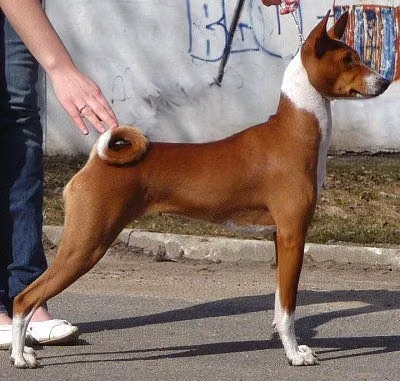
The Basenji is a small, square, finely built dog with a short coat, a wrinkled forehead, upright ears, and a tail that curls tightly over the hip.
The Basenji is lightly built and evenly proportioned, with a level back and legs that look long against the rest of the body. The whole picture is one of poise, balanced on its toes and ready to move. The forehead wrinkles when the dog is alert, and the dark, almond-shaped eyes give it a watchful look. The ears sit high, stand up straight, and tip slightly forward. The tail curls over to one side and lies against the hip.
| Trait | Detail |
|---|---|
| Height | 41 to 43 cm (dogs slightly taller than bitches) |
| Weight | 10 to 11 kg |
| Coat | Short, fine, close-lying |
| Colours | Chestnut red, black, tricolour, brindle, each with white |
| Eyes | Dark, almond-shaped |
Coat and colours
The coat is short, smooth, and fine, which keeps grooming down to a minimum and odour low, a real plus in a country where a lot of dogs live indoors. Recognised colours are chestnut red, solid black, tricolour (black with chestnut markings), and brindle (red with black stripes). Every colour comes with white feet, chest, and tail tip, and plenty of dogs also carry white legs, a blaze, or a collar of white. The fine coat gives next to no protection from the cold, so the breed feels a Southland winter, or even a sharp Wellington southerly, more than a heavily coated dog would.
Temperament and personality
The Basenji is independent, clever, and standoffish with strangers, affectionate with its own household, and quick to chase anything small that moves.
The Basenji is alert and inquisitive, with a mind of its own that owners notice within the first week. It attaches firmly to its household and often picks out a favourite person, but it stays cool with strangers until it decides, on its own terms, that they are worth trusting. Affection comes when the dog chooses to give it, not on demand.
Around children the Basenji generally does best with older kids who already know how to read a dog and respect its limits. With other dogs it can be sociable enough, though two of the same sex sometimes butt heads. The strong prey drive puts cats, rabbits, and other small pets at real risk unless the dog has grown up alongside them and is watched closely.
It does not bark the way most dogs do, but calling it quiet would be misleading. Basenjis yodel, chortle, and grumble their way through the day, and a bored or under-exercised one will find its own, less welcome ways to keep busy. Enough mental work alongside the physical keeps the temperament on an even keel.
| Trait | Rating |
|---|---|
| Affection | 3 |
| Energy | 4 |
| Trainability | 2 |
| Vocalness | 2 |
| Shedding | 2 |
Care and daily needs
The Basenji needs very little grooming but plenty of daily exercise, a genuinely secure section, and extra warmth through a cold snap.
Grooming
- Brush the short coat once a week with a soft brush or a grooming mitt
- Bath only now and then, since the dog grooms itself and stays low-odour between times
- Trim nails every few weeks
- Check and clean the upright ears on a regular basis
- Brush teeth several times a week
Exercise
- Aim for at least 60 minutes of activity every day
- Use a securely fenced section or a long line for any off-lead running
- Keep the dog on lead in open spaces, since recall goes out the window the moment prey is in sight
- Bring in puzzle feeders and scent games to work the mind as well as the body
Environment
The Basenji copes fine in a flat or a house, so long as it gets its daily exercise. Fencing needs to be tall and genuinely secure, because this is a breed that climbs and finds gaps when it is motivated to. The fine coat gives barely any insulation, so a coat or jumper helps through a cold or wet spell, and the dog should not be left out in low temperatures, particularly further south.
Nutrition and feeding
The Basenji does well on a complete, balanced diet portioned for its small size and activity level, with weight kept in check to avoid extra kilos.
Feed a complete dog food that meets recognised nutritional standards for the dog's life stage. Because the Basenji is small and athletic, portions stay modest, and the right amount comes down to weight, age, and activity level. Split the daily total across two meals to keep energy and digestion steady. Fresh water should be down at all times.
| Life stage | Amount per day | Meals |
|---|---|---|
| Puppy (2 to 6 months) | Per pack instructions, by weight | 3 to 4 |
| Puppy (6 to 12 months) | Per pack instructions, by weight | 2 to 3 |
| Adult | About 100 to 150 g dry food | 2 |
| Senior | Adjusted down for lower activity | 2 |
Treats and supplements
Keep treats to roughly 10 percent of daily calories at most, so the dog stays lean. A balanced commercial diet generally covers what a healthy Basenji needs, so most dogs get by without supplements. Check with a vet before adding anything extra, especially for puppies, older dogs, or dogs with existing health conditions.
Health and common conditions
The Basenji is generally a hardy breed with a 13 to 14 year lifespan, though it carries known risks for Fanconi syndrome and certain eye and metabolic disorders.
The Basenji is a solid, robust breed with a typical lifespan of 13 to 14 years. Responsible breeders screen for inherited conditions, and a DNA test is available for Fanconi syndrome, a kidney disorder that turns up in the breed. Knowing a dog's genetic status, and its parents' health history, helps an owner plan ahead for preventive care.
| Condition | Signs | Note |
|---|---|---|
| Fanconi syndrome | Drinking and urinating more than usual, losing weight | Kidney disorder; DNA test available |
| Progressive retinal atrophy | Night blindness, vision fading | Inherited eye disease; screen breeding dogs |
| Hypothyroidism | Weight gain, low energy, coat changes | Managed with daily medication |
| Hip dysplasia | Stiffness, reluctance to exercise | Less common than in larger breeds |
| Persistent pupillary membranes | Often no symptoms; picked up on an eye exam | Strands of eye tissue; usually mild |
Preventive care
- Keep vaccinations and parasite control up to date
- Book annual vet checks, more often once the dog is a senior
- Use the Fanconi DNA test and ask for eye screening on breeding dogs
- Keep the dog lean and stay on top of dental hygiene
- Watch water intake, since drinking more than usual can point to kidney trouble
Training and behaviour
The Basenji is clever but independent, so training calls for patience, short sessions, and reward-based methods rather than repetition or a firm hand.
The Basenji picks things up fast when it can see the point of cooperating, but its independent streak means it will not obey just to keep someone happy. Sessions work best kept short, varied, and worth the dog's while. Harsh corrections tend to backfire and make the dog more distant rather than more obedient. Recall is a particular sticking point, since prey drive will override a well-learned command in a heartbeat, so off-lead freedom should stay limited to properly secure areas.
Basics
- Start socialising early with people, places, and other animals
- Teach name recognition and focus using food rewards
- Build up sit, down, and stay in short sessions each day
- Get a solid recall going on a long line before any off-lead work
- Reinforce loose-lead walking to manage pulling towards distractions
- Bring in puzzle toys and scent games to give that curiosity somewhere to go
Breeding and raising puppies
Basenji females are known for coming into season just once a year, and litters average around four to six puppies that need early socialisation.
Basenjis reach physical maturity at around one to two years old. The breed stands out among dogs because females typically come into season once a year rather than twice, a pattern they share with some wild canids. That single annual cycle shapes how a breeder has to plan litters.
Gestation runs about 63 days, standard for dogs. Litters average roughly four to six puppies. Newborns rely entirely on the dam for warmth and feeding through the first weeks, and a careful breeder keeps a close eye on weight gain.
Responsible breeding means health screening both parents, with the Fanconi DNA test and eye checks as the priorities. Puppies do better for early handling and exposure to everyday sights and sounds, since the breed's reserved streak makes early socialisation especially worthwhile. Anyone bringing a Basenji into New Zealand from overseas needs to factor in MPI import requirements and quarantine time well ahead of the move. Puppies usually head to new homes at around eight to ten weeks.
| Metric | Value |
|---|---|
| Sexual maturity | About 1 to 2 years |
| Heat cycle | Once a year (unusual for dogs) |
| Gestation | About 63 days |
| Average litter size | 4 to 6 puppies |
| Weaning age | About 6 to 8 weeks |
| Homing age | About 8 to 10 weeks |
Registering a Basenji in New Zealand, microchip and all
Alongside council registration, a free United Pet Club record keeps a live phone number behind your Basenji and its chip.
Basenji registration and microchip registration in New Zealand
Keeping a Basenji findable is mostly paperwork: a profile carrying your phone number, a photo, and the dog's details, sitting where a scan can reach it. Registering your dog with United Pet Club sets that up free, and the record never lapses or bills you.
Getting the chip implanted was the vet's job; giving the number somewhere to point is yours. Registering the microchip with United Pet Club costs nothing on the lifetime plan, suits any brand a Kiwi vet reaches for, and keeps the record searchable at any hour from anywhere. Creating a free account ties the profile and the chip together.
How do I register my Basenji in New Zealand?
Setting up a free United Pet Club account, adding your Basenji's details and a photo, and saving is all it takes. The record stays free for the dog's whole life, chip or no chip.
How do I register my Basenji's microchip?
Just add the fifteen digit number to your free account along with your current address and phone. Under the lifetime plan there is nothing to pay for the registration or any later update.
Does my Basenji need a microchip in New Zealand?
Dogs registered for the first time since 2006 need one under the National Dog Database rules, working farm dogs aside. The council record and your United Pet Club profile do different jobs, and the second one is free.
What does registering a Basenji cost?
Nothing. The free lifetime plan carries the profile, the chip record, and every update, and no renewal notice ever arrives.
Frequently asked questions
Common questions about the Basenji cover its size, temperament, care demands, lifespan, suitability, and the famous barkless trait.
How big does a Basenji get?
The Basenji is a small breed. Adults stand around 41 to 43 cm at the shoulder and weigh roughly 10 to 11 kg.
Do Basenjis really not bark?
They do not have a typical bark, which is where the barkless dog name comes from. They are not silent, though. The breed yodels, chortles, and makes a good range of other noises.
What is the Basenji's temperament like?
Basenjis are independent, clever, curious, and alert. They are affectionate with family and standoffish with strangers, and they keep a strong instinct to chase anything small that moves.
Are Basenjis hard to look after?
Grooming is easy thanks to the short, low-odour coat, but the breed needs daily exercise, secure fencing, and patient training. The independent streak makes obedience training more of a project than it is with a lot of other breeds.
How long do Basenjis live?
A healthy Basenji typically lives about 13 to 14 years.
Is the Basenji a good family dog?
It can suit an active household, especially one with older children. Owners need to provide exercise and consistent handling, and should keep an eye on the dog around very small pets.
Are Basenjis good for first-time owners?
They can be, as long as the owner is ready for an independent dog that needs early socialisation, daily activity, and reward-based training rather than constant obedience.
From the community
Ask about the BasenjiNo questions about the Basenji yet. Be the first to ask.
Browse Dog breeds