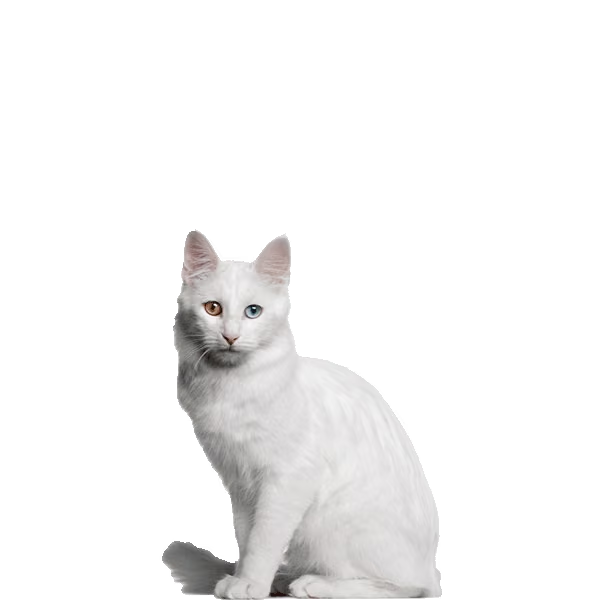
The Turkish Vankedisi is the pure-white Van variety, prized for its active, affectionate temperament and loyal bond with its people.
How the Turkish Vankedisi coat is built, and what that means when you groom it.
Caution: A Turkish Vankedisi coat mats easily.
Fine or long hair tangles at the base of the coat, out of sight, where the mats tighten and pull on the skin. Brushing has to reach right down to the roots in sections, not just skim the surface.
Information: A Turkish Vankedisi drops its undercoat in heavy bursts.
The undercoat comes out in heavy bursts over a few weeks. An undercoat rake, or a bath followed by a proper blow-dry, clears it far faster than daily brushing. Clipping the coat down is not a shortcut for this.
The Turkish Vankedisi is an all-white cat breed preserved as a Turkish national treasure, entirely distinct from the Turkish Van. In New Zealand, this breed is effectively unknown, with no recorded NZCF registrations. Importing one requires navigating MPI's strict biosecurity requirements.
If you have heard of the Turkish Van, you might assume the Turkish Vankedisi is simply a white version of it. It is not. The Vankedisi is a separate breed, developed and maintained by Turkish universities in Van and Ankara, and designated as a distinct animal of Turkish national heritage. The key difference is the coat: the Vankedisi is all-white from ears to tail, every single time, by breed definition. There are no coloured markings anywhere.
This matters in New Zealand because the Turkish Van has some presence here, with a small number of registered breeders and cats through the NZCF (New Zealand Cat Fancy). The Turkish Vankedisi has essentially none. If you are looking for a Vankedisi in New Zealand, you are looking at an import from Turkey or Europe, full stop.
The all-white coat is also not albinism, which is a common and important misconception. Albino cats have no melanin at all and show pink or washed-out eyes with light sensitivity. The Vankedisi's white coat comes from dominant white or white-spotting genes that suppress coat pigmentation while leaving eye pigmentation intact. This produces the breed's signature odd-eyed look, one blue eye and one amber or green, in many individuals. When bringing a Vankedisi through New Zealand MPI (Ministry for Primary Industries) biosecurity, being able to articulate this distinction accurately helps ensure the health declaration process goes smoothly.
| Characteristic | Detail |
|---|---|
| Origin | Turkey (Van and Ankara regions) |
| Coat | All-white, semi-long, no coloured markings ever |
| Eye colour | Odd-eyed (heterochromia) most common; solid blue or amber also occur |
| Size | Medium to large, 4–9 kg |
| Lifespan | 12–17 years |
The Vankedisi is a medium to large cat with a muscular, semi-foreign body type. It is not a fragile or decorative breed. It is active, alert, and strong-willed, and it tends to bond deeply with its household while remaining wary of strangers. In New Zealand conditions it adapts well to indoor life, which is the recommended management approach regardless of climate.
The Turkish Vankedisi originated in the Lake Van region of eastern Turkey alongside the better-known Turkish Van. While the Van was exported to Britain in the 1950s and gained international recognition, the all-white cats stayed in Turkey and were later formally developed by Turkish universities as a distinct national breed.
The Lake Van region of eastern Turkey has produced distinctive semi-long-haired cats for centuries. When British travellers brought these cats to the United Kingdom in the 1950s, they selected for the bicolour pattern, coloured patches on the head and tail against a white body, which became the defining characteristic of the Turkish Van. The all-white cats in the same population were left behind.
Turkish institutions, particularly Van University and Ankara University, recognised the all-white cats as a distinct population worth preserving and began formal documentation and breeding programmes. The Turkish government has at various points treated these cats as protected cultural heritage, reflecting the deep national attachment to them. The name Vankedisi translates roughly to 'Van cat' in Turkish, reinforcing the geographic and cultural identity of the breed.
The result of this preservation effort is a breed that exists in meaningful numbers only within Turkey, with very small populations in parts of Europe. New Zealand and Australia have seen almost no documented examples. This stands in contrast to the Turkish Van, which has established a modest but real presence in many Western countries, including New Zealand through the NZCF registry.
For any New Zealand cat fancier pursuing a Vankedisi, the journey begins with understanding that you are not buying from a local breeder. You are sourcing from a tiny international gene pool, navigating export requirements from Turkey or a European country, and bringing an animal through MPI biosecurity at considerable time and expense.
The Turkish Vankedisi is characterised by a pure all-white coat from head to tail. This whiteness comes from dominant white genetics, not albinism, and the breed typically shows heterochromia with mismatched eye colours.
The Turkish Vankedisi's appearance is anchored entirely in its white coat. Every registered Vankedisi is white. There are no acceptable colour variants, no tabby points, no colour-and-white patterns. The coat is semi-long with a silky texture and a lighter undercoat than many northern semi-longhairs, which means it manages heat reasonably well and does not mat as aggressively as heavier double-coated breeds.
The white is produced by dominant white or white-spotting genes, not by albinism. This is a distinction that matters both scientifically and practically. Albino cats have no melanin in any tissue and display characteristic pale pink eyes or very washed-out pale blue eyes with a strong sensitivity to light. A Vankedisi with classic odd eyes, one vivid blue and one deep amber, is showing you exactly why it is not an albino: its iris pigmentation is working normally. The coat pigmentation is suppressed; the eye pigmentation is not.
| Feature | Description |
|---|---|
| Body | Medium to large, muscular, semi-foreign build |
| Coat length | Semi-long, silky, lighter undercoat than many northern breeds |
| Coat colour | Pure white, no markings of any kind |
| Eyes | Odd-eyed most common (one blue, one amber/green); solid blue or amber both accepted |
| Head | Moderately wedge-shaped, broad forehead, medium-length nose |
The ears are medium-sized and wide-set, often with light feathering at the tips. The tail is full and well-plumed. The overall build is athletic without being extreme in any direction, giving the cat a capable, substantial look rather than the angular refinement of oriental breeds or the bulk of the largest northern longhairs.
In New Zealand's variable climate, the semi-long coat with its lighter undercoat is well suited to indoor life. Outdoor exposure is not recommended for Vankedisi cats, both because of the sun protection concerns for white-coated cats and because of the road and predator risks that apply to any pedigree cat in a New Zealand environment.
The Turkish Vankedisi is an engaged, curious cat that bonds closely with its household. It is active and intelligent, needs consistent stimulation, and tends to be reserved with people it does not know well.
The Vankedisi is not a passive cat. It wants to know what is happening in the household, and it has the energy and curiosity to stay involved. Owners report that this breed will follow them from room to room, investigate new objects within minutes of their arrival, and make its preferences known through persistent vocalisation if ignored.
This is a breed that needs genuine engagement. Interactive toys, puzzle feeders, and daily play sessions are not optional extras for a Vankedisi; they are part of what the cat requires to stay mentally healthy. A Vankedisi left alone in a quiet house with nothing to do will find its own entertainment, which may not align with your preferences for the furniture.
With strangers, the Vankedisi tends toward caution. It will typically observe from a distance before choosing to interact, and some individuals take several visits before they approach a new person voluntarily. This is not shyness in a pathological sense; it is the breed's measured approach to trust, and it resolves reliably with patient, consistent exposure.
| Trait | Rating / Notes |
|---|---|
| Affection with family | High: bonds closely, follows household members actively |
| Tolerance of strangers | Moderate: cautious initially, builds trust with time |
| Playfulness | High: maintains play drive well into adulthood |
| Tolerance of other cats | Moderate to high: gradual introductions work best |
| Suitability for children | Good: tolerates calm, respectful interaction well |
The Turkish Vankedisi has moderate grooming needs and a high activity requirement. New Zealand owners should plan for consistent enrichment, be aware of deafness-related management needs, and consider the environmental demands of an all-white coat.
Grooming the Turkish Vankedisi
The Vankedisi's semi-long coat is silky and relatively low-tangle compared to double-coated longhairs, but it still needs regular attention to stay in good condition.
Exercise and enrichment
The Vankedisi is an active breed that expects its environment to offer genuine stimulation. A quiet room and a window is not sufficient.
Environmental considerations for New Zealand
New Zealand's UV levels are high, particularly in the South Island and during summer months. White cats with unpigmented skin on the ear tips and nose are at elevated risk of squamous cell carcinoma from sun exposure. Keep your Vankedisi as an indoor cat, use UV-filtering window film or curtains to limit direct sun exposure through glass, and have your vet check the ear tips and nose annually for early signs of solar damage. The country's temperate and varied climate is otherwise well-suited to an indoor Vankedisi lifestyle, with no extreme cold or heat demands in most regions.
The Vankedisi is a muscular, active cat that benefits from a high-protein diet matched to its life stage. Weight management is relevant for indoor-only cats with limited opportunity for self-directed exercise.
The Turkish Vankedisi's active build and energy level make a high-quality, protein-forward diet appropriate at all life stages. New Zealand has a good range of premium cat foods available through pet stores and veterinary clinics, and finding a suitable option is not difficult. Look for foods with a named protein source (chicken, fish, lamb) as the first ingredient, and avoid products that list cereals or by-products at the top of the ingredients list.
Wet food is a useful addition to the diet, particularly for indoor cats, because it contributes to daily water intake. Cats that eat primarily dry food in warm weather can fall short of their hydration needs. A mix of wet and dry is the approach most New Zealand vets recommend for indoor pedigree cats.
| Life stage | Recommended food type | Feeding frequency |
|---|---|---|
| Kitten (under 12 months) | High-protein kitten formula, wet and dry | Three to four times daily |
| Adult (1–7 years) | High-protein adult formula, balanced wet and dry | Two times daily |
| Senior (7+ years) | Senior formula with joint and kidney support | Two times daily, portion-controlled |
Treats should be limited to ten percent of daily caloric intake to avoid weight gain in an indoor cat with naturally bounded activity. If you are using treats as training rewards, use small pieces and account for them within the daily food budget. Avoid human foods, particularly onion, garlic, grapes, and dairy, all of which are harmful to cats.
The Turkish Vankedisi is a generally healthy breed, but the dominant white gene linked to its all-white coat also carries a real risk of congenital deafness, especially in blue-eyed individuals. Deafness testing before purchase is essential.
The Turkish Vankedisi is not an albino breed and does not share the health profile of albino cats. However, the same genetic mechanism responsible for the all-white coat, primarily the dominant white (W) gene, is associated with an elevated risk of congenital deafness. The link between white coats, blue eyes, and deafness in cats is one of the most thoroughly documented examples of gene pleiotropy in domestic animals.
Blue-eyed white cats carry the highest deafness risk. Odd-eyed cats (one blue, one non-blue) have intermediate risk, with the deaf ear typically on the side of the blue eye. White cats with two non-blue eyes have the lowest deafness risk within the breed. BAER testing (Brainstem Auditory Evoked Response) is the definitive diagnostic tool and can be performed on kittens as young as five to six weeks. Any reputable Vankedisi breeder should test all kittens before sale and provide certificates.
| Condition | Risk level | Notes |
|---|---|---|
| Congenital deafness | Elevated, especially in blue-eyed cats | BAER testing is essential; indoor management recommended for deaf cats |
| Squamous cell carcinoma (ear tips, nose) | Elevated under high UV exposure | NZ UV levels are high; annual skin checks; limit direct sun exposure |
| Hypertrophic cardiomyopathy | Low to moderate baseline feline risk | Echocardiogram screening recommended from age 2 |
| Dental disease | Moderate baseline feline risk | Regular dental hygiene reduces incidence |
A deaf Vankedisi is not an unhealthy cat in any other sense. Deaf cats adapt to visual and vibration cues quickly and live full, active lives when managed appropriately. Indoor living is strongly recommended, as deaf cats cannot hear approaching dangers. Owners who discover their Vankedisi is deaf should inform their vet so that examinations account for the cat's inability to hear instructions.
New Zealand veterinary clinics in major centres will have access to BAER testing equipment or referral pathways to veterinary specialists who do. If a breeder overseas claims BAER testing was performed, ask for the certificate to be included in the import documentation.
The Turkish Vankedisi is an intelligent, trainable cat that responds well to positive reinforcement. Training sessions serve double duty as mental enrichment, which this active breed genuinely needs.
The Vankedisi is one of the more trainable semi-long-haired breeds. It has the attention span, the curiosity, and the social orientation to engage with reward-based training over repeated sessions. Clicker training is effective, and many Vankedisi learn to respond reliably to their name, sit on cue, and retrieve small toys. The breed remembers routines and can become frustrated when they are not maintained consistently.
For New Zealand owners who plan to show their Vankedisi through NZCF, early habituation to handling, noise, and strangers is essential. A show-quality Vankedisi that freezes or hisses under judge handling will not compete successfully regardless of its structural quality. This means beginning socialisation before twelve weeks, including exposure to car travel, unfamiliar people, and busy environments.
Deaf Vankedisi cats train particularly well with visual cues. Hand signals replace verbal commands, and the cat's natural focus on its owner's face and hands can make the training process quicker than it might seem. The key shift is ensuring the cat is looking at you before you give the signal, which requires a light tap on a nearby surface to attract its attention first.
Keep training sessions short. Five to ten minutes, twice a day, is more effective than a single extended session. The Vankedisi engages fully when sessions are brief and rewarding, and disengages quickly when it senses that sessions are going on too long or that the reward rate has dropped.
Establishing a Vankedisi breeding programme in New Zealand would require importing cats from Turkey or Europe, NZCF registration for an unlisted breed, and careful management of white coat genetics to minimise deafness in offspring.
The Turkish Vankedisi is not a breed any New Zealand cat fancier can simply start breeding from existing local stock. There is none. Any breeding programme in New Zealand would need to begin with imported cats, navigating MPI import biosecurity requirements, which include import permits, approved-country health conditions, and mandatory quarantine on arrival.
Once founding cats are here, the genetics require careful management. The dominant white gene that produces the all-white coat also drives deafness risk. Pairing two blue-eyed white cats raises the probability of deaf kittens substantially. Breeders should work toward pairing cats with different eye colours to reduce deafness incidence in the breeding programme, and all kittens must be BAER tested before sale.
Regarding NZCF registration, the Turkish Vankedisi is not a recognised breed on the NZCF books. Any breeder wishing to register cats or litters would need to contact NZCF about the process for gaining recognition for a new breed, which involves submitting a breed standard and documentation of the breed's established history and characteristics. The process is not quick, but NZCF has pathways for rare and emerging breeds.
Prospective Vankedisi breeders in New Zealand should connect with European Vankedisi breeders, particularly those in Germany, Italy, or the Netherlands where small but established populations exist, before committing to a breeding programme.
| Factor | Detail |
|---|---|
| Deafness risk management | BAER test all kittens; avoid blue-eyed x blue-eyed pairings where possible |
| Coat genetics | Dominant white or white-spotting gene; not albino; all offspring will be white |
| Litter size | Typically 3–5 kittens |
| Breeding age | Females from 18 months; males from 12–18 months |
| New Zealand gene pool | Effectively zero; import from Turkey or Europe required to establish |
Cats sit outside the National Dog Database, so a free United Pet Club record is what stands behind your Turkish Vankedisi's chip.
Giving your Turkish Vankedisi a record takes less time than choosing her food: name, colouring, photo, phone number, save. The profile holds for life, free, with a chip number slot waiting whenever the vet's done. Registering your cat starts it.
Pop the fifteen digit number from the vet paperwork into your free United Pet Club account, check your phone number is current, and your Turkish Vankedisi's chip finally points somewhere. Every brand is accepted, every update free, and the record answers scans at any hour. Microchip registration is the link in the middle.
It's a matter of creating a free United Pet Club account, adding her name, colouring, and a photo, and saving. The record is free for her whole life, indoors or out.
Adding the fifteen digit number to your free account with your current details is the whole job. The lifetime plan never charges for the record or its updates, whatever the chip brand.
There's no national requirement the way the dog database works, though some councils encourage it and shelters chip on rehoming. Requirement or not, a registered chip is what turns a found Turkish Vankedisi into a phone call.
Nothing at all. Profile, chip registration, and every later update are free under the lifetime plan.
Practical answers for New Zealand cat enthusiasts asking about MPI import requirements, NZCF registration, cost in NZD, the difference from Turkish Van, and white coat care in the New Zealand climate.
Not currently. There are no known Vankedisi breeders or registered cats in New Zealand through the NZCF. Anyone wanting a Vankedisi in New Zealand would need to import one from Turkey or from a European country where a small breeding population exists. This is a significant undertaking in terms of time, paperwork, and cost.
The Ministry for Primary Industries (MPI) requires an import permit, compliance with health and vaccination requirements from the country of export, a microchip, proof of approved treatments for parasites, and a quarantine period at an MPI-approved facility on arrival. New Zealand's biosecurity requirements are among the strictest in the world. The specific requirements depend on which country the cat is coming from. Detailed conditions are available on the MPI Biosecurity Import Health Standards pages, and using an experienced pet import agent is strongly recommended.
The Turkish Van has coloured patches on the head and tail against an otherwise white body. The Turkish Vankedisi is pure white with no coloured markings at all. They come from the same Lake Van region of Turkey but are formally separate breeds. The Turkish Van has been exported internationally since the 1950s and has a real presence in New Zealand through NZCF. The Vankedisi was kept in Turkey and developed separately; its international presence is minimal. If you want an all-white Turkish breed, the Vankedisi is the correct breed, but you will need to import one.
The NZCF does not currently list the Turkish Vankedisi as a recognised breed. If you import a Vankedisi and wish to register it or breed from it under NZCF, you would need to contact NZCF directly to discuss provisional registration or the process for seeking breed recognition. NZCF does have pathways for rare and unlisted breeds, but the process takes time and requires documentation of breed standards and history.
The purchase price of a Vankedisi kitten from a reputable Turkish or European breeder might be NZD 2,500 to 6,000 or more depending on the breeder and pedigree. On top of that, import costs including the permit, international transport, MPI-approved quarantine, and veterinary clearances could add NZD 4,000 to 10,000. Total costs of NZD 8,000 to 15,000 or more are realistic for a single imported cat. This is not a breed to pursue without a realistic budget and a long planning horizon.
White cats with dominant white genetics have an elevated deafness risk compared to other cats, particularly when they have blue eyes. The link between the white coat gene, blue eyes, and cochlear degeneration is well documented. Odd-eyed cats (one blue, one non-blue) have intermediate risk. BAER testing (Brainstem Auditory Evoked Response) is the definitive test and should be performed on every Vankedisi kitten before purchase. Always ask for the BAER certificate. A deaf Vankedisi can be a wonderful companion with appropriate indoor management.
New Zealand's UV levels are high, particularly during summer and in the South Island, due to the thin ozone layer. White cats with unpigmented skin on ear tips and nose leather have an elevated risk of squamous cell carcinoma from sun exposure. Keep your Vankedisi as an indoor cat, use UV-filtering window coverings, and ask your vet to check the ear tips and nose annually. Beyond sun protection, New Zealand's mild and temperate climate is not problematic for the breed.
