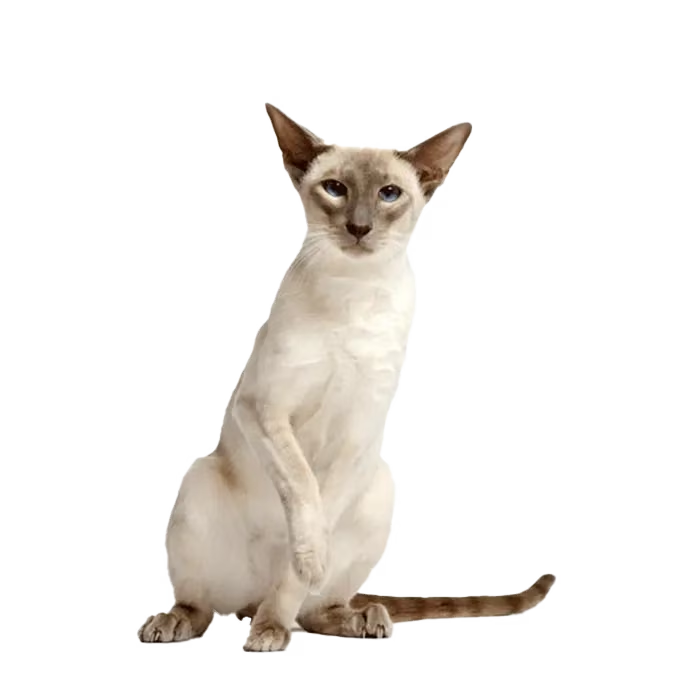
The modern Siamese is a striking, talkative breed known for its vocal, affectionate nature and deep devotion to its people.
How the Siamese (modern) coat is built, and what that means when you groom it.
The modern Siamese is a medium-sized, talkative cat from Thailand, known for its colour-pointed coat, vocal personality, and strong attachment to people.
The modern Siamese is a medium-sized shorthaired cat, recognisable by its colour-pointed coat, deep blue almond-shaped eyes, and lean, elongated build. Its origins lie in Thailand, where pointed cats were maintained for centuries before the type became known in Europe. Among domestic cats, the Siamese is one of the most vocal and relies on a broad range of loud, low-pitched calls to communicate with the people it lives with.
Character is as central to the breed as its looks. Siamese cats are attentive, clever, and strongly attached to their people. A typical Siamese will single out one or two household members to follow from room to room, and most owners describe the breed as companionable rather than self-sufficient, with a keen interest in daily domestic life.
The term "modern" sets the current show type apart from older, rounder-headed lines. Both carry the same pointed colouring and lively, talkative nature. The breed is also notably long-lived, with a reported lifespan of 12 to 20 years.
| Attribute | Detail |
|---|---|
| Origin | Thailand |
| Size | Medium |
| Lifespan | 12 to 20 years |
| Group / role | Shorthair companion cat |
| Good with | Families, attentive owners, other social cats |
The Siamese is well suited to people who want an engaged, conversational companion and who spend enough time at home to meet its social needs. It settles well in households where someone is around during the day or where a second cat keeps it company. It is not a good fit for anyone who needs a quiet or low-maintenance pet, as the breed vocalises often and takes a dim view of being left alone for extended periods.
The New Zealand Cat Fancy (NZCF) recognises the modern Siamese, and affiliated breeders can be found through the NZCF registry.
The Siamese comes from Thailand, formerly Siam, where pointed cats were documented for centuries before arriving in Britain in the 1880s and developing into today's modern show type.
The modern breed descends from pointed cats long established in Thailand, then known as Siam. Thai manuscripts describe pale-bodied cats with dark extremities well before any such animals were seen in Europe, placing Thailand firmly as the breed's origin.
Siamese cats arrived in Britain during the 1880s, brought across from Bangkok. Their distinctive pointed colouring and vivid blue eyes attracted considerable attention at early cat shows, since nothing comparable existed among European breeds at the time. Formal pedigree recording and selective breeding began in the closing decades of the nineteenth century.
Over the course of the twentieth century, breeders gradually refined the show type toward a longer, more angular head, larger ears, and a finer body frame. This progressive selection created the modern Siamese now seen in the show ring. The earlier, rounder-headed form continues as a recognised traditional type, but both trace back to the same Thai origin.
The modern Siamese also provided the genetic foundation for a number of other breeds, passing on both the pointed pattern and its characteristic fine body.
The modern Siamese is a slender, medium-sized cat with a wedge-shaped head, large ears, deep blue almond eyes, and a short pointed coat in colours such as seal, blue, chocolate, and lilac.
The body of the modern Siamese is long and fine-boned, with a level back and a tubular silhouette. The head is a long wedge, the ears are large and angled to follow the line of the wedge, and the eyes are almond-shaped with a clear, deep blue colour. Legs are slender, paws small and oval, and the tail is long and tapers to a point. The overall impression is of a cat that is lean and lithe.
| Trait | Standard |
|---|---|
| Height | Around 23 to 25 cm at the shoulder |
| Weight | 2.5 to 5.5 kg |
| Coat | Short, fine, close-lying, glossy |
| Colours | Seal, blue, chocolate, lilac and further point colours |
| Eyes | Almond-shaped, deep blue |
The coat is short, lies close to the body, and has little undercoat. The breed's signature feature is its colour-pointed pattern: a pale body with richer colour restricted to the face mask, ears, legs, feet, and tail. The pattern follows temperature, with cooler parts of the body carrying deeper pigmentation and the warmer torso remaining pale. Seal (dark brown), blue (grey), chocolate (warm brown), and lilac (pale grey) are the four classic point colours. Many additional colours and tabby-based patterns are also recognised, including by the NZCF. Points deepen with age and tend to darken in cooler environments.
The Siamese is affectionate, highly intelligent, and people-oriented, with an active, demanding personality and a famously loud, frequent voice.
Among domestic cat breeds, the Siamese stands out for its level of engagement with people. It bonds closely with its household, typically gravitating toward one person in particular and keeping close company through the day. Most will seek laps, creep under duvets, and insert themselves into whatever activity is under way. This sociability is the defining feature of the breed's character.
A well-socialised Siamese is generally confident and curious around new faces rather than wary, though individual temperament varies. The breed coexists comfortably with other cats and dog companions, and a second active cat is a practical choice for households with working owners. Around small animals, supervision is wise, as the Siamese retains a strong predatory chase instinct well into adult life.
Intelligence expresses itself through constant inquisitiveness: testing cupboard latches, retrieving toys, and tracking household routines. Vocally, the Siamese is forthright. It comments on food timing, closed doors, and arrivals home, and the volume increases noticeably when it is bored or under-stimulated.
| Trait | Rating |
|---|---|
| Affection | 5 |
| Energy | 4 |
| Trainability | 4 |
| Vocalness | 5 |
| Shedding | 2 |
The short-coated Siamese needs little grooming but high levels of attention, play, and company to stay content indoors.
Routine care for the Siamese is straightforward on the grooming side and more demanding on the social side. Its coat requires minimal effort, but the breed's active, people-centred nature calls for considerably more engagement than most domestic cats need.
An indoor life or a securely enclosed outdoor area suits the Siamese well. The fine coat provides little insulation, so warmth is a practical concern, particularly in New Zealand's cooler South Island winters. Long periods of solitude do not suit the breed; without company or stimulation it may become vocal or take to destructive behaviour. Consistent routines and daily interaction help keep it settled.
The Siamese does best on a complete, protein-rich cat food fed in measured meals, with care taken to avoid foods that are toxic to cats.
The Siamese is an obligate carnivore and needs a complete, balanced cat food with animal protein as the primary ingredient. Its lean and active frame means it uses energy efficiently, but meal sizes should still be controlled to guard against gradual weight gain. Fresh water must be on offer at all times, and a combination of wet and dry food helps maintain good hydration.
| Life stage | Amount per day | Meals |
|---|---|---|
| Kitten (2 to 12 months) | Per pack guide, fed to appetite | 3 to 4 |
| Adult (1 to 7 years) | Around 200 to 300 kcal | 2 |
| Senior (7 years and older) | Adjusted to activity and weight | 2 |
Treats should account for no more than about 10 per cent of daily calorie intake so the core diet remains complete. A quality commercial cat food generally covers all nutritional requirements, meaning supplements are only appropriate when a veterinarian advises them, for instance to support joints or dental health in an older cat. Introduce any new food gradually across several days to avoid digestive upset.
The Siamese is generally long-lived at 12 to 20 years but is associated with several inherited conditions, so regular veterinary care and dental attention matter.
As a breed, the Siamese is generally robust and long-lived, with a reported lifespan of 12 to 20 years. Being a pedigree line, it has a higher likelihood of certain inherited and breed-associated conditions. Regular health checks and awareness of these conditions help identify problems before they progress. Reputable breeders carry out health screening on their breeding cats and should be able to provide information on parental health.
| Condition | Signs | Note |
|---|---|---|
| Progressive retinal atrophy | Night blindness, bumping into objects | Inherited; leads to gradual vision loss |
| Dental disease | Bad breath, drooling, reduced eating | Common; helped by regular dental care |
| Respiratory sensitivity | Coughing, wheezing in some lines | More noted in young cats |
| Amyloidosis | Drinking and weight changes | Affects organs in some bloodlines |
| Heart disease | Lethargy, breathing difficulty | Includes inherited heart muscle disease |
The Siamese is highly trainable and learns tricks, recall, and harness walking quickly when taught with reward-based methods.
The Siamese is among the easiest cat breeds to train. Its combination of intelligence and social drive makes it willing to engage with structured learning, and individuals often take readily to tricks, leash walking, or retrieving objects. The same mental agility that makes training straightforward also means an under-stimulated Siamese may occupy itself by working out how to open cabinets, so directed activity is worthwhile. Sessions work best when kept short and run frequently.
Siamese queens reach maturity early and call loudly when in season; litters average four to six kittens, born pale and developing their points over the first weeks.
Sexual maturity comes early in the Siamese, often between five and ten months of age. Queens in season are particularly vocal, calling persistently until mated or the cycle ends. Conscientious breeders delay mating until a queen is fully physically mature, generally in her first or second year, and carry out health screening on both parents before breeding.
Gestation lasts approximately 63 to 67 days. Litter sizes tend to be above the domestic cat average, with four to six kittens being typical. Kittens arrive white or cream and their point colour develops over the following weeks as cooler body regions accumulate pigment; full coloration is not apparent at birth.
Mothers generally care attentively for their litters. Kittens should remain with the queen and their siblings until at least 12 weeks to complete weaning, socialisation, and the initial course of vaccinations. This period is particularly important for the Siamese, as early handling and human contact shape the breed's characteristic confidence and sociability. NZCF-registered breeders in New Zealand are expected to adhere to the registry's standards for kitten health and welfare.
| Metric | Value |
|---|---|
| Sexual maturity | About 5 to 10 months |
| Gestation | 63 to 67 days |
| Average litter size | 4 to 6 kittens |
| Point colour development | Over the first weeks after birth |
| Recommended rehoming age | 12 weeks or older |
Cats sit outside the National Dog Database, so a free United Pet Club record is what stands behind your Siamese (modern)'s chip.
With no national database covering cats, the record behind your Siamese (modern)'s chip is entirely yours to provide. A free United Pet Club profile does it: your number, her photo, her details, one scan away. Registering your cat is free for life and done in minutes.
Pop the fifteen digit number from the vet paperwork into your free United Pet Club account, check your phone number is current, and your Siamese (modern)'s chip finally points somewhere. Every brand is accepted, every update free, and the record answers scans at any hour. Microchip registration is the link in the middle.
It's a matter of creating a free United Pet Club account, adding her name, colouring, and a photo, and saving. The record is free for her whole life, indoors or out.
Adding the fifteen digit number to your free account with your current details is the whole job. The lifetime plan never charges for the record or its updates, whatever the chip brand.
There's no national requirement the way the dog database works, though some councils encourage it and shelters chip on rehoming. Requirement or not, a registered chip is what turns a found Siamese (modern) into a phone call.
Nothing at all. Profile, chip registration, and every later update are free under the lifetime plan.
Common questions about the modern Siamese cover its size, talkative nature, care needs, lifespan, suitability, and how to find one in New Zealand.
It is a medium-sized cat, typically 2.5 to 5.5 kg, with a long, slender, fine-boned body that can look smaller than its actual weight.
Yes. The Siamese is one of the most talkative breeds and uses a loud, low voice to communicate often throughout the day. People who want a quiet cat should consider another breed.
The short coat needs only weekly brushing, so grooming is easy. The challenge is its need for attention, play, and company, since it dislikes being left alone for long periods.
They are long-lived for a pedigree cat, with a typical range of 12 to 20 years given good care, diet, and regular veterinary checks.
Yes, well-socialised Siamese cats are affectionate with families and usually live well with other cats and cat-friendly dogs. They suit homes where someone is around during the day.
Not always, but a compatible second cat helps in households that are out for much of the day, since the breed is highly social and prone to loneliness.
Contact the New Zealand Cat Fancy (NZCF) for a list of registered breeders who health-test their cats and rehome kittens at 12 weeks or older. Breed rescues occasionally have adult Siamese cats available for adoption.
