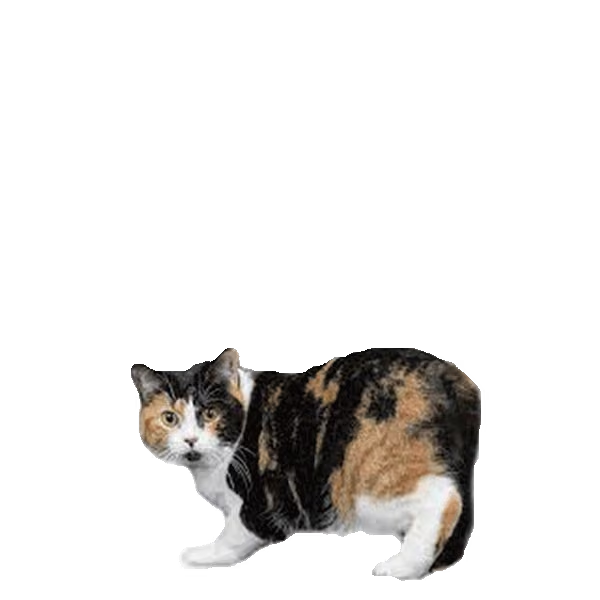
The Manx is a tailless, even-tempered cat from the Isle of Man, prized for its playful, loyal, and dog-like devotion to its people.
How the Manx coat is built, and what that means when you groom it.
Critical: A Manx should not be shaved.
The undercoat keeps heat out as well as in, and the outer coat shields the skin from sun and insect bites. Clipping the whole coat off removes both. It often grows back patchy, soft or a different colour, and in some animals the guard hairs never return properly. Brush the undercoat out instead of cutting it off.
Information: A Manx drops its undercoat in heavy bursts.
The undercoat comes out in heavy bursts over a few weeks. An undercoat rake, or a bath followed by a proper blow-dry, clears it far faster than daily brushing. Clipping the coat down is not a shortcut for this.
The Manx is a medium-sized, tailless cat from the Isle of Man, known for a settled nature and a playful, loyal attachment to its household.
The Manx is a medium-sized domestic cat best known for its missing or shortened tail, which comes from a natural genetic mutation that became common on the Isle of Man. A completely tailless cat is called a rumpy, while cats carrying different amounts of tail are known as rumpy-riser, stumpy, and longy.
Apart from the absent tail, the Manx has a rounded build with a broad chest, a deep flank, and hind legs that sit noticeably longer than the front legs. This shape gives the cat an arched back and a rabbit-like hop when it picks up speed. The head is round, the cheeks are full, and the whole animal reads as solid and compact.
Manx cats are steady and people-oriented. Plenty of owners note dog-like habits, such as trailing family members from room to room, learning to retrieve, and answering to their names. The breed is usually easy-going with children and slots neatly into a family routine.
| Attribute | Detail |
|---|---|
| Origin | United Kingdom (Isle of Man) |
| Size | Medium |
| Lifespan | 12 to 14 years |
| Group / role | Companion / domestic shorthair and longhair |
| Good with | Children and other pets |
The Manx suits homes that want an interactive, affectionate cat rather than a standoffish one. It fares well with families, with people who are home often, and with owners who enjoy play and simple training games. Anyone thinking about the breed should know that the same gene behind the taillessness can cause spinal trouble, so choosing a breeder who screens their cats matters.
The Manx grew from a tail-shortening mutation on the Isle of Man, where an isolated cat population carried the trait for centuries before cat fancies recognised the breed.
The breed takes its name from the Isle of Man, an island in the Irish Sea between Great Britain and Ireland. The taillessness comes from a dominant genetic mutation. On a small island with a limited cat population, the trait spread far and became a defining local feature across many generations.
Written accounts of tailless cats on the island go back to the early 1800s. Folk tales offered lively explanations, among them a story that the cat lost its tail in the door of Noah's Ark, but the real cause is the natural mutation that held on inside an isolated breeding pool.
The Manx was among the cats shown at some of the earliest organised cat exhibitions in Britain in the late nineteenth century, and it was one of the first breeds recognised when formal cat registries took shape. Early cat fancies listed the Manx as a foundation breed.
A long-haired variety, sometimes registered on its own as the Cymric, descends from the same population and carries the same tailless gene. Today the Manx is bred and shown across the world, including through clubs affiliated with the New Zealand Cat Fancy, with breeding programmes that manage the genetics with care because the gene can be lethal when it comes from both parents.
The Manx is a round, compact cat with a short or absent tail, longer hind legs, and a dense double coat found in both shorthair and longhair forms.
The Manx has a rounded, muscular body with a short back and a deep, broad chest. The hind legs run longer than the front legs, lifting the rump and creating the trademark arched topline. The head is round with prominent cheeks, a firm muzzle, and medium to large ears set fairly wide apart. The eyes are large and round.
Tail length varies and falls into four registry categories: rumpy (no tail), rumpy-riser (a small rise of bone), stumpy (a short partial tail), and longy (a near-normal tail). Show standards favour the rumpy, yet all of these turn up in the same litters.
| Trait | Standard |
|---|---|
| Height | Approx. 25 to 30 cm at the shoulder |
| Weight | 3.5 to 5.5 kg (males larger than females) |
| Coat | Double coat; shorthair or longhair (Cymric) |
| Colours | Most colours and patterns including tabby, solid, tortoiseshell, and bicolour |
| Eyes | Large, round; colour complements coat |
The shorthair Manx has a short, dense double coat with a thick, padded undercoat that gives a plush feel. The longhair variety carries a silkier, medium-length coat with a fuller ruff and breeches. Both come in a broad range of colours and patterns. Coat texture counts for as much as colour in the breed standard, with the dense, well-padded feel treated as typical of the breed.
The Manx is even-tempered, playful, and loyal, often forming a strong bond with one household and showing dog-like habits such as following its owners and retrieving.
The Manx is calm and affectionate without being clingy. It tends to bond closely with its household and often picks favourite people, trailing them through the house and settling nearby. The breed draws frequent comparisons with a dog because many cats learn to fetch, come when called, and even put up with lead walking.
With children the Manx is usually patient and playful, and it generally accepts other cats and dogs when the introductions are handled well. With strangers it is typically reserved at first, then warms up rather than staying wary. Manx cats are clever and curious, and they take to problem-solving toys and games. They are not especially vocal; when they do speak it is often a quiet trill or chirp rather than loud meowing.
| Trait | Rating |
|---|---|
| Affection | 5 |
| Energy | 3 |
| Trainability | 4 |
| Vocalness | 2 |
| Shedding | 3 |
The Manx needs routine coat brushing, daily play, and an indoor or secure setting, with extra care around the hindquarters because of the breed's spinal sensitivity.
The Manx is a low-maintenance cat on the whole, but its double coat and its physical build call for a few set routines.
The Manx settles into flats and houses alike. Keeping the cat indoors or in a secure outdoor run protects it from traffic and predators and eases strain on a body that can be prone to spinal issues. Provide stable scratching surfaces and easy access to a litter tray, since some affected cats have reduced bowel or bladder control.
The Manx does well on a complete, protein-forward cat food fed in measured portions, with portion control key to preventing weight gain on its compact frame.
Feed a complete and balanced cat food with animal protein as the main ingredient. The Manx has a solid, rounded body that can mask weight gain, so measure portions rather than leaving food down all day. Always provide fresh water, and match the food to the cat's life stage and activity level.
| Life stage | Amount per day | Meals |
|---|---|---|
| Kitten (2 to 12 months) | Follow product label; feed to appetite | 3 to 4 |
| Adult (1 to 7 years) | Approx. 200 to 280 kcal | 2 |
| Senior (7+ years) | Adjust to keep a healthy weight | 2 |
Keep treats to no more than about 10 percent of daily calories. A cat on a complete diet usually needs no supplements, though a vet may suggest joint support for an older Manx or one with spinal concerns. Introduce any new food gradually over several days to avoid an upset stomach.
The Manx usually lives 12 to 14 years but carries a breed-specific risk of spinal and nerve problems known as Manx syndrome, tied to the tailless gene.
The Manx is a sturdy cat with a typical lifespan of 12 to 14 years. Its main health concern links straight back to the gene that shortens the tail. When the mutation hits the spine too hard, it can bring on a group of conditions known together as Manx syndrome, which usually shows in the first months of life. Responsible breeders steer clear of mating two tailless cats, because inheriting the gene from both parents is lethal to the developing embryo.
| Condition | Signs | Note |
|---|---|---|
| Manx syndrome (spina bifida and related defects) | Hopping gait, bowel or bladder incontinence, hind-limb weakness | Usually evident by 4 to 6 months of age |
| Constipation / megacolon | Straining, infrequent stools | Linked to nerve supply near the shortened spine |
| Arthritis at the tail base | Stiffness, sensitivity when touched | More common in stumpy and partial-tail cats |
| Corneal dystrophy | Cloudiness of the eye | Reported in the breed; have eyes checked |
The Manx is clever and people-focused, which makes it one of the more trainable cat breeds for cues, fetch, and even lead walking.
The Manx learns quickly and enjoys interaction, so training is both realistic and rewarding. Its dog-like nature means many cats take to fetch, recall, and simple tricks through short, regular sessions. Keep sessions to a few minutes, finish on a success, and use food or play as the reward.
Manx breeding calls for careful genetic management because the tailless gene is lethal when inherited from both parents, so breeders pair a tailless cat with a tailed one.
Female cats reach sexual maturity at around five to ten months, though responsible breeders wait until the cat is physically mature before breeding. Gestation runs roughly 63 to 67 days, and litters average three to four kittens.
The central rule of Manx breeding turns on the tailless gene, which is dominant and lethal in its double form. A kitten that inherits the gene from both parents does not survive to birth. To sidestep this, breeders pair a tailless or partly tailed Manx with a tailed cat, which yields a mix of rumpy, stumpy, and tailed kittens in the same litter.
Kittens should be watched closely through the first months for any sign of Manx syndrome, since spinal defects generally show by four to six months. Affected kittens are taken out of breeding programmes. Queens raise their litters in the usual feline pattern, with kittens weaned at around eight weeks and ready for new homes only once they have been health-checked and socialised.
| Metric | Value |
|---|---|
| Sexual maturity | 5 to 10 months |
| Gestation | 63 to 67 days |
| Average litter size | 3 to 4 kittens |
| Weaning age | Around 8 weeks |
| Key genetic rule | Never breed two tailless cats (homozygous lethal) |
Cats sit outside the National Dog Database, so a free United Pet Club record is what stands behind your Manx's chip.
Keeping an indoor Manx safe is partly latches and partly paperwork. The paperwork half is a free profile carrying your contact details and her photo, ready for the day a door swings wider than it should. Cat registration with United Pet Club never costs anything.
Pop the fifteen digit number from the vet paperwork into your free United Pet Club account, check your phone number is current, and your Manx's chip finally points somewhere. Every brand is accepted, every update free, and the record answers scans at any hour. Microchip registration is the link in the middle.
It's a matter of creating a free United Pet Club account, adding her name, colouring, and a photo, and saving. The record is free for her whole life, indoors or out.
Adding the fifteen digit number to your free account with your current details is the whole job. The lifetime plan never charges for the record or its updates, whatever the chip brand.
There's no national requirement the way the dog database works, though some councils encourage it and shelters chip on rehoming. Requirement or not, a registered chip is what turns a found Manx into a phone call.
Nothing at all. Profile, chip registration, and every later update are free under the lifetime plan.
Common questions about the Manx cover its size, temperament, care needs, lifespan, family suitability, and availability.
The Manx is a medium-sized cat. Adults usually weigh between 3.5 and 5.5 kg, with males larger than females, and stand about 25 to 30 cm at the shoulder.
Manx cats are even-tempered, playful, and loyal. They bond closely with their families, often show dog-like habits such as following people and fetching, and are quiet rather than vocal.
Daily care is straightforward: weekly brushing for the shorthair, more for the longhair, plus daily play. The main extra attention goes on watching the hindquarters and litter-tray habits because of the breed's spinal sensitivity.
A healthy Manx typically lives 12 to 14 years. Buying from a breeder who screens for spinal health and keeping the cat at a healthy weight support a full lifespan.
Yes. The Manx is generally patient with children and accepts other cats and dogs when introduced gradually, which makes it a good family cat.
Tail length varies within the breed because of how the tailless gene expresses. Litters can include rumpy (no tail), rumpy-riser, stumpy (short tail), and longy (near-normal tail) kittens.
The Manx is an established, widely recognised breed available through dedicated breeders, including some registered with the New Zealand Cat Fancy, but careful genetic management means litters are smaller and kittens may take time to source. Tailless rescue cats also turn up at shelters.
