

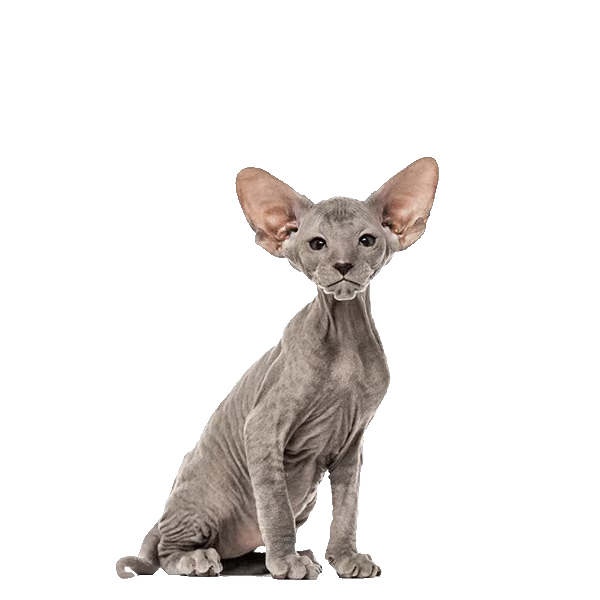
Lykoi
The Lykoi is a striking partially-hairless 'werewolf cat' that is affectionate, intelligent, and loyally devoted to its family.
- Size
- Small
- Lifespan
- 12–15 years
- Origin
- United States
- Temperament
- Affectionate
- Standard colours
- Black, White and Blue and 13 more
Characteristics
Coat and grooming
How the Lykoi coat is built, and what that means when you groom it.
- Coat layers
- Single coat
- Coat length
- Short
- Shedding
- Low shedding
Grooming guidance
Caution: A Lykoi needs protection from the sun.
Bare skin burns quickly and offers no insulation against cold either. Time outdoors needs shade, a coat in cool weather, or a sunscreen a vet has approved for animals.
Lykoi colours and patterns
What each club's breed standard says about every Lykoi colour and pattern. Point at a ruling to see the club's own wording.
Breed standards describe the Lykoi in Black, White, Blue, Lilac, Silver, Platinum, Brown, Chocolate, Seal, Sable, Cinnamon, Red, Gold, Cream, Fawn and Champagne. Standard patterns: Solid, Bicolour, Harlequin, Roan, Pointed, Tabby, Mackerel tabby, Classic tabby, Spotted tabby, Ticked tabby, Tortoiseshell, Calico, Torbie, Mink, Sepia, Van, Smoke, Shaded, Chinchilla and Caliby.
| Colour or pattern | TICA | CFA | FIFE | GCCF |
|---|---|---|---|---|
| Black | Standard (“Black roan”) | Standard | Standard (“black”) | Standard |
| White | No ruling | Standard | Standard (“white”) | Not recognised (“white self”) |
| Blue | No ruling | Standard | Standard (“blue”) | Standard |
| Lilac | No ruling | Standard | Standard (“lilac”) | Standard |
| Silver | No ruling | No ruling | Standard (“silver”) | No ruling |
| Platinum | No ruling | No ruling | Standard (“lilac”) | No ruling |
| Brown | No ruling | No ruling | Standard (“black tabby”) | No ruling |
| Chocolate | No ruling | Standard | Standard (“chocolate”) | Standard |
| Seal | No ruling | No ruling | Standard (“seal”) | No ruling |
| Sable | No ruling | No ruling | Standard (“brown”) | No ruling |
| Cinnamon | No ruling | Standard | Standard (“cinnamon”) | Standard |
| Red | No ruling | Standard | Standard (“red”) | Standard |
| Gold | No ruling | No ruling | Standard (“golden”) | No ruling |
| Cream | No ruling | Standard | Standard (“cream”) | Standard |
| Fawn | No ruling | Standard | Standard (“fawn”) | Standard |
| Champagne | No ruling | No ruling | Standard (“chocolate”) | No ruling |
| Patterns | ||||
| Solid | Standard (“Solid”) | Standard (“solid-colored”) | Standard (“solid”) | No ruling |
| Bicolour | No ruling | Standard (“bicolor”) | Standard (“bicolour”) | Not recognised (“bicolours”) |
| Harlequin | No ruling | No ruling | Standard (“harlequin”) | No ruling |
| Roan | Standard (“roan”) | Standard (“Roaning”) | Standard (“roan”) | Standard (“roaning”) |
| Pointed | No ruling | No ruling | Standard (“Siamese pointed”) | No ruling |
| Tabby | No ruling | No ruling | Standard (“tabby”) | No ruling |
| Mackerel tabby | No ruling | No ruling | Standard (“mackerel”) | No ruling |
| Classic tabby | No ruling | No ruling | Standard (“blotched”) | No ruling |
| Spotted tabby | No ruling | No ruling | Standard (“spotted”) | No ruling |
| Ticked tabby | No ruling | No ruling | Standard (“ticked”) | No ruling |
| Tortoiseshell | No ruling | No ruling | Standard (“tortie”) | No ruling |
| Calico | No ruling | No ruling | Standard (“tortie with white”) | No ruling |
| Torbie | No ruling | No ruling | Standard (“tortie tabby”) | No ruling |
| Mink | No ruling | No ruling | Standard (“Tonkinese pointed”) | No ruling |
| Sepia | No ruling | No ruling | Standard (“Burmese pointed”) | No ruling |
| Van | No ruling | No ruling | Standard (“van”) | No ruling |
| Smoke | No ruling | No ruling | Standard (“smoke”) | No ruling |
| Shaded | No ruling | No ruling | Standard (“shaded”) | No ruling |
| Chinchilla | No ruling | No ruling | Standard (“shell”) | No ruling |
| Caliby | No ruling | No ruling | Standard (“tortie with white”) | No ruling |


| Colour or pattern | TICA | FIFE | GCCF |
|---|---|---|---|
| Blue | No ruling | Standard (“deep blue”) | No ruling |
| Orange | No ruling | Standard (“copper or deep orange”) | No ruling |
| Copper | No ruling | Standard (“copper or deep orange”) | No ruling |
| Amber | No ruling | No ruling | Standard (“amber”) |
| Yellow | No ruling | Standard (“golden yellow”) | No ruling |
| Gold | Standard (“Gold”) | Standard (“golden yellow”) | Standard (“Gold”) |
| Green | No ruling | Standard (“green”) | No ruling |
| Aqua | No ruling | Standard (“aquamarine”) | No ruling |
| Patterns | |||
| Odd-eyed | No ruling | Standard (“odd eyed”) | No ruling |

What the rulings mean
- Standard
- Described by the club's breed standard.
- Not recognised
- The club does not accept this colour or pattern for the breed.
Colour changes
How a Lykoi's colours can change over its life.
Brownchanges toCopal
Coat · With age · from 0 to 52 weeks
Blackchanges toRusset
Coat · Progressive
Tabbychanges toSolid
Coat · With age · from 0 to 39 weeks
Whitechanges toShaded
Coat · With age
Whitechanges toChinchilla
Coat · With age
Tabbychanges toShaded
Coat · With age · from 0 to 6 weeks
Tabbychanges toChinchilla
Coat · With age · from 0 to 6 weeks
Bluechanges toTortoiseshell
Coat · With age
Blackchanges toBrown
Coat · With body condition · can change back
Blackchanges toBrown
Coat · In the sun · can change back
Blackchanges toBrown
Coat · Progressive
Whitechanges toPointed
Coat · With age · from 1 to 52 weeks
Solidchanges toSmoke
Coat · With age · from 3 to 104 weeks
Bluechanges toGreen
Eyes · With age · from 4 to 17 weeks
Bluechanges toYellow
Eyes · With age · from 4 to 17 weeks
Bluechanges toGold
Eyes · With age · from 4 to 17 weeks
Bluechanges toCopper
Eyes · With age · from 4 to 17 weeks
Bluechanges toOrange
Eyes · With age · from 4 to 17 weeks
Bluechanges toHazel
Eyes · With age · from 4 to 17 weeks
Bluechanges toAmber
Eyes · With age · from 4 to 17 weeks
Sources
Each ruling comes from the club's published breed standard or colour list.
Lykoi breed standard
What each club's standard asks of the Lykoi: size, build and forms. A club speaks only for itself, and a figure no club published is left out.
Conformation
Head shape
Modified wedge
“Modified wedge with rounded contours”
Facial profile
Dished (concave)
“A concave curve from brow to bridge.”
Stop
None
“No Stop.”
Muzzle length
Medium
“Muzzle is medium in length”
Eye shape
Oval
“Medium, oval in shape to almost round.”
Ear carriage
Erect (prick)
“vertical and erect”
Ear set
High
“Set high on the head”
Ear size
Large
“Large, wide at the base”
Ear tip
Pointed
“pointed on the tips”
Neck length
Medium
“Neck: Medium length.”
Leg length
Medium
“Medium boning; medium length.”
Body type
Foreign
“Torso: Foreign type.”
Bone and substance
Moderate
“Boning: Medium.”
Feet
Oval
“Feet are medium in size and oval shaped.”
Tail shape
Tapering
“shorter than body and tapers to a point.”


Markings


Parts of the body


About the Lykoi
The Lykoi is a small, partly hairless cat nicknamed the werewolf cat for its patchy roan coat. It is affectionate, clever, and closely bonded to its family.
The Lykoi is a small domestic cat that arose in the United States from natural mutations found in feral and domestic shorthair populations. The nickname werewolf cat comes from the partial hairlessness around the eyes, muzzle, chin, and feet, paired with a roan coat that blends black and white hairs across the body. The name Lykoi comes from a Greek word meaning wolf.
The appearance is unusual, but the temperament is ordinary cat. The Lykoi is affectionate with the people it knows, playful long into adulthood, and inquisitive about everything around it. The breed tends to bond tightly to its household and will often trail family members from room to room.
Coat is the variable part. Some hairs are absent altogether in patches, and the overall amount shifts with the seasons. A Lykoi may moult heavily at one point and grow the coat back at another, which gives it a changeable, weathered look.
| Attribute | Detail |
|---|---|
| Origin | United States |
| Size | Small |
| Lifespan | 12 to 15 years |
| Group/role | Companion cat |
| Good with | Families, attentive owners, other pets when introduced gradually |
Who it suits
The Lykoi fits households that want an active, people-oriented cat and are not put off by an out-of-the-ordinary look. Its devotion and drive suit homes where someone is around often and happy to play. The partial coat calls for some skin care, so owners who can keep a light grooming routine going will get on best with the breed.
History of the Lykoi
The Lykoi arose in the United States from natural coat mutations in domestic shorthair cats, with focused breeding beginning in Tennessee in the early 2010s.
The Lykoi is a recent breed. Cats carrying its distinctive partial-hairlessness mutation had turned up now and then in feral and domestic shorthair populations, but nobody bred them on purpose until the 2010s.
The breed's development is tied to breeders in Tennessee who looked closely at two unrelated litters of kittens showing the same roan, partly hairless coat. Veterinary checks ruled out disease and skin disorders as the cause, and DNA testing confirmed the cats were domestic shorthairs rather than relatives of other hairless breeds such as the Sphynx.
To confirm the trait was a recessive natural mutation, breeders paired unrelated cats that carried it. The resulting kittens showed the same coat, which proved the look could be reproduced. Outcrossing to black domestic shorthairs has stayed part of the breeding programme to keep the gene pool sound.
Cat registries have recognised the Lykoi for competition in stages over the years since its development. It is still an uncommon breed, and breeding programmes are few compared with long-established cats.
Appearance of the Lykoi
The Lykoi is a small to medium cat with a partial roan coat, hairless areas on the face and feet, and large eyes that give it a wolf-like look.
The Lykoi has a lean, athletic body of small to medium build. The defining feature is its coat, which is partly missing. Hair is sparse or absent around the eyes, nose, muzzle, chin, and the backs of the feet, while the rest of the body carries a thin roan coat. The blend of pigmented and unpigmented hairs creates the silvery, grizzled look behind the werewolf nickname.
The head is a modified wedge with large, upright ears and wide, expressive eyes. The legs are slender and the tail is shorter than the body. Because the coat varies, the same cat can look fuller or more bare depending on the season and where it sits in its moult cycle.
| Trait | Standard |
|---|---|
| Height | Roughly 20 to 25 cm at the shoulder |
| Weight | About 1.8 to 3.6 kg (4 to 8 lb) |
| Coat | Partial roan; hairless on face and feet |
| Colours | Black roan (black and white hairs mixed) |
| Eyes | Large, rounded, often yellow to gold |
Coat and colours
The recognised coat is a black roan, where black hairs are threaded through with white or colourless hairs across the body. The face mask and feet are usually bare. Coat quantity is not fixed: a Lykoi can moult much of its hair and grow it back later, so density shifts through the year. The exposed skin shows the pigment beneath and can range from pink to dark grey.
What the Lykoi standard says, club by club
What the breed standards say about the build of the Lykoi. Clubs compared: ACFA, CCA, CFA, FIFE, GCCF, LOOF, TICA, WCF.
Clubs set their own figures for the Lykoi. These come from each club's published standard: ACFA, CCA, CFA, FIFE, GCCF, LOOF, TICA, WCF.
Build and forms
At least one club accepts each of these:
- Head shape: Modified wedge, Wedge, Triangular
- Facial profile: Dished (concave)
- Stop: None
- Muzzle length: Medium
- Eye shape: Walnut, Oval
- Ear carriage: Erect (prick)
- Ear set: High
- Ear size: Large
- Ear tip: Rounded, Pointed
- Neck length: Medium
Forms the clubs penalise
A fault or a disqualification is a judgment under a show standard. It can affect placings and, at some clubs, registration.
- Disqualifying: Head shape: Round (GCCF); Body type: Cobby (GCCF); Tail shape: Kinked (ACFA, CCA, CFA, WCF)
- Fault: Muzzle shape: Snipy (GCCF); Ear size: Small (CCA, GCCF); Body type: Cobby (CCA); Bone and substance: Fine (light) (CCA); Tail length: Long (CCA); Tail shape: Whip (CCA)
Markings
Each club's ruling on the breed's named marks:
- Locket: Alternate (ACFA, CCA, CFA, GCCF, LOOF, TICA, WCF)
- Buttons: Alternate (ACFA, CCA, CFA, WCF)
See every point side by side: compare the clubs.
Rulings come from each club's published breed standard, and clubs revise their standards. Before a show or a registration, check the current text with the club.
Which forms do clubs penalise in the Lykoi?
Disqualifying: Head shape: Round (GCCF); Body type: Cobby (GCCF); Tail shape: Kinked (ACFA, CCA, CFA, WCF). Fault: Muzzle shape: Snipy (GCCF); Ear size: Small (CCA, GCCF); Body type: Cobby (CCA); Bone and substance: Fine (light) (CCA); Tail length: Long (CCA); Tail shape: Whip (CCA).
Which Lykoi colours the clubs accept
Every club we track accepts Black for the Lykoi.
On the Lykoi, every club we track agrees on Black. Clubs compared: CFA, FIFE, GCCF, TICA.
Patterns listed as standard for the Lykoi: Solid, Bicolour, Harlequin, Roan, Pointed, Tabby.
Where the clubs split
At least one club accepts each of these, and at least one other penalises or refuses it.
- Bicolour: Standard (CFA, FIFE); Not recognised (GCCF)
- White: Standard (CFA, FIFE); Not recognised (GCCF)
Beyond the main colour
Standards rule on more than the main colour. These are listed as standard:
- Eyes: Blue, Orange, Copper, Amber, Yellow, Gold
Rulings come from each club's published breed standard, and clubs revise their standards. Before a show or a registration, check the current text with the club.
Which Lykoi colours do all the clubs accept?
All of these clubs accept Black: CFA, FIFE, GCCF, TICA.
Do clubs disagree about Lykoi colours?
Yes. Clubs rule differently on Bicolour, White.
Temperament of the Lykoi
The Lykoi is affectionate, playful, and clever, with strong loyalty to its family and a measured, alert manner around strangers and other pets.
The Lykoi is an engaged, people-focused cat. It builds a close bond with its household and tends to seek out company, often shadowing owners around the home and settling nearby. Affection comes readily once trust is there.
With strangers the breed is alert and a little reserved to begin with, a manner owners sometimes call dog-like watchfulness. It thaws after a short while. The Lykoi is clever and inquisitive, and it enjoys problem-solving toys and interactive play.
With children and other pets the Lykoi generally does well when introductions are gradual. Its hunting drive is strong, a carryover from the feral origins of the founding cats, so it benefits from outlets such as wand toys and chase games. Energy stays high right through adulthood, and a bored Lykoi can turn restless.
| Trait | Rating |
|---|---|
| Affection | 4 |
| Energy | 4 |
| Trainability | 4 |
| Vocalness | 2 |
| Shedding | 3 |
Caring for the Lykoi
The Lykoi needs regular skin care because of its partial coat, plus daily play and a warm indoor home to stay comfortable and well.
The Lykoi's partial coat changes its grooming needs compared with a fully coated cat. Exposed skin can build up oils, so the breed does better with routine cleaning than with heavy brushing.
Grooming
- Wipe or bathe the skin now and then to clear oil buildup on bare areas
- Clean the ears gently, since exposed ear skin gathers debris
- Check the eye and muzzle areas, which are often hairless
- Trim claws every few weeks
- Brush the coated areas lightly during a moult to lift loose hair
Exercise
- Provide daily interactive play with wand or chase toys to satisfy the hunting drive
- Offer climbing space such as a cat tree or shelves
- Rotate puzzle feeders and toys to keep the mind busy
- Set aside time for active play across two or more short sessions a day
Environment
The Lykoi is best kept as an indoor cat. Its sparse coat gives little insulation, so it loses heat in cold rooms and is prone to sunburn on bare skin. Keep the home comfortably warm, provide warm resting spots, and limit direct sun coming through windows.
Grooming a Lykoi
The Lykoi coat: Single coat, Short, Low shedding.
Most of what a Lykoi needs from grooming follows from its coat.
- Coat layers: Single coat
- Coat length: Short
- Shedding: Low shedding
What this coat asks of you
- A single coat has no dense undercoat, so there is less to brush out and less insulation against the cold.
- Short hair rarely tangles but it still sheds, so regular brushing keeps the loose hair down.
- Low shedding does not mean low upkeep. Hair that stays in the coat can still tangle unless it is brushed out.
What to tell a groomer
Mention these when you book. The coat notes on this page explain each one.
- Needs sun protection
A groomer who knows the breed can adapt all of this to the individual animal. Sore skin, mats pressed against the skin or a sudden change in the coat are worth showing to a vet.
What kind of coat does a Lykoi have?
On our records: Coat layers: Single coat; Coat length: Short; Shedding: Low shedding.
How much does a Lykoi shed?
Low shedding does not mean low upkeep. Hair that stays in the coat can still tangle unless it is brushed out.
What should a groomer know about a Lykoi?
These grooming rules apply: Needs sun protection.
Feeding the Lykoi
The Lykoi needs a balanced, protein-forward cat diet sized to its small frame and active habits, with fresh water always on hand.
The Lykoi is an obligate carnivore like every cat and does best on a complete, balanced diet with animal protein as the main ingredient. The breed is small but active, so portion control matters: it needs enough energy for its busy habits without being overfed. Some owners find a slightly higher calorie intake helps the bare-skinned body through cold spells, but weight should still be watched.
| Life stage | Amount per day | Meals |
|---|---|---|
| Kitten (to 12 months) | Free-fed or measured per package, growth formula | 3 to 4 |
| Adult (1 to 7 years) | About 45 to 70 g dry or equivalent wet, to body condition | 2 |
| Senior (7+ years) | Adjusted to activity and body condition | 2 |
Treats and supplements
Treats should stay under about ten percent of daily calories. Plain cooked meat in small amounts works well as a reward. A diet labelled complete and balanced supplies the nutrients needed, so supplements are not usually called for. Talk over any supplement, such as a skin or coat product, with a vet before adding it.
Health of the Lykoi
The Lykoi is generally healthy with a lifespan of 12 to 15 years, though its bare skin needs attention and the breed is young enough that long-term data is limited.
The Lykoi is considered a generally healthy breed, with a typical lifespan of 12 to 15 years. Its founding cats came from outbred domestic shorthair stock, and ongoing outcrossing helps hold onto genetic diversity. Because the breed is recent, long-term health records are still being gathered, and no breed-defining hereditary disease has been firmly pinned down. The main day-to-day concerns come back to the exposed skin.
| Condition | Signs | Note |
|---|---|---|
| Skin oil buildup | Greasy or dirty bare areas, odour | Manage with routine skin cleaning |
| Sunburn | Reddened or sore exposed skin | Limit direct sun on bare areas |
| Cold sensitivity | Seeking heat, shivering | Keep the home warm; provide warm beds |
| Dental disease | Bad breath, drooling, gum redness | Common in cats generally; brush teeth and have checkups |
Preventive care
- Book annual veterinary exams, more often for senior cats
- Keep core vaccinations and parasite prevention up to date
- Maintain a dental care routine
- Inspect the skin regularly for irritation, parasites, or sores
- Keep an eye on body condition to prevent weight gain
Training the Lykoi
The Lykoi is clever and responsive, which makes it well suited to play-based training, trick learning, and harness work using rewards.
The Lykoi is one of the more trainable cats. Its intelligence and its bond with people mean it pays attention to its owners and picks things up quickly when sessions are short and rewarding. The breed responds well to clicker training and food rewards, and many individuals enjoy learning tricks, fetch, or harness walking. The strong prey drive can be steered into trained games rather than left to find its own outlets.
Basics
- Start with litter habits, which most kittens learn readily, and keep boxes clean
- Introduce a marker such as a clicker, pairing it with a small treat
- Teach simple cues like come and sit using lure-and-reward
- Build up to tricks or harness training in short daily sessions
- Redirect rough play or hunting on people onto toys, never hands
Breeding the Lykoi
The Lykoi coat comes from a recessive gene, so planned breeding and outcrossing to black domestic shorthairs are used to produce kittens and keep the line healthy.
The Lykoi coat is caused by a recessive mutation, which means a kitten shows the look only when it inherits the gene from both parents. Breeders pair two Lykoi to produce fully coated Lykoi kittens, and they also outcross to black domestic shorthairs to widen the gene pool. Cats from an outcross carry the gene without showing it and can be bred back into the programme.
Females reach sexual maturity within their first year, though responsible breeders wait until a cat is mature and health-checked before breeding. Gestation runs about 63 to 67 days, similar to other cats. Litters are usually small. Kittens are born with more coat than they keep and develop the characteristic partial-hairless pattern as they grow.
Queens raise their kittens for several weeks, with weaning around four to six weeks and rehoming usually after twelve weeks once kittens are socialised and vaccinated. Because the breed is uncommon, waiting lists for kittens from established breeders are the norm.
| Metric | Value |
|---|---|
| Sexual maturity | Within the first year |
| Gestation | About 63 to 67 days |
| Typical litter size | 2 to 5 kittens |
| Weaning age | 4 to 6 weeks |
| Earliest homing | About 12 weeks |
| Inheritance | Recessive coat gene; outcross to black domestic shorthair |
A registered Lykoi: sorted for life, chip included
Cats sit outside the National Dog Database, so a free United Pet Club record is what stands behind your Lykoi's chip.
Registering a Lykoi and its chip in New Zealand
Giving your Lykoi a record takes less time than choosing her food: name, colouring, photo, phone number, save. The profile holds for life, free, with a chip number slot waiting whenever the vet's done. Registering your cat starts it.
If she is chipped already, finish the job the implant started: a chip with no record reads as a dead end. Registering the microchip is free for life with United Pet Club, open to any brand, with updates that never cost a thing. Creating a free account sorts the profile at the same time.
How do I register my Lykoi in New Zealand?
It's a matter of creating a free United Pet Club account, adding her name, colouring, and a photo, and saving. The record is free for her whole life, indoors or out.
How do I register my Lykoi's microchip?
Adding the fifteen digit number to your free account with your current details is the whole job. The lifetime plan never charges for the record or its updates, whatever the chip brand.
Do cats have to be microchipped in New Zealand?
There's no national requirement the way the dog database works, though some councils encourage it and shelters chip on rehoming. Requirement or not, a registered chip is what turns a found Lykoi into a phone call.
How much does it cost to register a Lykoi?
Nothing at all. Profile, chip registration, and every later update are free under the lifetime plan.
Lykoi frequently asked questions
Common questions about the Lykoi cover its size, temperament, care needs, lifespan, suitability, and how hard it is to find.
How big does a Lykoi get?
The Lykoi is a small to medium cat, usually weighing about 1.8 to 3.6 kg (4 to 8 lb) with a lean, athletic build.
What is the Lykoi's temperament like?
It is affectionate, playful, and clever, with strong loyalty to its family. It can be reserved with strangers at first but warms up quickly, and it keeps a high prey drive into adulthood.
Is the Lykoi hard to care for?
Care is moderate. The partial coat needs routine skin cleaning, the cat should be kept warm indoors, and it needs daily play. None of these jobs is difficult, but they are ongoing.
How long do Lykoi cats live?
A Lykoi typically lives 12 to 15 years with good veterinary care, nutrition, and an indoor home.
Is the Lykoi a good family pet?
Yes. It bonds closely with its household and generally does well with children and other pets when introductions are gradual. It suits homes where someone is around often to give it attention and play.
Is the Lykoi hypoallergenic?
No. The partial coat still produces dander and the allergen found in cat saliva, so the breed is not hypoallergenic. People with allergies should spend time around the breed before committing.
Are Lykoi cats easy to find?
No. The Lykoi is a recent and uncommon breed with only a handful of breeding programmes, so kittens are scarce and waiting lists are common.
From the community
Ask about the LykoiNo questions about the Lykoi yet. Be the first to ask.
Browse Cat breeds