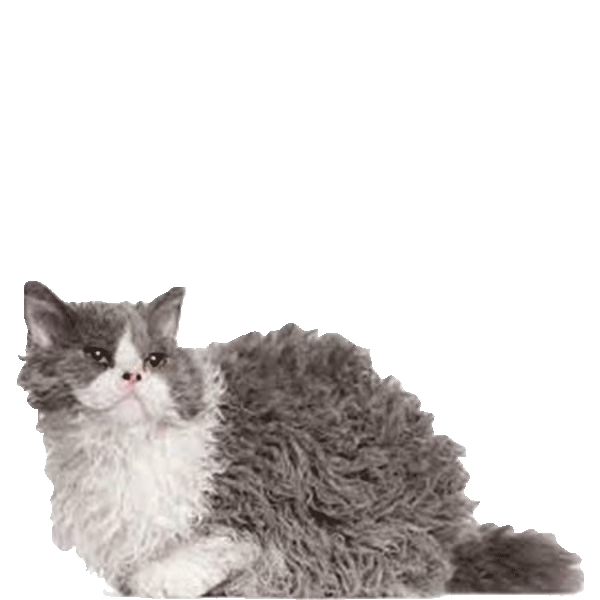
The Lambkin is an affectionate, playful dwarf breed adored for its short legs and soft curly coat reminiscent of a lamb's fleece.
How the Lambkin coat is built, and what that means when you groom it.
Caution: A Lambkin coat mats easily.
Fine or long hair tangles at the base of the coat, out of sight, where the mats tighten and pull on the skin. Brushing has to reach right down to the roots in sections, not just skim the surface.
The Lambkin is a small dwarf cat with short legs and a soft, curly coat resembling a lamb's fleece. Gentle, affectionate and playful, it lives around 12 to 15 years.
The Lambkin is a small domestic cat that comes from crossing the short-legged Munchkin with the curly-coated Selkirk Rex. What you get is a low-slung cat wearing a plush, wavy coat. The name points to that coat, which carries the soft texture of a young lamb's fleece. The breed also goes by the name Nanus Rex.
Lambkins are companion cats. Affectionate and people-oriented, they keep a kitten-like playfulness long into adulthood. Short legs and all, they get around a home with ease and enjoy climbing onto laps and furniture. The breed is rare and litters are small, so kittens do not come along often.
The short legs trace back to the same dominant gene carried by the Munchkin, and the curly coat to the dominant gene of the Selkirk Rex. As both traits are dominant, not every kitten in a litter ends up with both the short legs and the curls.
| Attribute | Detail |
|---|---|
| Origin | United States |
| Size | Small |
| Lifespan | 12 to 15 years |
| Group / role | Companion / lap cat |
| Good with | Families, children, other pets, seniors |
The Lambkin fits households wanting a calm, affectionate companion they can give steady attention to. It does well with families, with other cats and dogs, and with people who are home often. Its short legs make it less of a high jumper than most cats, so it usually keeps closer to the ground. It is best kept as an indoor cat.
The Lambkin was developed in the United States in the late 1980s, crossing the Munchkin with the Selkirk Rex to join short legs with a curly coat.
The Lambkin is a recent breed. It came out of the United States, with breeder Terri Harris commonly credited for the early work across the late 1980s and 1990s. The idea was to join the short legs of the Munchkin with the curly coat of the Selkirk Rex.
The Munchkin gives the short-legged form. Its short legs arise from a natural dominant genetic mutation that affects the long bones of the limbs. The Munchkin was recognised as a breed by The International Cat Association during the 1990s, which opened it up as a foundation breed for new dwarf crosses like the Lambkin.
The Selkirk Rex gives the coat. That breed started in Montana in 1987 from a curly-coated kitten in a shelter litter, and its curls trace to a dominant gene. Crossing the two produced kittens that could carry both the short legs and the soft, loose curls.
The Lambkin is still rare. Registries treat it as an experimental or developing breed rather than a fully recognised championship breed, and breeding programmes remain small. In New Zealand it is a curiosity rather than an established show cat, so enquiries tend to run through TICA rather than the mainstream registers of the New Zealand Cat Fancy. Because both founding traits are dominant, breeders can bring out the look in a single generation, but careful pairing is still needed to keep the cats healthy.
The Lambkin is a small, low-slung cat with short legs and a soft, loosely curled coat that can be short or long and comes in any colour or pattern.
The Lambkin is a small cat with a sturdy, rounded body carried low to the ground on short legs. The head is broad with full cheeks, the ears are medium and set wide, and the eyes are large and round. What stands out most are the short legs from the Munchkin and the wavy coat from the Selkirk Rex.
The coat sits in soft, loose curls rather than tight waves. Curl tends to show most on the belly, the neck and the tail. Kittens are often born curly, may lose much of the curl as they grow, then get it back once they mature.
| Trait | Description |
|---|---|
| Height | About 18 to 23 cm (7 to 9 in) at the shoulder |
| Weight | About 2 to 4 kg (4 to 9 lb) |
| Coat | Soft and curly; short or long; plush texture |
| Colours | All colours and patterns accepted |
| Eyes | Large, round, colour in keeping with the coat |
The coat can be short or long, and the curl carries through both lengths. Nothing limits colour or pattern, so Lambkins show up in solids, tabby, bicolour, tortoiseshell and pointed coats. The texture is plush and woolly, and that is the trait behind the breed's name. Longer coats carry looser, more flowing curls, while shorter coats carry a denser wave.
The Lambkin is affectionate, gentle and playful. It bonds closely with its people, gets on with children and other pets, and keeps a kitten-like curiosity into adulthood.
The Lambkin is a friendly, people-focused cat. It builds strong bonds with its household and likes to stay close, often following its people from room to room and settling on a lap. Gentle and patient by nature, it fits well into homes with children.
With strangers the Lambkin is usually curious and sociable rather than shy, though like any cat it appreciates being able to approach in its own time. It generally gets on with other cats and with cat-friendly dogs, which makes it a good match for multi-pet homes.
Playfulness runs deep in the breed. Lambkins stay keen on toys, games and small puzzles well beyond kittenhood. Short legs do not hold them back from playing, though they do less high jumping than a long-legged cat, so much of their activity sits at floor and furniture level. They are moderately vocal and will talk in soft sounds, but they are not as chatty as some oriental breeds. Being so bonded to their company, they are not fond of long stretches on their own.
| Trait | Rating |
|---|---|
| Affection | 5 |
| Energy | 3 |
| Trainability | 3 |
| Vocalness | 2 |
| Shedding | 3 |
The Lambkin needs gentle regular coat care, daily indoor play and a safe home that keeps high jumps and outdoor risks to a minimum.
The Lambkin is a moderate-maintenance cat. The curly coat wants regular but gentle care, and the breed needs daily play and a safe indoor space to stay healthy and content.
The Lambkin is an indoor cat. Keeping it inside shields it from traffic, predators and disease. Give it warm resting spots, scratching posts and quiet places to retreat to. Because it is so attached to company, a second pet or a steady human presence helps prevent loneliness when the home is empty.
The Lambkin needs a complete, meat-based cat food matched to its life stage, fed in measured meals to keep this small breed at a healthy weight.
Cats are obligate carnivores, so the Lambkin needs a complete and balanced diet built around animal protein. Pick a quality cat food that meets a recognised nutritional standard such as AAFCO and matches the cat's life stage. Since the Lambkin is small, portions stay modest and weight control matters; feed measured amounts rather than leaving food out all day, and keep fresh water available at all times.
| Life stage | Amount per day | Meals |
|---|---|---|
| Kitten (to 12 months) | Free-fed or 3 to 4 measured portions | 3 to 4 |
| Adult (1 to 7 years) | About 150 to 250 kcal | 2 |
| Senior (7 years and over) | Adjusted to activity and weight | 2 |
Hold treats to no more than about 10 percent of daily calories so they do not unbalance the diet. A cat on a complete commercial food usually needs no extra supplements; add fish oil or the like only on a vet's advice. Watch body condition closely, since on such a small frame even a little extra weight has a big effect on the joints and overall health.
The Lambkin usually lives 12 to 15 years and is generally healthy, though the short-legged trait can affect the spine and joints and warrants attention.
The Lambkin generally enjoys good health and a lifespan of about 12 to 15 years. As a young breed built from two foundation breeds, its long-term health picture is still being recorded. The main concerns come back to the short-legged dwarf trait, which can put extra load on the spine and joints, and to conditions inherited from the parent breeds.
| Condition | Signs | Note |
|---|---|---|
| Lordosis (spinal curve) | Dip in the spine, breathing or posture changes | Linked to the dwarf trait; severity varies |
| Pectus excavatum (sunken chest) | Flattened or hollow chest, exercise intolerance | Seen in some short-legged cats |
| Joint and mobility strain | Stiffness, reluctance to jump | Short limbs change weight loading |
| Dental disease | Bad breath, drooling, tartar | Common in cats; prevent with dental care |
| Obesity | Weight gain, low activity | Adds stress to spine and joints |
The Lambkin is intelligent and food-motivated, so it responds well to short, reward-based sessions for litter habits, handling and simple tricks.
The Lambkin is intelligent, curious and keen on interaction, which makes it more trainable than the average cat. It picks up litter tray habits quickly and can learn to come when called, walk on a harness and perform simple tricks. Keep sessions short and upbeat, and use food or play as the reward. As the breed is sensitive and attached to its people, harsh methods work against you and damage trust.
Lambkin breeding calls for careful outcrossing because both the short-leg and curly-coat genes are dominant, and the short-leg gene is not bred cat to cat.
Breeding Lambkins is specialised work because of the genetics behind the breed. Both defining traits are dominant: the short legs come from the Munchkin gene and the curls from the Selkirk Rex gene. A single copy of each gene is enough to show the trait, so kittens can carry both features in one generation, yet a litter will also include some long-legged or straight-coated kittens.
The short-leg gene is handled with care. It is not bred from two short-legged cats, because pairing two copies is associated with non-viable kittens. Responsible breeders match a short-legged cat with a normal-legged carrier, which keeps litters healthy while still producing short-legged kittens.
Queens reach maturity at around 7 to 12 months, though responsible breeders wait until the cat is physically mature before the first litter. Gestation lasts about 63 to 67 days. Litters are typically small. The mother raises the kittens, which are weaned at around 8 weeks and usually move to new homes at 12 weeks or later, once vaccinated and socialised. The coat often changes through kittenhood, losing and then regaining curl as the cat matures.
| Metric | Value |
|---|---|
| Sexual maturity | About 7 to 12 months |
| Gestation | About 63 to 67 days |
| Typical litter size | 2 to 5 kittens |
| Weaning | Around 8 weeks |
| Recommended rehoming age | 12 weeks or later |
| Key rule | Do not pair two short-legged cats |
Cats sit outside the National Dog Database, so a free United Pet Club record is what stands behind your Lambkin's chip.
With no national database covering cats, the record behind your Lambkin's chip is entirely yours to provide. A free United Pet Club profile does it: your number, her photo, her details, one scan away. Registering your cat is free for life and done in minutes.
If she is chipped already, finish the job the implant started: a chip with no record reads as a dead end. Registering the microchip is free for life with United Pet Club, open to any brand, with updates that never cost a thing. Creating a free account sorts the profile at the same time.
It's a matter of creating a free United Pet Club account, adding her name, colouring, and a photo, and saving. The record is free for her whole life, indoors or out.
Adding the fifteen digit number to your free account with your current details is the whole job. The lifetime plan never charges for the record or its updates, whatever the chip brand.
There's no national requirement the way the dog database works, though some councils encourage it and shelters chip on rehoming. Requirement or not, a registered chip is what turns a found Lambkin into a phone call.
Nothing at all. Profile, chip registration, and every later update are free under the lifetime plan.
Common questions about the Lambkin cat, covering its size, temperament, care needs, lifespan, suitability and availability.
The Lambkin is a small cat. Adults usually weigh about 2 to 4 kg (4 to 9 lb) and stand low to the ground because of their short legs.
Lambkins are affectionate, gentle and playful. They bond closely with their people, get on well with children and other pets, and stay curious and kitten-like into adulthood.
Care is moderate. The curly coat needs gentle combing once or twice a week, and the cat needs daily play and a safe indoor home. Over-brushing the coat should be avoided so the curls are not broken.
A Lambkin typically lives about 12 to 15 years with good care, a healthy weight and regular veterinary checkups.
Yes. Its gentle, sociable nature suits families with children, multi-pet homes and people who are home often. It should be kept indoors and does not like being left alone for long.
Yes. The Lambkin is a rare, developing breed with small breeding programmes and small litters, so kittens are limited and often come with a waiting list. Buy only from breeders who health-screen their cats.
The short legs come from the same dominant gene found in the Munchkin, one of its two foundation breeds. The curly coat comes from the Selkirk Rex.
