

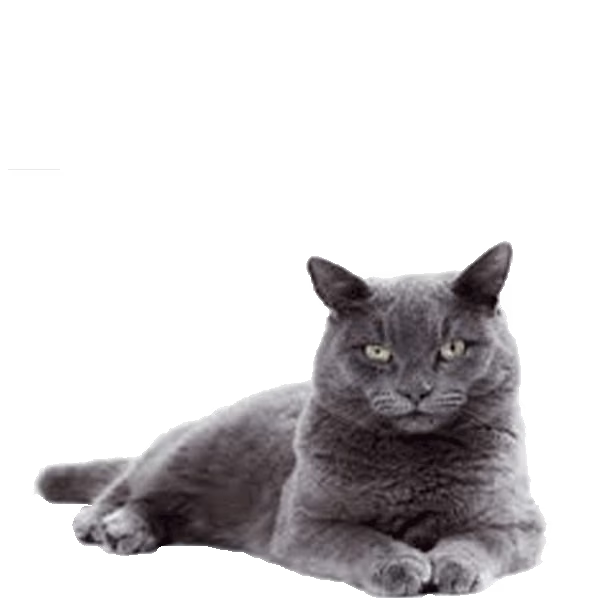
Korat
The Korat is a devoted, affectionate breed treasured in Thailand as a good-luck cat with a silver-blue coat and gentle, loyal heart.
- Size
- Small
- Lifespan
- 12–15 years
- Origin
- Thailand
- Temperament
- Devoted
- Standard colours
- Blue
Characteristics
Coat and grooming
How the Korat coat is built, and what that means when you groom it.
- Coat layers
- Single coat
- Coat texture
- Smooth
- Coat length
- Short
- Shedding
- Low shedding
Korat colours and patterns
What each club's breed standard says about every Korat colour and pattern. Point at a ruling to see the club's own wording.
Breed standards describe the Korat in Blue. Standard patterns: Solid.
| Colour or pattern | TICA | CFA | FIFE | GCCF |
|---|---|---|---|---|
| Blue | Standard (“Blue”) | Standard (“Silver-Tipped Blue”) | Standard (“silver blue”) | Standard (“blue”) |
| Patterns | ||||
| Solid | Standard (“Solid”) | No ruling | Standard (“solid”) | No ruling |

| Colour or pattern | TICA | CFA | FIFE | GCCF |
|---|---|---|---|---|
| Amber | Standard (“amber cast”) | Standard (“amber cast”) | Standard (“amber”) | Standard (“amber cast”) |
| Green | Standard (“green”) | Standard (“luminous green”) | Standard (“brilliant green”) | Standard (“Brilliant green”) |
| Colour or pattern | TICA | CFA | FIFE | GCCF |
|---|---|---|---|---|
| Blue | Standard (“dark blue”) | Standard (“dark blue”) | Standard (“dark blue-grey”) | Standard (“dark blue”) |
| Lilac | Standard (“lavender”) | Standard (“lavender”) | Standard (“lavender”) | Standard (“lavender”) |
| Colour or pattern | TICA | CFA | FIFE | GCCF |
|---|---|---|---|---|
| Blue | Standard (“dark blue”) | Standard (“dark blue”) | Standard (“dark blue-grey”) | Standard (“dark blue”) |
| Lilac | Standard (“lavender with a pinkish cast”) | Standard (“lavender with a pinkish tinge”) | Standard (“lavender with a pink tinge”) | Standard (“lavender with pinkish tinge”) |
What the rulings mean
- Standard
- Described by the club's breed standard.
Colour changes
How a Korat's colours can change over its life.
Bluechanges toTortoiseshell
Coat · With age
Tabbychanges toSolid
Coat · With age
Solidchanges toSmoke
Coat · With age · from 3 to 104 weeks
Amberchanges toGreen
Eyes · With age · from 4 to 208 weeks
Yellowchanges toGreen
Eyes · With age · from 4 to 208 weeks


Sources
Each ruling comes from the club's published breed standard or colour list.
Korat breed standard
What each club's standard asks of the Korat: size, build and forms. A club speaks only for itself, and a figure no club published is left out.
Conformation
Head shape
Broad
“Smooth, curved lines. Broad”
Head shape
NarrowFault
“Pinch or narrowness in the head”
Stop
Slight
“Slight stop between forehead and nose”
Eye shape
Round
“Fully rounded when open”
Eye size
Large
“Oversized for face”
Eye size
SmallFault
“Small or dull looking eyes”
Ear set
High
“Set high on head”
Ear size
Large
“Large with rounded tip”
Ear tip
Rounded
“Large with rounded tip”
Neck length
Medium
“Medium in length, strong”
Body type
Semi-cobby
“Semi-cobby. Medium-sized”
Bone and substance
Moderate
“Boning: Medium, strong”
Chest
Broad
“Broad-chested with good space between forelegs”
Feet
Oval
“Oval-shaped”
Toes
Normal
“Five toes front; four back”
Tail length
Medium
“Medium in length”
Tail shape
Tapering
“tapering to a rounded tip”
Tail shape
KinkedDisqualifying
“Tail Kink (visible or invisible)”


Markings
- SpotsDisqualifying“White spots, white toes, white locket.”


Parts of the body


About the Korat
The Korat is a heritage natural breed from Thailand recognized by the NZCF, cherished by New Zealand's passionate but small cat fancy community for its rarity, its cloud-coloured Tamra Maew description, and a practical low-shedding coat.
The Korat is one of the oldest natural cat breeds, with roots in the Korat province of north-eastern Thailand. It is a small to medium cat with a single, close-lying coat in blue tipped with silver. The ancient Thai manuscript known as the Tamra Maew, or Cat-Book Poems, describes this cat as cloud-coloured with eyes like dewdrops, and New Zealanders familiar with the country's cloud-draped mountain landscapes and notoriously rain-heavy skies may find that description unexpectedly apt.
In Thailand the Korat is called Si-Sawat and is treated as a living symbol of good fortune, gifted in pairs to brides for centuries. That tradition survived unchanged and crossed the Pacific when the breed was first imported to the United States in 1959. The New Zealand Cat Fancy (NZCF) now registers Korats, but the breed remains genuinely rare here: only a small number of dedicated New Zealand breeders maintain the lines.
The single coat with no undercoat produces minimal shedding, a small irony for a country whose wool industry is legendary. Korats form strong bonds with their people, attaching closely to one or two household members and preferring calm, predictable settings.
| Attribute | Detail |
|---|---|
| Origin | Thailand (Korat province) |
| Size | Small to medium |
| Lifespan | 12 to 15 years |
| Group/role | Companion cat |
| Good with | Attentive adults, older children, calm households |
Who the Korat suits
The Korat suits New Zealand enthusiasts who value heritage over fashion and want a genuinely rare natural breed with centuries of documented history. It does best in a quiet home where it has steady company, either from a person who is home often or from a compatible companion pet. MPI biosecurity requirements govern importation from Australia, the USA, or Thailand, and the wait list from New Zealand breeders is real. Those drawn to rare breeds for their substance rather than their novelty tend to connect deeply with this cat.
History of the Korat
The Korat is a natural Thai breed documented for centuries as the Si-Sawat good-luck cat, brought to the West in the mid-twentieth century and developed from a small number of imported cats.
The Korat takes its name from the Korat province (Nakhon Ratchasima) in north-eastern Thailand, where it has existed as a natural breed for centuries. In Thailand it is known as the Si-Sawat, a name that refers to its silver-blue colour and carries a sense of good fortune and prosperity.
The breed appears in a Thai manuscript known as the Tamra Maew, or Cat-Book Poems, a collection of verse and illustration describing native cats. The Si-Sawat is among the cats depicted there, which places written record of the type well before it reached the West. Korats were given in pairs to mark weddings and to wish good luck, and they were kept and bred close to their original population.
Korats reached the United States in 1959, when a breeding pair was imported from Thailand. American breeders built their lines from this and later imports, keeping the population close to its Thai roots rather than crossing widely with other breeds. The Korat Cat Fanciers Association formed in the years that followed to record pedigrees and promote the breed.
Major registries recognised the Korat through the 1960s, and breeders have continued to import cats directly from Thailand to maintain genetic diversity. In New Zealand the breed is registered through the New Zealand Cat Fancy (NZCF) and through TICA-affiliated bodies. It remains relatively uncommon, and many catteries still trace their cats to documented foundation imports.
Korat appearance
The Korat is a small, muscular cat with a heart-shaped face, large luminous green eyes, and a single silver-tipped blue coat that has no other accepted colour.
The Korat is a compact, semi-cobby cat that carries surprising weight for its size because of dense muscle. Viewed from the front the head forms a heart shape, with a strong jaw and a slight stop on the nose. The ears are large, set high, and rounded at the tips. The eyes are the breed's most striking feature: large, round when open, and a luminous green at maturity. Kittens are often born with amber or yellow-green eyes that deepen to full green over the first two to four years.
| Trait | Standard |
|---|---|
| Height | About 23 to 25 cm at the shoulder |
| Weight | 2.7 to 4.5 kg |
| Coat | Short, single, close-lying, no undercoat |
| Colours | Blue tipped with silver only |
| Eyes | Large, round, luminous green at maturity |
Coat and colours
The Korat has one accepted colour: a solid blue coat in which each hair is tipped with silver. The silver tipping catches the light and produces a halo or sheen, most visible on a cat in good condition. The coat is short, fine, and lies flat against the body, with no woolly undercoat. Because there is only one coat and no undercoat, the Korat sheds less than many cats and needs little grooming. There are no markings, patches, or alternative colours in the breed standard.
What the Korat standard says, club by club
What the breed standards say about the build of the Korat. Clubs compared: ACFA, CCA, CFA, FIFE, GCCF, LOOF, TICA, WCF.
Clubs set their own figures for the Korat. These come from each club's published standard: ACFA, CCA, CFA, FIFE, GCCF, LOOF, TICA, WCF.
Build and forms
At least one club accepts each of these:
- Head shape: Broad
- Stop: Slight
- Eye shape: Round
- Eye set: Prominent, Wide-set
- Eye size: Large
- Ear set: High
- Ear size: Large
- Ear tip: Rounded
- Neck length: Medium
- Leg length: Medium
Forms the clubs penalise
A fault or a disqualification is a judgment under a show standard. It can affect placings and, at some clubs, registration.
- Disqualifying: Bite: Malocclusion (GCCF); Toes: Polydactyl (extra toes) (CFA); Tail shape: Kinked (CFA, TICA)
- Fault: Head shape: Narrow (CCA, CFA, LOOF, TICA); Eye set: Close-set (LOOF); Eye size: Small (CCA, CFA, LOOF, TICA)
Markings
Each club's ruling on the breed's named marks:
- Locket: Disqualifying (CFA, TICA)
- Spots: Disqualifying (CFA, GCCF, TICA)
- Socks: Disqualifying (TICA)
- Flecking: Alternate (CCA)
- White markings: Fault (WCF); Disqualifying (GCCF); Not recognised (FIFE)
See every point side by side: compare the clubs.
Rulings come from each club's published breed standard, and clubs revise their standards. Before a show or a registration, check the current text with the club.
Which forms do clubs penalise in the Korat?
Disqualifying: Bite: Malocclusion (GCCF); Toes: Polydactyl (extra toes) (CFA); Tail shape: Kinked (CFA, TICA). Fault: Head shape: Narrow (CCA, CFA, LOOF, TICA); Eye set: Close-set (LOOF); Eye size: Small (CCA, CFA, LOOF, TICA).
Which Korat colours the clubs accept
Every club we track accepts Blue for the Korat.
On the Korat, every club we track agrees on Blue. Clubs compared: CFA, FIFE, GCCF, TICA.
Patterns listed as standard for the Korat: Solid.
Beyond the main colour
Standards rule on more than the main colour. These are listed as standard:
- Eyes: Amber, Green
- Nose: Blue, Lilac
- Paw pads: Blue, Lilac
Rulings come from each club's published breed standard, and clubs revise their standards. Before a show or a registration, check the current text with the club.
Which Korat colours do all the clubs accept?
All of these clubs accept Blue: CFA, FIFE, GCCF, TICA.
Korat temperament
The Korat is affectionate, devoted, and gentle, forming deep bonds with its people while staying alert and sensitive to noise and change.
The Korat is a people-focused cat that attaches closely to its household, and it usually settles on one or two favourite people. It likes to stay near them, sit on a lap, and join whatever they are doing. Rather than making constant loud demands, the breed communicates with a soft, expressive voice, and it reads its owner's moods with noticeable attention.
With family, the Korat is warm and loyal. With strangers it tends to be reserved at first, watching from a distance before it decides to approach. It is intelligent and curious and learns household routines quickly. The breed can be assertive about wanting company and may dislike being left alone for long stretches.
Korats are sensitive cats. Sudden noise, rough handling, and frequent disruption unsettle them. Most do well with another calm, compatible cat or a respectful dog, but they can be wary of boisterous animals. With gentle older children who handle them quietly they are affectionate; very young, loud children are a poorer match.
| Trait | Rating |
|---|---|
| Affection | 5 |
| Energy | 3 |
| Trainability | 4 |
| Vocalness | 3 |
| Shedding | 2 |
Korat care
The Korat is low-maintenance to groom thanks to its single coat, but it needs steady company, moderate play, and a calm, stable home to stay content.
Grooming
The Korat's single, short coat is easy to maintain and sheds modestly.
- Brush or hand-stroke once a week to lift loose hair and keep the silver sheen
- Wipe the coat with a damp hand or chamois between brushings for shine
- Trim claws every two to three weeks
- Check and clean the large ears regularly, and brush the teeth to limit dental disease
Exercise
The Korat has moderate energy and enjoys short, regular bouts of play.
- Offer two or three play sessions a day with wand toys or chase toys
- Provide a cat tree or shelves for climbing and a high perch for watching
- Rotate puzzle feeders and small toys to keep an intelligent cat occupied
- Use interactive play to bond, since this cat prefers playing with its person
Environment
The Korat does best in a calm, predictable indoor home. It dislikes loud, chaotic settings and manages poorly with long hours alone. Its single coat means less insulation in cold Wellington or South Island winters, so a warm sleeping spot near its people is welcome through the colder months. Keep feeding, play, and rest on a steady routine. If you plan to import a kitten from Australia, the USA, or Thailand, MPI health certification is required; documentation requirements are stricter from non-Australian sources. Indoor housing protects this uncommon breed from outdoor hazards and disease.
Grooming a Korat
The Korat coat: Single coat, Smooth, Short, Low shedding.
Most of what a Korat needs from grooming follows from its coat.
- Coat layers: Single coat
- Coat texture: Smooth
- Coat length: Short
- Shedding: Low shedding
What this coat asks of you
- A single coat has no dense undercoat, so there is less to brush out and less insulation against the cold.
- A smooth coat lies flat and is the easiest kind to keep. A soft brush or a grooming mitt lifts dust and loose hair.
- Short hair rarely tangles but it still sheds, so regular brushing keeps the loose hair down.
- Low shedding does not mean low upkeep. Hair that stays in the coat can still tangle unless it is brushed out.
A groomer who knows the breed can adapt all of this to the individual animal. Sore skin, mats pressed against the skin or a sudden change in the coat are worth showing to a vet.
What kind of coat does a Korat have?
On our records: Coat layers: Single coat; Coat texture: Smooth; Coat length: Short; Shedding: Low shedding.
How much does a Korat shed?
Low shedding does not mean low upkeep. Hair that stays in the coat can still tangle unless it is brushed out.
Korat nutrition
The Korat needs a complete, protein-rich cat food fed in measured portions to keep its dense, muscular body in good condition without excess weight.
As an obligate carnivore, the Korat needs a complete and balanced diet built around animal protein. Choose a quality cat food appropriate to the cat's life stage and follow the feeding guide on the label, then adjust to body condition. The Korat is muscular and can carry more weight than its frame suggests, so portion control matters. Fresh water should always be available, and many cats benefit from some wet food to support hydration.
| Life stage | Amount per day | Meals |
|---|---|---|
| Kitten (2 to 12 months) | Per label, free-fed or 3 to 4 meals | 3 to 4 |
| Adult (1 to 7 years) | About 50 to 70 g of dry, or equivalent wet | 2 |
| Senior (7+ years) | Adjusted to weight and activity | 2 |
Treats and supplements
Keep treats to no more than about ten per cent of daily calories so the main diet stays balanced. A complete commercial food usually needs no added supplements; give any vitamins or joint support only on a vet's advice. Use small, low-calorie treats during training and play to reward the cat without encouraging weight gain.
Korat health
The Korat is generally a healthy, long-lived breed of 12 to 15 years, with a known genetic risk for two related neurological storage disorders that responsible breeders screen for.
The Korat is a robust natural breed and usually lives 12 to 15 years with good care. Its main documented health concern is a pair of inherited neurological conditions, GM1 and GM2 gangliosidosis, which are lysosomal storage disorders seen in the breed. Reliable DNA tests exist for both, and reputable breeders test their breeding cats so affected kittens are not produced. Buying from a breeder who screens for these conditions is the most important health step for the breed.
| Condition | Signs | Note |
|---|---|---|
| GM1 gangliosidosis | Tremors, weakness, declining coordination in young cats | Inherited; DNA test available, breeders should screen |
| GM2 gangliosidosis | Progressive neurological decline in early life | Inherited; DNA test available, breeders should screen |
| Dental disease | Bad breath, drooling, tartar, sore gums | Common in cats; managed with dental care |
| Obesity | Weight gain, reduced activity | Manage with measured portions and play |
Preventive care
- Schedule annual veterinary exams, and twice yearly for senior cats
- Keep core vaccinations and parasite control up to date
- Maintain dental care with brushing and professional cleaning as advised
- Feed measured portions and monitor body condition
- Buy only from breeders who DNA-test for GM1 and GM2 gangliosidosis
Korat training
The Korat is intelligent and eager to please its people, which makes it responsive to gentle, reward-based training for litter habits, handling, and simple tricks.
The Korat is a smart, attentive cat that learns quickly and enjoys interacting with its owner, which gives training a strong foundation. Because the breed is sensitive, it responds far better to patience and rewards than to pressure or scolding. Short, positive sessions hold its interest, and the close bond it forms means it is often motivated by praise and time with its person as much as by food.
Basics
- Set up a clean, quiet litter tray early and keep it in a consistent place
- Provide a scratching post and reward its use to protect furniture
- Get the cat used to gentle handling, carrier, and grooming from kittenhood
- Reward calm, wanted behaviour right away with a treat or praise
- Teach simple cues such as come or sit in brief sessions, then build from there
Korat breeding
Korat breeding centres on health-tested parents and careful, ethical pairing, since the breed carries inherited gangliosidosis and is uncommon enough to require attention to genetic diversity.
Responsible Korat breeding begins with DNA testing both parents for GM1 and GM2 gangliosidosis so that no affected kittens are produced. The breed is relatively rare, and many lines trace to a small number of foundation imports, so breeders also weigh genetic diversity and sometimes work with cats imported directly from Thailand. Females typically reach sexual maturity within the first year, though responsible breeders wait until a queen is physically mature and health-checked before mating.
Gestation in cats lasts about 63 to 67 days. Korat litters are usually small to moderate in size. Queens generally raise their kittens well, and newborns depend fully on the mother for warmth and milk in the first weeks. Kittens open their eyes within the first two weeks and begin weaning around four to six weeks. Eye colour is amber or yellow-green at first and deepens toward the breed's mature green over the following years.
Kittens should stay with the mother and litter until at least twelve weeks so they are weaned, socialised, vaccinated, and ready for a new home. Early gentle handling helps produce confident adults that match the breed's affectionate reputation.
| Metric | Value |
|---|---|
| Sexual maturity | Around 6 to 12 months (breed when mature) |
| Gestation | About 63 to 67 days |
| Litter size | Typically 2 to 5 kittens |
| Eyes open | Around 7 to 14 days |
| Weaning | About 4 to 6 weeks |
| Ready for new home | 12 weeks or older |
A registered Korat: sorted for life, chip included
Cats sit outside the National Dog Database, so a free United Pet Club record is what stands behind your Korat's chip.
Registering a Korat and its chip in New Zealand
Giving your Korat a record takes less time than choosing her food: name, colouring, photo, phone number, save. The profile holds for life, free, with a chip number slot waiting whenever the vet's done. Registering your cat starts it.
If she is chipped already, finish the job the implant started: a chip with no record reads as a dead end. Registering the microchip is free for life with United Pet Club, open to any brand, with updates that never cost a thing. Creating a free account sorts the profile at the same time.
How do I register my Korat in New Zealand?
It's a matter of creating a free United Pet Club account, adding her name, colouring, and a photo, and saving. The record is free for her whole life, indoors or out.
How do I register my Korat's microchip?
Adding the fifteen digit number to your free account with your current details is the whole job. The lifetime plan never charges for the record or its updates, whatever the chip brand.
Do cats have to be microchipped in New Zealand?
There's no national requirement the way the dog database works, though some councils encourage it and shelters chip on rehoming. Requirement or not, a registered chip is what turns a found Korat into a phone call.
How much does it cost to register a Korat?
Nothing at all. Profile, chip registration, and every later update are free under the lifetime plan.
Korat frequently asked questions
Common questions about the Korat cover its size, temperament, care needs, lifespan, suitability, and how readily the breed can be found.
Why is the Korat so rare in New Zealand?
Three factors combine: the breed's strict natural-breed standards mean no crossing with other breeds to expand numbers; the global population of registered Korats is small; and MPI biosecurity requirements make importation from Australia, the USA, or Thailand a deliberate undertaking. That rarity is also part of the breed's appeal for New Zealand enthusiasts who value heritage natural breeds.
How does the Korat differ from other blue cats available in New Zealand?
The Korat's silver-tipped single coat produces a glowing halo that no other blue cat matches. Russian Blues have denser double coats with a plush, even blue; British Shorthair blues are broader and heavier. The Korat is the only blue cat with an ancient written description, the Tamra Maew, placing it among Thailand's most revered natural breeds.
Does the Korat suit New Zealand's climate?
The Korat adapts well to indoor life across New Zealand's climate zones. Its single coat provides less insulation than a double-coated breed, so owners in cold South Island or Wellington winters should provide warm sleeping spots. The coat's low shedding is a practical advantage in any NZ household.
How big does a Korat get?
The Korat is a small to medium cat, usually weighing about 2.7 to 4.5 kg. It is muscular and dense, so it often feels heavier than it looks.
Is the Korat easy to groom?
Yes. The single, short coat needs only weekly brushing to stay in good condition. With no undercoat, the Korat sheds far less than most cats, which is practical for any New Zealand home.
How long do Korats live?
With good care a Korat typically lives 12 to 15 years. Buying from a breeder who DNA-tests for GM1 and GM2 gangliosidosis supports a healthy, long life.
Is the Korat good for families?
Yes, for the right household. It suits attentive adults, older children who handle cats gently, and homes with a calm routine. It is less suited to very loud, busy environments or long daily absences.
From the community
Ask about the KoratNo questions about the Korat yet. Be the first to ask.
Browse Cat breeds