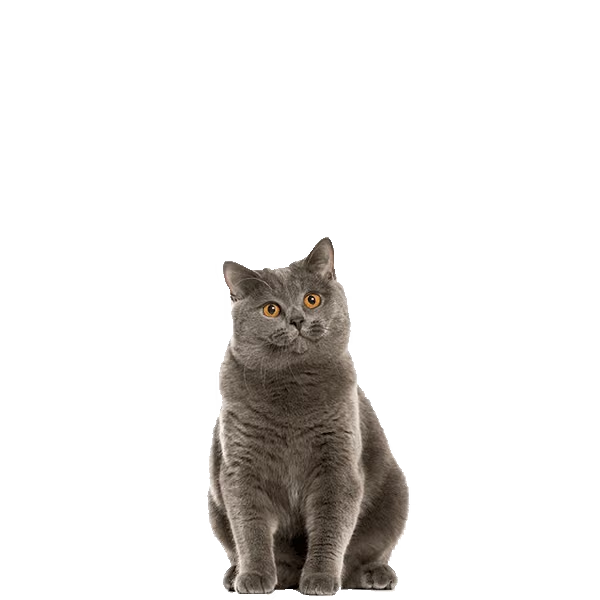
The Kinkalow is a playful, affectionate dwarf breed charming for its short legs and curled ears paired with a curious, kittenish spirit.
How the Kinkalow coat is built, and what that means when you groom it.
Caution: A Kinkalow coat mats easily.
Fine or long hair tangles at the base of the coat, out of sight, where the mats tighten and pull on the skin. Brushing has to reach right down to the roots in sections, not just skim the surface.
The Kinkalow is a dwarf cat from the United States with short legs and backward-curling ears. In New Zealand it falls outside NZCF recognition, MPI biosecurity governs all imports, and the NZ Veterinary Association has noted growing welfare discussion around chondrodystrophic breeds. Affectionate and compact, it lives 12 to 15 years.
The Kinkalow is a dwarf cat breed developed in the United States by crossing the Munchkin, which carries the gene for short legs, with the American Curl, which carries the gene for backward-curling ears. The result is a small cat with the low-slung body of the Munchkin and the distinctive curled ear tips of the Curl.
The New Zealand Cat Fancy (NZCF) follows conservative recognition standards and does not recognise the Kinkalow. TICA holds the breed at an experimental stage, which is the only international registration available, and that status closes off NZCF show entry entirely. New Zealand's Animal Welfare Act 1999 is considered one of the world's most comprehensive, and the NZ Veterinary Association has acknowledged growing discussion within the profession about breeds produced through deliberate mutation, including the chondrodystrophy that gives the Kinkalow its short legs and raises spinal health concerns. These discussions may influence how New Zealand approaches such breeds at a regulatory level in coming years.
No breeders operate in New Zealand, so every buyer must import. The breed is affectionate and people-oriented: Kinkalows are curious and playful into adulthood, and their compact size suits Wellington apartments, Auckland townhouses, and similar smaller New Zealand homes.
| Attribute | Detail |
|---|---|
| Origin | United States |
| Size | Small (about 3 to 7 lb) |
| Lifespan | 12 to 15 years |
| Group / role | Companion / dwarf breed |
| Good with | Families, children, other pets when socialised |
The Kinkalow works well in Wellington flats, Auckland terraced houses, and similar compact New Zealand homes where a sociable, low-maintenance companion is wanted. Because no breeders are established in New Zealand, every buyer will need to import, which means navigating MPI health certification, pre-export veterinary inspection, and potentially mandatory quarantine. Import from the United States adds cost and lead time that can run to several months. The breed dislikes long periods alone and is happiest in homes where someone is around for most of the day.
The Kinkalow is a recent American dwarf breed made by crossing the Munchkin with the American Curl, combining short legs with curled ears. It stays rare and is still being developed.
The Kinkalow originated in the United States during the 1990s. Breeder Terri Harris is credited with the early crosses that shaped the breed, pairing the Munchkin, a short-legged cat, with the American Curl, known for ears that curl backward. The goal was a small cat that carried both traits.
The Munchkin, which supplies the short-leg gene, was itself recognised as a breed only in the 1990s. The American Curl, which supplies the curled-ear gene, traces back to a single stray cat found in California in 1981. The Kinkalow draws directly on both of these foundation breeds.
The name joins "kink," for the curled ears, with "low," for the short stature. Major cat registries still regard the breed as experimental, and it is bred in small numbers. In New Zealand it falls outside the championship classes of the New Zealand Cat Fancy (NZCF), while international recognition rests with bodies such as TICA, which lists the Kinkalow at a preliminary stage. Breeding programmes carry on toward consistent type.
Because the population is small and both parent traits are dominant but variable in expression, litters can include kittens with long legs, straight ears, or both. Responsible breeders track these outcomes and keep outcrossing to maintain health and genetic diversity.
The Kinkalow is a small cat with short legs, a long body, and backward-curling ears. Coats vary in length and come in many colours and patterns.
The Kinkalow has the short legs of its Munchkin parent set on a body that looks long in proportion to its height. The head is rounded with a short muzzle, and the eyes are large and set wide apart. The defining feature is the ear, which curls back from the face. The degree of curl ranges from a slight bend to a firm backward arc.
| Trait | Description |
|---|---|
| Height | About 3 to 7 inches at the shoulder |
| Weight | About 3 to 7 lb |
| Coat | Short to medium length, soft and fine |
| Colours | Most colours and patterns, including solid, tabby, tortoiseshell, and bicolour |
| Eyes | Large, round, colour varies with coat |
The coat is soft and can be short or medium in length, depending on the parent cats. No single colour is standard for the breed, so Kinkalows turn up in a broad range of solid shades, tabby markings, tortoiseshell, and two-colour patterns. Short-haired cats need little coat care, while medium-haired cats benefit from more frequent brushing. Whatever the curl, the ears should feel firm at the base rather than floppy.
The Kinkalow is affectionate, playful, and curious, staying kitten-like into adulthood. It is sociable with family and usually friendly toward children and other pets.
The Kinkalow is an affectionate breed that forms close bonds with the people it lives with. It is playful and curious, and many cats keep a kittenish manner throughout their lives, chasing toys and investigating new objects well into adulthood.
Around family members the breed is sociable and seeks attention, often following people from room to room and settling on laps. With strangers it is usually confident rather than shy, though early socialisation helps. Kinkalows generally get on with children who handle them gently and with other cats and cat-friendly dogs when introductions are managed slowly.
The short legs do not slow the cat down much. Kinkalows climb and jump, using their back legs to reach favoured perches, and they stay active indoors. They do not tolerate long periods alone well and are happiest in homes where someone is around or where a second pet provides company.
| Trait | Rating |
|---|---|
| Affection | 5 |
| Energy | 4 |
| Trainability | 3 |
| Vocalness | 2 |
| Shedding | 2 |
The Kinkalow needs regular grooming, daily play, and a fully indoor home with accessible perches. New Zealand owners should schedule spinal checks with their vet and be aware of MPI requirements before importing.
The Kinkalow is an indoor cat. New Zealand's outdoor environment poses specific risks for a dwarf breed: native wildlife encounters, urban traffic, and the limited mobility that comes with short legs all make outdoor access inadvisable. New Zealand's Animal Welfare Act 1999 places a clear duty of care on owners to prevent unnecessary suffering, which supports keeping dwarf breeds entirely indoors. Ask your vet to check the spine and joints at each annual visit, particularly during the first two years, as early detection of lordosis allows for management before it becomes a quality-of-life issue.
The Kinkalow needs a complete, protein-rich cat food fed in measured portions to avoid weight gain on its small frame. Fresh water should always be available.
The Kinkalow does best on a complete, balanced cat food with animal protein as the main ingredient. Because the breed is small, portion control matters more than it does for a larger cat, since even a little extra weight adds strain to the spine and joints. Choose a food formulated for the cat's life stage and feed by weight rather than by free choice.
| Life stage | Amount per day | Meals |
|---|---|---|
| Kitten (to 12 months) | Per package guidance for body weight, fed to appetite | 3 to 4 |
| Adult (1 to 7 years) | About 1/4 to 1/2 cup dry, or equivalent wet | 2 |
| Senior (7+ years) | Adjusted to maintain a lean body condition | 2 |
Keep treats to no more than about 10 percent of daily kilojoules so the cat stays at a healthy weight. A cat on a complete commercial diet usually needs no supplements. Discuss any joint or other supplement with a veterinarian first, especially given the breed's short-legged build. Always keep fresh water available, and offer wet food to support hydration.
The Kinkalow generally lives 12 to 15 years but can inherit spinal and joint issues linked to its short legs. Routine veterinary care supports a healthy life.
The Kinkalow generally enjoys a lifespan of 12 to 15 years with good care. As a dwarf breed, it can be prone to skeletal problems tied to the short-leg gene, and the curled ears need monitoring. Buying from a breeder who screens parent cats reduces the risk of inherited conditions.
| Condition | Signs | Note |
|---|---|---|
| Lordosis (spinal curvature) | Dip in the spine, reduced mobility | Linked to the dwarfism gene; severity varies |
| Pectus excavatum (sunken chest) | Breathing difficulty, poor growth | Seen in some dwarf kittens |
| Joint and limb strain | Stiffness, reluctance to jump | Short legs add load to the joints |
| Ear infection | Head shaking, odour, discharge | Curled ears can trap debris |
The Kinkalow is curious and food-motivated, so it learns tricks, recall, and harness use through short, reward-based sessions.
The Kinkalow is intelligent and curious, which makes it responsive to training when sessions are short and rewarding. The breed enjoys mental challenges, and clicker training, puzzle feeders, and simple tricks all work well. Litter training is usually straightforward; provide a low-sided tray the short-legged cat can enter easily.
Kinkalow breeding takes care because both the short-leg and curled-ear genes are variable, and pairing two short-legged cats is avoided for health reasons.
Breeding the Kinkalow takes planning because both defining traits are inherited in ways that do not always express fully. The short-leg gene is dominant but can be lethal when a kitten inherits two copies, so two short-legged cats are not bred together. Breeders pair a short-legged cat with a standard-legged or American Curl cat to keep litters healthy.
Females reach sexual maturity at several months of age, but responsible breeders wait until a queen is physically mature before mating. Gestation lasts about 63 to 67 days. Litters are usually small, and a single litter can hold kittens with short or long legs and with curled or straight ears, since neither trait passes to every kitten.
Kittens are born with straight ears that begin to curl in the first weeks of life, then settle into their final shape over several months. Queens raise their kittens with normal maternal care. Breeders should screen for spinal and chest conditions and place only healthy kittens, ideally once the ear curl and limb development have become clear.
| Metric | Value |
|---|---|
| Sexual maturity | Around 5 to 9 months |
| Gestation | About 63 to 67 days |
| Average litter size | 2 to 4 kittens |
| Ears at birth | Straight, begin curling within weeks |
| Weaning age | Around 8 to 10 weeks |
Cats sit outside the National Dog Database, so a free United Pet Club record is what stands behind your Kinkalow's chip.
Keeping an indoor Kinkalow safe is partly latches and partly paperwork. The paperwork half is a free profile carrying your contact details and her photo, ready for the day a door swings wider than it should. Cat registration with United Pet Club never costs anything.
If she is chipped already, finish the job the implant started: a chip with no record reads as a dead end. Registering the microchip is free for life with United Pet Club, open to any brand, with updates that never cost a thing. Creating a free account sorts the profile at the same time.
It's a matter of creating a free United Pet Club account, adding her name, colouring, and a photo, and saving. The record is free for her whole life, indoors or out.
Adding the fifteen digit number to your free account with your current details is the whole job. The lifetime plan never charges for the record or its updates, whatever the chip brand.
There's no national requirement the way the dog database works, though some councils encourage it and shelters chip on rehoming. Requirement or not, a registered chip is what turns a found Kinkalow into a phone call.
Nothing at all. Profile, chip registration, and every later update are free under the lifetime plan.
Common questions from New Zealand buyers cover NZCF recognition, MPI import requirements, the NZ Veterinary Association's position on dwarf breeds, and what health checks to request from overseas breeders.
No. The NZCF does not recognise the Kinkalow. TICA holds the breed at an experimental stage, which is the only registration available, and that status means the cat cannot compete in NZCF-sanctioned shows.
Yes, but the process is lengthy and costly. New Zealand's MPI requires a specific health certificate from an accredited vet in the country of origin, a pre-export veterinary inspection, and may require quarantine on arrival. Allow several months and budget for significant import costs before committing to a purchase.
The NZ Veterinary Association has acknowledged growing professional discussion about breeds produced by deliberate mutation, including chondrodystrophic breeds like the Munchkin and the Kinkalow that inherits its short-legged build. New Zealand vets may recommend spinal X-rays before or after import to establish a health baseline.
No. NZCF-sanctioned shows do not include the Kinkalow. TICA-affiliated shows in New Zealand that offer experimental classes are the only show option available to Kinkalow owners.
With good care, a Kinkalow typically lives 12 to 15 years.
Yes. Its compact size and limited jumping range make it well suited to Wellington flats and Auckland apartments. Daily play and indoor enrichment are essential, since outdoor access is not recommended for this dwarf breed.
Ask for spine X-ray results for the parents or the kitten, confirmation that the breeder avoids pairing two short-legged cats, and a chest conformation check to rule out pectus excavatum. This documentation is also useful when registering with a New Zealand veterinarian after import.
