

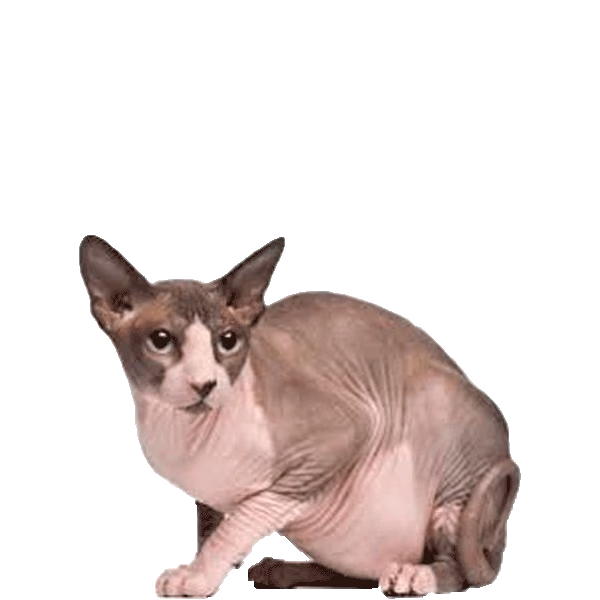
Dwelf
The Dwelf is a playful, affectionate breed combining hairless skin, short legs, and curled ears with an outgoing, curious personality.
- Size
- Small
- Lifespan
- 12–15 years
- Origin
- United States
- Temperament
- Playful
Characteristics
Coat and grooming
How the Dwelf coat is built, and what that means when you groom it.
- Coat layers
- Hairless
- Coat length
- Short
- Shedding
- Low shedding
Grooming guidance
Caution: A Dwelf needs protection from the sun.
Bare skin burns quickly and offers no insulation against cold either. Time outdoors needs shade, a coat in cool weather, or a sunscreen a vet has approved for animals.
About the Dwelf cat
The Dwelf is a small hairless cat with short legs and curled ears, known for being affectionate, playful and curious. It originated in the United States.
The Dwelf is a small hairless cat developed in the United States by combining three distinct cat breeds. The name blends "dwarf" and "elf," a nod to the cat's short stature and its outward-curling ears. Three traits come together in the breed: the hairless coat of the Sphynx, the short legs of the Munchkin and the curled ears of the American Curl.
Dwelfs are people-oriented cats. They will follow their owners from room to room, seek out laps and stay in the middle of whatever the household is doing. Because they are highly social and hold a steady energy, they make interactive companions that do not cope well with being left alone for long stretches.
The breed is recent and produced from several parent lines, so it remains uncommon. It is registered with some experimental or rare-breed bodies rather than the major mainstream associations, and only a handful are found in New Zealand.
| Attribute | Detail |
|---|---|
| Origin | United States |
| Size | Small |
| Lifespan | 12 to 15 years |
| Group / role | Companion cat (rare/experimental breed) |
| Good with | Families, children, other pets, attentive owners |
Who the Dwelf suits
Owners who want a highly interactive indoor cat and can give it daily attention will find the Dwelf a good match. Its hairless coat needs regular skin care, and the short legs mean the cat is best kept indoors. The breed settles well into homes where someone is around often, or where another companion animal already lives.
History and origin
The Dwelf was developed in the United States in the 2000s by crossing the Sphynx, Munchkin and American Curl to combine hairlessness, short legs and curled ears in one cat.
The Dwelf is a modern breed that emerged in the United States in the early 2000s. It was created on purpose by crossing three established breeds, each chosen for a single defining trait.
From the Sphynx came the hairless coat, the result of a natural mutation first documented in cats during the 1960s. From the Munchkin came the short legs, caused by a dominant gene that affects limb length. From the American Curl came the ears that curve backward away from the face, a trait first seen in California in 1981.
The breeders who combined these lines wanted to fix all three features in one small cat. Since both the short-leg gene and the hairless trait can carry health considerations, breeding has stayed cautious and small in scale.
The Dwelf is still treated as an experimental or rare breed. It carries no championship status in the largest international cat registries, and most kittens come from a small group of committed breeders.
Appearance and breed standard
The Dwelf is a small hairless cat with short legs, a compact muscular body, large ears that curl backward and wrinkled skin that may show fine downy fuzz.
The Dwelf has a striking and unusual look. Its body is small and muscular, set on noticeably short legs. The head is wedge-shaped with prominent cheekbones and large, wide-set eyes. The hairless skin and the large ears that curl backward at the tips are its most distinctive features.
The skin is wrinkled, especially around the head, shoulders and legs, and it feels warm to the touch. Some cats carry a fine, almost invisible down rather than being fully bare. Against the compact body, the tail looks long and tapering.
| Feature | Standard |
|---|---|
| Height | Approx. 15 to 18 cm at the shoulder |
| Weight | 1.8 to 3.2 kg |
| Coat | Hairless; may have fine down, skin feels suede-like |
| Colours | Skin pigment in any colour or pattern (black, white, grey, pink, tabby-patterned skin) |
| Eyes | Large, wide-set, round to lemon-shaped, colour varies |
Coat and colours
Since the Dwelf is hairless, what would be a coat colour shows through as skin pigment instead. The skin can be solid, spotted or patterned, and markings that would read as tabby or pointed on a coated cat appear as variation in skin tone. With no fur, the cat loses body heat quickly and feels warmer to handle than a coated breed.
Temperament and personality
The Dwelf is affectionate, playful, curious and highly sociable, bonding closely with its family and generally getting on with children and other pets.
The Dwelf is an outgoing and affectionate cat. It forms close bonds with its people and stays near them, often climbing into laps or perching on shoulders. Curious by nature, it will investigate new objects, rooms and visitors rather than hide away.
With family members the Dwelf is warm and keen for attention. It usually does well with children who handle it gently, and once introduced it is friendly toward strangers. Its sociable nature also helps it get on with other cats and with dogs.
Dwelfs keep a steady level of energy through adulthood and enjoy interactive play. Long periods alone can leave them bored or lonely, so a second pet or regular human company helps keep them settled.
| Trait | Rating |
|---|---|
| Affection | 5 |
| Energy | 4 |
| Trainability | 3 |
| Vocalness | 3 |
| Shedding | 1 |
Care and grooming
The Dwelf needs regular skin cleaning rather than brushing, warmth and indoor housing, plus daily interactive play to meet its social and energy needs.
Grooming
- Wipe or bathe the skin regularly (often weekly) to remove the oils that fur would normally absorb
- Clean the ear folds gently, as the curled shape can trap wax and debris
- Keep nails trimmed and check skin folds for redness or irritation
- Pat the skin fully dry after bathing to avoid chilling
Exercise
- Provide daily interactive play with wand toys, balls and puzzle feeders
- Offer low climbing structures and perches suited to short legs
- Rotate toys to keep the curious mind engaged
- Set aside regular play sessions, since the breed stays active into adulthood
Environment
The Dwelf is an indoor cat. Its hairless skin offers little protection from cold, heat or sun, and its short legs limit jumping and outdoor agility. Keep the home warm, provide soft bedding and warm resting spots, and limit direct sun exposure, which can burn unprotected skin.
Grooming a Dwelf
The Dwelf coat: Hairless, Short, Low shedding.
Grooming a Dwelf comes down to its coat, so start there.
- Coat layers: Hairless
- Coat length: Short
- Shedding: Low shedding
What this coat asks of you
- Hairless skin has nothing to shield it, so it needs gentle cleaning and protection from sun and cold.
- Short hair rarely tangles but it still sheds, so regular brushing keeps the loose hair down.
- Low shedding does not mean low upkeep. Hair that stays in the coat can still tangle unless it is brushed out.
What to tell a groomer
Mention these when you book. The coat notes on this page explain each one.
- Needs sun protection
A groomer who knows the breed can adapt all of this to the individual animal. Sore skin, mats pressed against the skin or a sudden change in the coat are worth showing to a vet.
What kind of coat does a Dwelf have?
On our records: Coat layers: Hairless; Coat length: Short; Shedding: Low shedding.
How much does a Dwelf shed?
Low shedding does not mean low upkeep. Hair that stays in the coat can still tangle unless it is brushed out.
What should a groomer know about a Dwelf?
These grooming rules apply: Needs sun protection.
Nutrition and feeding
The Dwelf needs a balanced, high-protein diet measured to its small size, with slightly higher energy intake to support the heat loss that comes with being hairless.
The Dwelf does best on a complete, high-protein diet formulated for cats. Because hairless cats lose body heat faster, they often run a slightly higher metabolism and may eat a little more for their size than a coated cat. Even so, portions should be measured against the cat's small frame to avoid weight gain. Fresh water should always be available.
| Life stage | Amount per day | Meals |
|---|---|---|
| Kitten (2 to 12 months) | Free-fed or 4 small portions | 3 to 4 |
| Adult (1 to 7 years) | Approx. 50 to 70 g (measured to weight) | 2 to 3 |
| Senior (7+ years) | Adjusted to activity and weight | 2 |
Treats and supplements
Keep treats to a small share of daily calories. A diet that is complete and balanced for the cat's life stage usually needs no extra supplements, but any addition (such as omega fatty acids for skin condition) should be discussed with a vet first.
Health and common conditions
The Dwelf typically lives 12 to 15 years and is generally healthy, though its parent breeds carry risks to the skin, skeleton and ear folds that owners should monitor.
The Dwelf generally lives 12 to 15 years. Built from three breeds with specific mutations, it can inherit health considerations from each parent line. The hairless trait affects skin and temperature regulation, the short-leg gene affects the skeleton, and the curled ears affect ear care. Responsible breeding and regular veterinary checks help keep these risks in hand.
| Condition | Signs | Note |
|---|---|---|
| Skin issues / sunburn | Redness, oily buildup, irritation, blackheads | Linked to hairless skin; limit sun and clean regularly |
| Skeletal / spinal strain | Reluctance to jump, altered gait, back discomfort | Associated with the short-leg gene |
| Ear infections | Head shaking, odour, discharge in ear folds | Curled ears can trap debris |
| Hypothermia / overheating | Shivering or seeking heat; lethargy in heat | Poor temperature regulation without fur |
| Heart conditions | Lethargy, breathing changes | Reported in related hairless lines; vet screening advised |
Preventive care
- Routine veterinary exams and vaccinations
- Regular skin cleaning and skin checks for irritation
- Ear cleaning to prevent buildup in the folds
- Weight monitoring to reduce strain on the spine and joints
- Keeping the cat warm and out of direct sun
Training
The Dwelf is intelligent and food-motivated, responding well to short, reward-based sessions for litter habits, handling and simple tricks or recall.
The Dwelf is intelligent, curious and keen to interact, which makes it more open to training than many cats. It can learn its name, come when called and perform simple tricks. Short, positive sessions work best, since cats lose interest quickly. Early handling pays off, because the breed needs regular bathing and skin care throughout its life.
Basics
- Get the kitten used to gentle handling and bathing from an early age
- Reward litter tray use and keep the tray clean and accessible
- Use a clicker or a marker word paired with a treat to teach simple commands
- Teach the cat to accept ear and nail care in small, calm steps
- Redirect scratching to appropriate posts and reward correct use
Breeding
Breeding the Dwelf takes care because it combines three genetic mutations; litters are small and responsible breeders screen for skeletal and skin health.
Breeding the Dwelf is complex because it brings together three separate mutations: hairlessness, short legs and curled ears. The short-leg gene is tied to skeletal risks, and mating two short-legged cats can produce nonviable offspring, so breeders pair carefully and often outcross to manage genetic health.
Queens reach sexual maturity in their first year, though responsible breeders wait until the cat is physically mature before mating. Litters tend to be small. Kittens are born hairless or with very fine down and need warmth from birth, since they cannot regulate their own body temperature well. A warm, clean, low-stress environment suits the mother and kittens, and the kittens stay with the queen until weaned and well socialised.
| Metric | Value |
|---|---|
| Sexual maturity | Around 6 to 12 months |
| Recommended breeding age | After physical maturity (12+ months) |
| Gestation | Approx. 63 to 67 days |
| Average litter size | 2 to 4 kittens |
| Weaning age | Around 8 to 12 weeks |
A registered Dwelf: sorted for life, chip included
Cats sit outside the National Dog Database, so a free United Pet Club record is what stands behind your Dwelf's chip.
Registering a Dwelf and its chip in New Zealand
Giving your Dwelf a record takes less time than choosing her food: name, colouring, photo, phone number, save. The profile holds for life, free, with a chip number slot waiting whenever the vet's done. Registering your cat starts it.
Pop the fifteen digit number from the vet paperwork into your free United Pet Club account, check your phone number is current, and your Dwelf's chip finally points somewhere. Every brand is accepted, every update free, and the record answers scans at any hour. Microchip registration is the link in the middle.
How do I register my Dwelf in New Zealand?
It's a matter of creating a free United Pet Club account, adding her name, colouring, and a photo, and saving. The record is free for her whole life, indoors or out.
How do I register my Dwelf's microchip?
Adding the fifteen digit number to your free account with your current details is the whole job. The lifetime plan never charges for the record or its updates, whatever the chip brand.
Do cats have to be microchipped in New Zealand?
There's no national requirement the way the dog database works, though some councils encourage it and shelters chip on rehoming. Requirement or not, a registered chip is what turns a found Dwelf into a phone call.
How much does it cost to register a Dwelf?
Nothing at all. Profile, chip registration, and every later update are free under the lifetime plan.
Frequently asked questions
Common questions about the Dwelf cat cover its size, temperament, care difficulty, lifespan, suitability and availability.
How big does a Dwelf cat get?
The Dwelf is a small cat, typically weighing about 1.8 to 3.2 kg, with short legs and a compact, muscular body.
What is the Dwelf's temperament like?
Dwelfs are affectionate, playful, curious and highly sociable. They bond closely with their families and usually get on with children and other pets.
Is the Dwelf hard to care for?
It needs more upkeep than an average cat. The hairless skin requires regular cleaning, the curled ears need attention, and the cat must be kept warm and indoors. It also needs daily company and play.
How long does a Dwelf cat live?
A Dwelf usually lives 12 to 15 years with good care, a balanced diet and regular veterinary checkups.
Is the Dwelf a good family pet?
Yes. Its sociable, affectionate nature suits families and homes with other pets, provided someone is around often and can meet its skin-care and warmth needs.
Are Dwelf cats rare?
Yes. The Dwelf is a recent experimental breed produced by a small number of breeders, so kittens are uncommon and not recognised by the major mainstream registries such as NZCF.
Do Dwelf cats shed?
No. Because the Dwelf is hairless, it does not shed fur. It still produces skin oils and dander, so it is not fully allergen-free.
From the community
Ask about the DwelfNo questions about the Dwelf yet. Be the first to ask.
Browse Cat breeds