

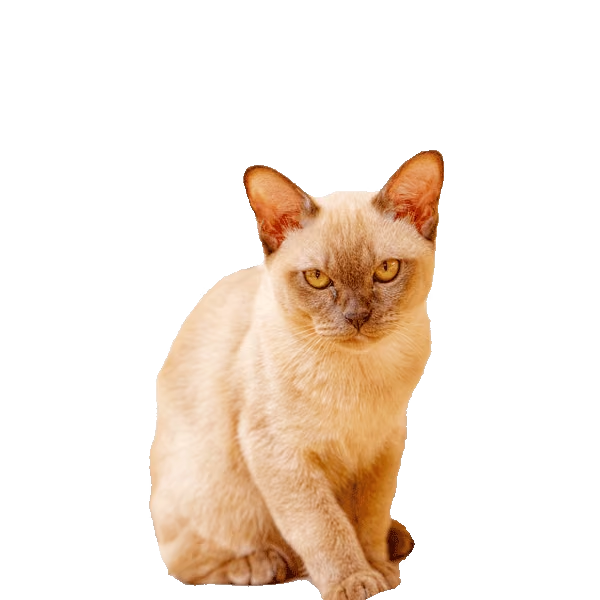
Burmese
The Burmese is an affectionate, people-oriented cat famous for its dog-like devotion and warm, playful personality.
- Size
- Medium
- Lifespan
- 16–18 years
- Origin
- United Kingdom
- Temperament
- Affectionate
- Standard colours
- Blue, Platinum and Sable and 5 more
Characteristics
Coat and grooming
How the Burmese coat is built, and what that means when you groom it.
- Coat layers
- Single coat
- Coat texture
- Smooth, Satin
- Coat length
- Short
- Shedding
- Low shedding
Burmese colours and patterns
What each club's breed standard says about every Burmese colour and pattern. Point at a ruling to see the club's own wording.
Breed standards describe the Burmese in Blue, Platinum, Sable, Cinnamon, Red, Cream, Fawn and Champagne. Standard patterns: Tortoiseshell and Sepia.
| Colour or pattern | TICA | CFA | FIFE | GCCF |
|---|---|---|---|---|
| Blue | Standard | Standard (“Blue”) | Standard (“Blue”) | Standard (“Blue”) |
| Platinum | Standard | Standard (“Platinum”) | Standard (“Lilac”) | Standard (“Lilac”) |
| Sable | Standard (“sable”) | Standard (“Sable”) | Standard (“Brown”) | Standard (“Brown”) |
| Cinnamon | Standard | No ruling | No ruling | No ruling |
| Red | Standard | No ruling | Standard (“Red”) | Standard (“Red”) |
| Cream | Standard | No ruling | Standard (“Cream”) | Standard (“Cream”) |
| Fawn | Standard | No ruling | No ruling | No ruling |
| Champagne | Standard | Standard (“Champagne”) | Standard (“Chocolate”) | Standard (“Chocolate”) |
| Patterns | ||||
| Tortoiseshell | Standard (“Tortoiseshell”) | No ruling | Standard (“tortie”) | Standard (“Tortie”) |
| Sepia | Standard (“Sepia”) | Standard | Standard (“Burmese”) | Standard (“Burmese Colour Restriction”) |
| Ticked | No ruling | No ruling | No ruling | Fault (“Ticking”) |
| Tabby | No ruling | No ruling | No ruling | Fault (“tabby markings”) |
| Smoke | No ruling | No ruling | No ruling | Fault (“smoke undercoat”) |


| Colour or pattern | TICA | CFA | FIFE | GCCF |
|---|---|---|---|---|
| Amber | No ruling | No ruling | Standard (“amber”) | Standard (“amber”) |
| Yellow | No ruling | Standard (“yellow”) | Standard (“all shades of yellow from chartreuse to amber”) | Standard (“yellow”) |
| Gold | Standard (“Gold”) | Standard (“gold”) | Standard (“golden yellow”) | Standard (“golden yellow”) |
| Blue | No ruling | Disqualifying (“Blue”) | Fault (“more blue than yellow pigmentation”) | Disqualifying (“blue”) |
| Orange | No ruling | No ruling | No ruling | Fault (“orange”) |
| Green | Disqualifying (“Green”) | Fault (“Green”) | No ruling | Fault (“Green”) |
| Copper | No ruling | No ruling | No ruling | Disqualifying (“copper”) |
| Colour or pattern | CFA | FIFE | GCCF |
|---|---|---|---|
| Blue | No ruling | Standard (“blue-grey”) | Standard (“blue”) |
| Lilac | Standard (“Lavender-pink”) | Standard (“lavender”) | Standard (“lavender pink”) |
| Slate | Standard (“Slate gray”) | No ruling | Standard (“dark-grey”) |
| Brown | Standard (“Brown / Light warm brown”) | Standard (“rich brown”) | Standard (“rich brown”) |
| Chocolate | No ruling | Standard (“chocolate-brown”) | Standard (“warm chocolate brown”) |
| Seal | No ruling | Standard (“seal brown”) | No ruling |
| Pink | No ruling | Standard (“pink”) | Standard (“pink”) |
| Colour or pattern | CFA | FIFE | GCCF |
|---|---|---|---|
| Blue | Standard (“slate gray to warm pinkish blue”) | Standard (“pinkish blue-grey”) | Standard (“blue”) |
| Lilac | Standard (“Lavender-pink”) | Standard (“lavender”) | Standard (“lavender pink”) |
| Brown | Standard (“Brown”) | No ruling | Standard (“brown”) |
| Chocolate | No ruling | Standard (“cinnamon to chocolate”) | Standard (“brick pink shading to chocolate”) |
| Seal | No ruling | Standard (“seal brown”) | No ruling |
| Cinnamon | No ruling | Standard (“cinnamon to chocolate”) | No ruling |
| Pink | No ruling | Standard (“pink”) | Standard (“pink”) |
What the rulings mean
- Standard
- Described by the club's breed standard.
- Fault
- Named by the club's breed standard as a fault: the animal can be shown but is penalised.
- Disqualifying
- The club's breed standard disqualifies an animal of this colour or pattern.
Colour changes
How a Burmese's colours can change over its life.
Tabbychanges toSolid
Coat · With age · from 0 to 39 weeks
Tabbychanges toShaded
Coat · With age · from 0 to 6 weeks
Tabbychanges toChinchilla
Coat · With age · from 0 to 6 weeks
Bluechanges toTortoiseshell
Coat · With age
Tabbychanges toSepia
Coat · With age
Bluechanges toGreen
Eyes · With age · from 4 to 17 weeks
Bluechanges toYellow
Eyes · With age · from 4 to 17 weeks
Bluechanges toGold
Eyes · With age · from 4 to 17 weeks
Bluechanges toCopper
Eyes · With age · from 4 to 17 weeks
Bluechanges toOrange
Eyes · With age · from 4 to 17 weeks
Bluechanges toHazel
Eyes · With age · from 4 to 17 weeks
Bluechanges toAmber
Eyes · With age · from 4 to 17 weeks
Pinkchanges toSeal
Nose · With age · from 1 to 52 weeks
Pinkchanges toBlue
Nose · With age · from 1 to 52 weeks
Pinkchanges toChocolate
Nose · With age · from 1 to 52 weeks
Pinkchanges toLilac
Nose · With age · from 1 to 52 weeks
Pinkchanges toSeal
Paw pads · With age · from 1 to 52 weeks
Pinkchanges toBlue
Paw pads · With age · from 1 to 52 weeks
Pinkchanges toChocolate
Paw pads · With age · from 1 to 52 weeks
Pinkchanges toLilac
Paw pads · With age · from 1 to 52 weeks


Sources
Each ruling comes from the club's published breed standard or colour list.
Burmese breed standard
What each club's standard asks of the Burmese: size, build and forms. A club speaks only for itself, and a figure no club published is left out.
Conformation
Head shape
Round
“Rounded, with no flat planes”
Facial profile
Nose break
“(BU) Visible break”
Muzzle length
Short
“Rounded, short, broad, well-developed”
Eye shape
Round
“Large, round, wide set”
Eye shape
AlmondFault
“almond-shaped eyes”
Eye shape
ObliqueFault
“oriental slant to the eyes”
Eye set
Wide-set
“Large, round, wide set”
Eye set
ProminentDisqualifying
“extremely protruding eyes”
Eye size
Large
“Large, round, wide set”
Ear size
Medium
“Medium in size. Wide set, but not flared”
Ear tip
Rounded
“Broad at the base with rounded tips”
Ear tip
PointedFault
“pointed ears”
Ear tip
Tufted (lynx tips)Fault
“tufts”
Neck length
Short
“Short, thick and well-developed”
Bone and substance
Fine (light)Fault
“fine boning”
Feet
Cat foot
“Rounded, compact and proportionate to the body”
Tail length
Medium
“Medium in length and in balance with the body”
Tail length
LongFault
“long, whippy tail”
Tail shape
Tapering
“Tapering to rounded tip”
Tail shape
WhipFault
“(BU): Ranginess, fine boning; long, whippy tail”


Markings


Parts of the body


Burmese varieties
The varieties on record for the Burmese.
- Blue
- Champagne
- Platinum
- Sable
Health
Conditions recorded as more common in the Burmese than in its species as a whole. A higher risk is not a diagnosis: many never develop any of them, and your vet can say which screening tests are worth doing.
High risk
- Endocrine system
Diabetes mellitus
Strong evidence
This content is for educational purposes and is not a substitute for professional veterinary advice. If you are worried about your pet, contact your veterinarian.
All health conditionsAbout the Burmese
A medium, people-focused cat, the Burmese is loved for its dog-like loyalty, a compact muscular build, and a warm, playful nature.
The Burmese is a medium shorthair that forms a strong attachment to the people it lives with. It weighs more than its size suggests, the body compact and muscular, which is how it came to be called "a brick wrapped in silk." The coat is short and glossy and lies flat to the skin.
Vocal but never shrill, this cat follows its household about the house and stays close to the action. Many Burmese come to the door for visitors, settle on a shoulder, and involve themselves in whatever is going on. Their loyalty gets compared to a dog's more often than not.
A lifespan of 16 to 18 years is usual, and most stay active into their senior years. The breed suits people who want a companion to interact with rather than a pet that keeps to itself.
| Attribute | Detail |
|---|---|
| Origin | United Kingdom (developed from a foundation cat brought from Burma) |
| Size | Medium |
| Lifespan | 16 to 18 years |
| Group/role | Companion shorthair |
| Good with | Families, children, other cats, cat-friendly dogs |
Who it suits
A Burmese does best in a home where someone is around for most of the day, or where a second pet provides company. Anyone wanting a hands-off cat should look elsewhere, as this breed dislikes long periods on its own and asks for constant interaction. Its sociable nature is a good fit for busy family homes, and for first-time owners who want a cat that stays involved.
History and origin of the Burmese
The modern Burmese descends from a single brown female, Wong Mau, brought to the United States in 1930; British breeders later built a separate line.
This breed goes back to one brown female cat, Wong Mau, brought from South-East Asia to the United States in 1930. Dr Joseph Thompson of San Francisco founded a breeding programme with her and crossed her to Siamese, since there was no comparable mate at the time.
Selective breeding across the following years separated the darker, solid-coated kittens from the Siamese-pointed ones. The Cat Fanciers' Association first recognised the Burmese in 1936, suspended that recognition in 1947 over concerns about ongoing Siamese crossing, and restored it in 1953 after the lines had stabilised.
British breeders brought in their own Burmese and built a separate line, longer in the body and shaped by different standards. That gives us the two types known today: the rounder American (or contemporary) Burmese and the more moderate British (or traditional) Burmese. The cat set out here is the United Kingdom line, and it is this type that the New Zealand Cat Fancy recognises.
From that first brown, breeders broadened the accepted colours over later decades, adding the dilute shades while keeping the dense, satin-like coat that sets the breed apart.
Burmese breed standard and appearance
A compact, muscular medium cat, the Burmese has a short satin coat and large rounded eyes in shades of gold, and it lifts heavier than expected.
The Burmese has a substantial, well-muscled body set on sturdy legs. Compared with the rounder American type, the British type is a shade longer and more moderate, but neither is anything but solid, and both lift heavier than expected. Its head is rounded, the muzzle short, and the large eyes, set well apart, carry a good deal of expression.
The coat is what people notice first: short, fine, and lying very close, with a satin sheen that shows the muscle underneath.
| Trait | Standard |
|---|---|
| Height | 25 to 30 cm at the shoulder |
| Weight | 3.5 to 5.5 kg (males heavier than females) |
| Coat | Short, fine, glossy, close-lying |
| Colours | Brown (sable), blue, chocolate, lilac, red, cream, and tortie variations |
| Eyes | Large, rounded, gold to yellow |
Coat and colours
Brown, or sable, is the original and most familiar colour: a deep, warm shade that runs a little lighter on the underparts. Later breeding brought in the dilute shades and the red series. A wider palette sits within the British standard than the American one, covering chocolate, lilac, red, cream, and the tortoiseshell patterns. Whatever the colour, there is little undercoat, so the coat lies flat and reflects the light.
What the Burmese standard says, club by club
What the breed standards say about the build of the Burmese. Clubs compared: ACFA, CCA, CFA, FIFE, GCCF, LOOF, TICA, WCF.
Each club words the Burmese standard its own way, so the figures below are listed per club: ACFA, CCA, CFA, FIFE, GCCF, LOOF, TICA, WCF.
Build and forms
At least one club accepts each of these:
- Head shape: Round, Wedge, Triangular
- Facial profile: Nose break
- Muzzle length: Short
- Muzzle shape: Blunt
- Eye shape: Round, Oblique
- Eye set: Wide-set
- Eye size: Large
- Ear size: Medium, Large
- Ear tip: Rounded
- Neck length: Short, Medium
Forms the clubs penalise
A fault or a disqualification is a judgment under a show standard. It can affect placings and, at some clubs, registration.
- Disqualifying: Head shape: Round (GCCF); Facial profile: Straight (GCCF); Bite: Undershot (CFA); Bite: Overshot (CFA); Bite: Wry mouth (CFA); Bite: Malocclusion (CFA); Eye shape: Round (GCCF); Eye shape: Almond (GCCF); Eye set: Close-set (GCCF); Eye set: Prominent (GCCF, TICA)
- Fault: Head shape: Wedge (CFA); Facial profile: Roman (convex) (LOOF); Facial profile: Dished (concave) (GCCF); Stop: Pronounced (CCA); Muzzle shape: Snipy (GCCF); Eye shape: Round (LOOF); Eye shape: Almond (TICA); Eye shape: Oblique (TICA); Eye set: Close-set (LOOF); Eye set: Prominent (LOOF)
Markings
Each club's ruling on the breed's named marks:
- Locket: Fault (TICA); Disqualifying (CFA, LOOF)
- Spots: Disqualifying (CFA)
- White markings: Disqualifying (LOOF)
- Blaze: Alternate (GCCF)
- Flecking: Fault (FIFE); Disqualifying (GCCF)
- Patch: Fault (WCF)
See every point side by side: compare the clubs.
Rulings come from each club's published breed standard, and clubs revise their standards. Before a show or a registration, check the current text with the club.
Which forms do clubs penalise in the Burmese?
Disqualifying: Head shape: Round (GCCF); Facial profile: Straight (GCCF); Bite: Undershot (CFA); Bite: Overshot (CFA); Bite: Wry mouth (CFA); Bite: Malocclusion (CFA); Eye shape: Round (GCCF); Eye shape: Almond (GCCF); Eye set: Close-set (GCCF); Eye set: Prominent (GCCF, TICA). Fault: Head shape: Wedge (CFA); Facial profile: Roman (convex) (LOOF); Facial profile: Dished (concave) (GCCF); Stop: Pronounced (CCA); Muzzle shape: Snipy (GCCF); Eye shape: Round (LOOF); Eye shape: Almond (TICA); Eye shape: Oblique (TICA); Eye set: Close-set (LOOF); Eye set: Prominent (LOOF).
Which Burmese colours the clubs accept
Every club we track accepts Blue, Platinum, Sable, Champagne for the Burmese.
Clubs compared for the Burmese: CFA, FIFE, GCCF, TICA. All of them accept Blue, Platinum, Sable, Champagne.
Patterns listed as standard for the Burmese: Tortoiseshell, Sepia.
Colours penalised in the show ring
A fault or a disqualification is a judgment under a show standard. It can affect placings and, at some clubs, registration.
- Fault: Ticked (GCCF), Tabby (GCCF), Smoke (GCCF)
Beyond the main colour
Standards rule on more than the main colour. These are listed as standard:
- Eyes: Amber, Yellow, Gold
- Nose: Blue, Lilac, Slate, Brown, Chocolate, Seal
- Paw pads: Blue, Lilac, Brown, Chocolate, Seal, Cinnamon
Rulings come from each club's published breed standard, and clubs revise their standards. Before a show or a registration, check the current text with the club.
Which Burmese colours do all the clubs accept?
All of these clubs accept Blue, Platinum, Sable, Champagne: CFA, FIFE, GCCF, TICA.
Which Burmese colours are faults or disqualifications?
Fault: Ticked (GCCF), Tabby (GCCF), Smoke (GCCF).
Burmese personality and temperament
Affectionate, playful, and firmly bonded to its people, the Burmese is often called dog-like and does not do well left alone for long.
The Burmese ranks among the most people-focused of all cat breeds. Laps, shoulders, any warm spot near its owner, it seeks them all out, and it stays interested in whatever the family is up to. It is patient and playful with children and will often tolerate handling that other cats would not. Other cats and cat-friendly dogs are generally welcome, and it fares better with feline company than on its own.
New people bring out curiosity rather than shyness, and many a Burmese greets guests head on. The breed carries its kitten-like playfulness into adult life and enjoys fetch, puzzle toys, and interactive games.
The one thing to watch is how much it dislikes being alone. Left for long hours day after day, a Burmese can turn bored or stressed, so a companion animal or regular human company counts. Its voice is soft and conversational, lighter than a Siamese, and it uses it to stay in touch rather than to demand.
| Trait | Rating |
|---|---|
| Affection | 5 |
| Energy | 4 |
| Trainability | 4 |
| Vocalness | 3 |
| Shedding | 2 |
Caring for and grooming a Burmese
With its short coat the Burmese is low-maintenance to groom, but it needs daily play and interaction, and ideally a companion, to stay settled.
Grooming
- Use a soft brush or rubber mitt once a week to take out loose hair and move the skin's natural oils through the coat.
- A wipe with a damp cloth or chamois adds shine; bathing is rarely called for.
- Trim the claws every two to three weeks.
- Look over the ears and clean them as needed, and brush the teeth regularly to keep dental disease at bay.
Exercise
- Fit in two or more interactive play sessions each day with wand toys, or throw a toy for the cat to fetch.
- Offer puzzle feeders and swap the toys around to keep the mind working.
- Set up climbing trees and shelves; this is an active breed that likes to get up high.
Environment
An indoor life suits the Burmese, and it prefers a warm, settled home. With its thin coat and light undercoat it feels the cold more than many breeds, so warm places to sleep really do matter. Company forms part of its care: a second cat, or a household where people are home a lot, gives it the best surroundings. Provide scratching posts, resting perches by the windows, and a quiet spot to sleep.
Grooming a Burmese
The Burmese coat: Single coat, Smooth, Satin, Short, Low shedding.
Grooming a Burmese comes down to its coat, so start there.
- Coat layers: Single coat
- Coat texture: Smooth, Satin
- Coat length: Short
- Shedding: Low shedding
What this coat asks of you
- A single coat has no dense undercoat, so there is less to brush out and less insulation against the cold.
- A smooth coat lies flat and is the easiest kind to keep. A soft brush or a grooming mitt lifts dust and loose hair.
- A satin coat gets its sheen from fine, glossy hair and needs only light brushing.
- Short hair rarely tangles but it still sheds, so regular brushing keeps the loose hair down.
- Low shedding does not mean low upkeep. Hair that stays in the coat can still tangle unless it is brushed out.
A groomer who knows the breed can adapt all of this to the individual animal. Sore skin, mats pressed against the skin or a sudden change in the coat are worth showing to a vet.
What kind of coat does a Burmese have?
On our records: Coat layers: Single coat; Coat texture: Smooth, Satin; Coat length: Short; Shedding: Low shedding.
How much does a Burmese shed?
Low shedding does not mean low upkeep. Hair that stays in the coat can still tangle unless it is brushed out.
Feeding and nutrition for the Burmese
The Burmese thrives on a complete high-protein diet fed in measured meals, with portions watched closely because the breed puts on weight easily.
Choose a complete, balanced cat food with animal protein leading the ingredient list. As a muscular, active cat the Burmese benefits from quality protein, yet its healthy appetite means it will gain weight if food is left out all day. Measured meals work better than free feeding. Fresh water should always be within reach, and a mix of wet and dry food helps with both hydration and dental health.
| Life stage | Amount per day | Meals |
|---|---|---|
| Kitten (2 to 12 months) | Follow the packet amount for growth; feed to appetite | 3 to 4 |
| Adult (1 to 7 years) | About 50 to 70 g dry or the wet equivalent, adjusted to weight | 2 |
| Senior (8 years and older) | Adjusted to keep lean weight and activity | 2 |
Treats and supplements
Hold treats to no more than ten percent of daily calories, and trim the meal portions to match so the cat doesn't put on weight. On a complete commercial diet a cat generally needs nothing extra; add vitamins or joint support only when a vet recommends it.
Burmese health and lifespan
Usually healthy and long-lived at 16 to 18 years, the Burmese does carry a few inherited conditions that responsible breeders screen for.
A robust, long-lived breed, the Burmese commonly reaches 16 to 18 years with good care. Overall it is a sound cat, though a small number of inherited conditions show up in the breed lines, and responsible breeders screen for them. Routine veterinary care, weight control, and attention to the teeth all support a long life.
| Condition | Signs | Note |
|---|---|---|
| Diabetes mellitus | Increased thirst, urination, weight loss | More common in the Burmese; weight control lowers the risk |
| Hypokalaemic polymyopathy | Muscle weakness, neck flexion, unsteady gait | Inherited; a genetic test is available in some lines |
| Flat-chested kitten syndrome | Flattened ribcage in young kittens | Affects newborns; many mild cases improve with growth |
| Dental disease | Bad breath, drooling, reduced appetite | Regular brushing and cleaning help prevent it |
Preventive care
- Yearly veterinary checkups, stepping up to twice a year for seniors.
- Keep vaccinations and parasite control current.
- Hold a lean body weight to bring down diabetes risk.
- Brush the teeth and arrange dental cleanings as advised.
- Ask the breeder about genetic screening for hypokalaemia.
Training the Burmese cat
Bright and keen to interact, the Burmese is one of the more trainable cats, taking well to tricks, fetch, and walking on a harness.
The Burmese learns fast and enjoys the attention that training brings. Because it is so focused on its people, it takes well to short, reward-based sessions, and plenty of them pick up fetch, sit, and even harness walking. Keep each session short and finish on a success, since a bored cat loses interest in no time. Litter training is usually easy; give the kitten a clean tray in a quiet spot and it settles in early.
Basics
- Begin with the litter tray: keep it away from food and noise, and keep it clean.
- Introduce a clicker or a marker word alongside a treat so the cat links the sound with a reward.
- Work on one simple behaviour at a time, such as coming when called.
- Reward straight away and keep each session to a few minutes.
- Move on to fetch or harness work once the basics are solid.
Breeding the Burmese
Burmese queens mature early and produce moderate litters, and responsible breeding means health screening for the breed's inherited conditions.
The Burmese reaches sexual maturity comparatively early, and a queen may come into season from around five to six months, although responsible breeders wait for full maturity before mating. Gestation runs about 63 to 67 days, with litters averaging four to five kittens. Burmese mothers usually take good care of their young.
Kittens are best kept with the mother until at least twelve to fourteen weeks, by which time they are fully weaned, litter trained, and socialised. Since the breed carries inherited conditions, ethical breeding programmes screen breeding stock for hypokalaemia where testing exists and keep an eye on litters for flat-chested kitten syndrome. Handling the kittens early on supports the friendly, people-oriented temperament the breed is valued for.
| Metric | Value |
|---|---|
| Sexual maturity | 5 to 7 months (mating delayed to full maturity) |
| Gestation | 63 to 67 days |
| Average litter size | 4 to 5 kittens |
| Weaning age | About 8 weeks |
| Recommended rehoming age | 12 to 14 weeks |
A registered Burmese: sorted for life, chip included
Cats sit outside the National Dog Database, so a free United Pet Club record is what stands behind your Burmese's chip.
Registering a Burmese and its chip in New Zealand
With no national database covering cats, the record behind your Burmese's chip is entirely yours to provide. A free United Pet Club profile does it: your number, her photo, her details, one scan away. Registering your cat is free for life and done in minutes.
Pop the fifteen digit number from the vet paperwork into your free United Pet Club account, check your phone number is current, and your Burmese's chip finally points somewhere. Every brand is accepted, every update free, and the record answers scans at any hour. Microchip registration is the link in the middle.
How do I register my Burmese in New Zealand?
It's a matter of creating a free United Pet Club account, adding her name, colouring, and a photo, and saving. The record is free for her whole life, indoors or out.
How do I register my Burmese's microchip?
Adding the fifteen digit number to your free account with your current details is the whole job. The lifetime plan never charges for the record or its updates, whatever the chip brand.
Do cats have to be microchipped in New Zealand?
There's no national requirement the way the dog database works, though some councils encourage it and shelters chip on rehoming. Requirement or not, a registered chip is what turns a found Burmese into a phone call.
How much does it cost to register a Burmese?
Nothing at all. Profile, chip registration, and every later update are free under the lifetime plan.
Frequently asked questions about the Burmese
Common questions on Burmese size, temperament, care, lifespan, suitability, types, and health.
How big does a Burmese cat get?
The Burmese is a medium-sized cat, generally 25 to 30 cm at the shoulder and 3.5 to 5.5 kg in weight, with males heavier than females. Being compact and muscular, it feels heavier than it looks.
What is the Burmese cat like to live with?
It is affectionate, playful, and firmly attached to its people, and often described as dog-like. It looks for constant company and stays part of family life, but it doesn't cope well with being left alone for long.
Is a Burmese cat easy to care for?
Grooming is simple with the short coat, needing only a weekly brush. The bigger commitment is social: the breed wants daily interaction and ideally a companion, so its care comes down to attention more than maintenance.
How long do Burmese cats live?
Given good care, Burmese cats commonly live 16 to 18 years, placing them among the longer-lived cat breeds.
Is the Burmese good for families and first-time owners?
Yes. It is patient with children, sociable with other pets, and engaging enough for first-time owners who want an interactive companion. It is less suited to a home left empty for long hours.
Are there different types of Burmese?
Yes. There is a rounder American (contemporary) type and a more moderate British (traditional) type developed in the United Kingdom. The two came from separate breed standards and differ mainly in body and head shape.
Does the Burmese have any health concerns?
The breed is generally healthy but can carry inherited conditions such as hypokalaemic polymyopathy, a tendency toward diabetes, and flat-chested kitten syndrome. Buying from a breeder who screens their breeding cats lowers the risk.
From the community
Ask about the BurmeseNo questions about the Burmese yet. Be the first to ask.
Browse Cat breeds