
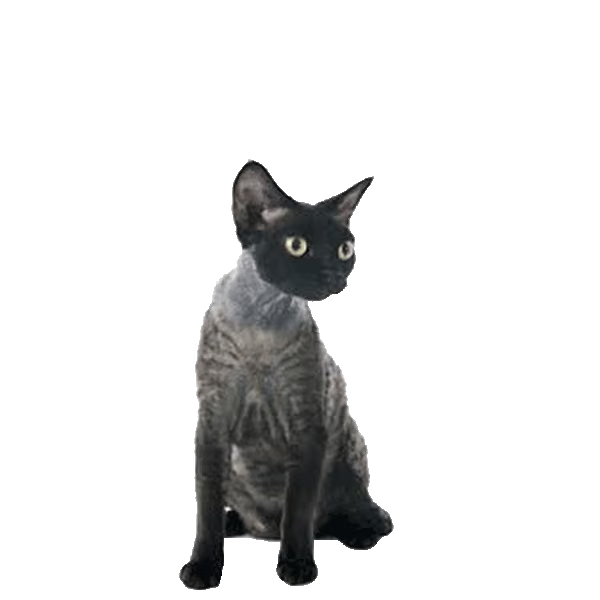
German Rex
The German Rex is a friendly, playful breed admired for its soft curly coat and warm, good-natured temperament.
- Size
- Medium
- Lifespan
- 9–14 years
- Origin
- Germany
- Temperament
- Friendly
- Standard colors
- Black, White and Blue and 13 more
Characteristics
Coat and grooming
How the German Rex coat is built, and what that means when you groom it.
- Coat layers
- Single coat
- Coat texture
- Curly
- Coat length
- Short
- Shedding
- Low shedding
German Rex colors and patterns
What each club's breed standard says about every German Rex color and pattern. Point at a ruling to see the club's own wording.
Breed standards describe the German Rex in Black, White, Blue, Lilac, Silver, Platinum, Brown, Chocolate, Seal, Sable, Cinnamon, Red, Gold, Cream, Fawn and Champagne. Standard patterns: Solid, Bicolour, Harlequin, Pointed, Tabby, Mackerel tabby, Classic tabby, Spotted tabby, Ticked tabby, Tortoiseshell, Calico, Torbie, Mink, Sepia, Van, Smoke, Shaded, Chinchilla and Caliby.
| Color or pattern | FIFE | WCF |
|---|---|---|
| Black | Standard (“black”) | Standard |
| White | Standard (“white”) | Standard |
| Blue | Standard (“blue”) | Standard |
| Lilac | Standard (“lilac”) | Not recognised (“lilac”) |
| Silver | Standard (“silver”) | No ruling |
| Platinum | Standard (“lilac”) | No ruling |
| Brown | Standard (“black tabby”) | No ruling |
| Chocolate | Standard (“chocolate”) | Not recognised (“chocolate”) |
| Seal | Standard (“seal”) | No ruling |
| Sable | Standard (“brown”) | No ruling |
| Cinnamon | Standard (“cinnamon”) | Not recognised (“cinnamon”) |
| Red | Standard (“red”) | Standard |
| Gold | Standard (“golden”) | No ruling |
| Cream | Standard (“cream”) | Standard |
| Fawn | Standard (“fawn”) | Not recognised (“fawn”) |
| Champagne | Standard (“chocolate”) | No ruling |
| Patterns | ||
| Solid | Standard (“solid”) | No ruling |
| Bicolour | Standard (“bicolour”) | No ruling |
| Harlequin | Standard (“harlequin”) | No ruling |
| Pointed | Standard (“Siamese pointed”) | Not recognised (“pointed pattern”) |
| Tabby | Standard (“tabby”) | No ruling |
| Mackerel tabby | Standard (“mackerel”) | No ruling |
| Classic tabby | Standard (“blotched”) | No ruling |
| Spotted tabby | Standard (“spotted”) | No ruling |
| Ticked tabby | Standard (“ticked”) | No ruling |
| Tortoiseshell | Standard (“tortie”) | No ruling |
| Calico | Standard (“tortie with white”) | No ruling |
| Torbie | Standard (“tortie tabby”) | No ruling |
| Mink | Standard (“Tonkinese pointed”) | No ruling |
| Sepia | Standard (“Burmese pointed”) | No ruling |
| Van | Standard (“van”) | No ruling |
| Smoke | Standard (“smoke”) | No ruling |
| Shaded | Standard (“shaded”) | No ruling |
| Chinchilla | Standard (“shell”) | No ruling |
| Caliby | Standard (“tortie with white”) | No ruling |


What the rulings mean
- Standard
- Described by the club's breed standard.
- Not recognised
- The club does not accept this colour or pattern for the breed.
Color changes
How a German Rex's colors can change over its life.
Brownchanges toCopal
Coat · With age · from 0 to 52 weeks
Blackchanges toRusset
Coat · Progressive
Tabbychanges toSolid
Coat · With age · from 0 to 39 weeks
Whitechanges toShaded
Coat · With age
Whitechanges toChinchilla
Coat · With age
Tabbychanges toShaded
Coat · With age · from 0 to 6 weeks
Tabbychanges toChinchilla
Coat · With age · from 0 to 6 weeks
Bluechanges toTortoiseshell
Coat · With age
Blackchanges toBrown
Coat · With body condition · can change back
Blackchanges toBrown
Coat · In the sun · can change back
Blackchanges toBrown
Coat · Progressive
Whitechanges toPointed
Coat · With age · from 1 to 52 weeks
Solidchanges toSmoke
Coat · With age · from 3 to 104 weeks
Bluechanges toGreen
Eyes · With age · from 4 to 17 weeks
Bluechanges toYellow
Eyes · With age · from 4 to 17 weeks
Bluechanges toGold
Eyes · With age · from 4 to 17 weeks
Bluechanges toCopper
Eyes · With age · from 4 to 17 weeks
Bluechanges toOrange
Eyes · With age · from 4 to 17 weeks
Bluechanges toHazel
Eyes · With age · from 4 to 17 weeks
Bluechanges toAmber
Eyes · With age · from 4 to 17 weeks
Sources
Each ruling comes from the club's published breed standard or color list.
About the German Rex
The German Rex is a medium-sized German cat with a soft, wavy coat and an affectionate, easy-going nature that suits families and quieter homes.
The German Rex is a medium-sized domestic cat, easily told apart by its short, curly coat and gentle nature. Its soft, wavy fur comes from a recessive gene, and the same trait shows in the whiskers, which are often curled or crimped. The body is rounded and moderately muscular, falling between the slimmer foreign breeds and the heavier cobby types.
Where temperament is concerned, the German Rex is friendly, playful, and good-natured. Cats of this breed usually stay active well into adulthood and grow closely attached to the people they live with. Rather than aloof, most are sociable, and a good number like to stay near their owners throughout the day.
Grooming is straightforward, as the short coat drops little loose hair. The breed takes readily to indoor life and needs no great amount of room, so it suits a flat or townhouse just as well as a house with a section.
| Attribute | Detail |
|---|---|
| Origin | Germany |
| Size | Medium |
| Lifespan | 9 to 14 years |
| Group/role | Companion cat, short curly-coated rex breed |
| Good with | Families, children, other cats, and calm dogs |
Who it suits
The German Rex suits owners after an affectionate, interactive cat without the heavy grooming. It does best in homes where someone is about for part of the day, since the breed enjoys company and play. Its calm, even temper also makes it a fair match for households with children or other pets, as long as introductions are handled gradually.
History and origin
The German Rex traces to a curly-coated cat found in Berlin in the early 1950s, one of the earliest recognised rex cat breeds in Europe.
The German Rex comes from Germany, with its documented foundation in Berlin during the early 1950s. A female cat with an unusual soft, wavy coat was found near the grounds of a hospital in the city. She became the foundation animal for the breed and passed her curly coat down to later generations.
The curl is the work of a recessive gene. Once the foundation cat was bred, kittens with the same wavy fur appeared, which confirmed the trait could be carried forward through planned matings. Breeders then worked to fix the coat type while holding to a sound, balanced body.
The German Rex grew up alongside other rex cats that appeared in Europe around the same time. It is often compared with the Cornish Rex, which came from a separate mutation in England. Studies of the two breeds found their curly coats are linked to compatible genetics, and the two have at times been crossed within breeding programmes.
The breed is still less numerous than many mainstream cats and is kept by a comparatively small group of dedicated breeders. In New Zealand it is rarely seen, and interested owners typically deal with registries such as the New Zealand Cat Fancy (NZCF) or TICA. Its longest presence, and its firmest standards, rest with the cat registries of Europe.
Appearance and breed standard
The German Rex is a medium, rounded cat with a short, soft, wavy coat, curled whiskers, large ears, and round eyes across a range of colours.
The German Rex has a medium build that is rounded and moderately muscular, neither slender nor heavy. The head is rounded with well-developed cheeks, medium to large ears set fairly wide, and large, round eyes. The legs are of medium length and the tail is moderately long and rounded at the tip.
The coat is the defining feature. It is short, soft, and silky with a clear wave, and it lies close to the body. The whiskers are curled or bent rather than straight, a hallmark of the breed.
| Feature | Standard |
|---|---|
| Height | Approximately 20 to 25 cm at the shoulder |
| Weight | 2.5 to 4.5 kg |
| Coat | Short, soft, silky, and wavy with curled whiskers |
| Colours | All colours and patterns, including solid, tabby, tortoiseshell, and bicolour |
| Eyes | Large and round, colour in keeping with the coat |
Coat and colours
The coat is what people notice first. It is fine and plush to the touch, with a gentle curl across the body that can be stronger on the back and flanks. With little guard hair, the fur feels velvety. The German Rex is accepted in a wide range of colours and patterns, so coat colour does not define the breed. The curled or crimped whiskers and eyebrows are there whatever the colour.
Temperament and personality
The German Rex is friendly, playful, and affectionate, staying active and sociable with family members, visitors, and other household pets.
The German Rex is known for a warm, good-natured personality. Cats of this breed are friendly and affectionate, and they tend to seek out the company of their owners rather than keep to themselves. Many will settle close to people and keep an eye on whatever is going on in the house.
Around family members the German Rex is gentle and attentive. It is usually patient with children when handling is calm and supervised. The breed tends to be social with visitors and is not often nervous around new people, though individual cats differ.
The German Rex generally gets on with other cats and with dogs that are calm and used to cats. Early, gradual introductions help. The breed stays playful well into adulthood and does well with interactive toys and regular attention. It is not an especially loud cat and tends to talk at a moderate level.
| Trait | Rating |
|---|---|
| Affection | 5 |
| Energy | 4 |
| Trainability | 3 |
| Vocalness | 2 |
| Shedding | 2 |
Care and grooming
The German Rex needs minimal grooming thanks to its short coat, daily play to use its energy, and a warm indoor environment.
Grooming
The short, fine coat of the German Rex is low-maintenance, though the delicate fur asks for a gentle hand.
- Stroke or lightly brush the coat once a week with a soft brush or your hand to lift loose hair.
- Steer clear of hard or wire brushes, which can damage the fine fur.
- Check the ears weekly and clean them when needed.
- Trim the claws every few weeks and brush the teeth regularly to support dental health.
Exercise
The German Rex is active and playful, so daily activity keeps it happy.
- Run interactive play with wand toys or balls each day.
- Offer climbing furniture such as a cat tree to work off energy.
- Rotate toys to keep play fresh.
- Set aside time for direct interaction, since the breed is people-oriented.
Environment
The German Rex takes readily to indoor living and to flats. The thin coat means the breed can feel the cold, so warm, draught-free resting spots matter. Provide a quiet sleeping area, a scratching post, and access to windows for watching what goes on outside.
Nutrition and feeding
The German Rex does well on a complete, balanced cat food fed in measured daily amounts suited to its life stage and activity level.
The German Rex needs a complete and balanced diet built around animal protein, since cats are obligate carnivores. A good-quality commercial cat food formulated for the cat's life stage covers the core requirements. Fresh water should always be on hand. As the breed stays active, energy needs can run moderate to high, but portions should still be measured to keep excess weight off.
| Life stage | Amount per day | Meals |
|---|---|---|
| Kitten (up to 12 months) | Follow product guidance, fed to appetite for growth | 3 to 4 |
| Adult (1 to 7 years) | Approximately 50 to 70 g dry or equivalent wet | 2 |
| Senior (8 years and older) | Adjusted to weight and activity, often slightly less | 2 |
Treats and supplements
Treats should make up only a small share of daily kilojoules, generally no more than around 10 percent. A balanced commercial diet usually supplies the vitamins and minerals a cat needs, so supplements are not required for most healthy cats. Check with a vet before adding any supplement, and adjust portions if treats are given so the total intake stays right.
Health and lifespan
The German Rex is generally a healthy breed with a typical lifespan of 9 to 14 years, supported by routine veterinary care and attention to its thin coat.
The German Rex is regarded as a generally healthy breed with no long list of breed-specific disorders. Typical lifespan is 9 to 14 years, and many cats reach the top of that range with good care. As with any cat, routine veterinary checks, vaccination, parasite control, and dental care support a long life. The thin coat means owners should watch for cold exposure and protect skin from sunburn on exposed areas.
| Condition | Signs | Note |
|---|---|---|
| Cold sensitivity | Seeking warmth, reluctance to move in cold rooms | Linked to the thin coat rather than disease; manage with warmth |
| Dental disease | Bad breath, drooling, reduced appetite | Common across cats; regular dental care helps |
| Obesity | Weight gain, low activity | Prevent with measured feeding and daily play |
| Ear infection | Head shaking, scratching, discharge | Check and clean ears as part of routine care |
Preventive care
- Book annual veterinary examinations, with more frequent visits for senior cats.
- Keep vaccinations and parasite control up to date.
- Maintain dental hygiene through brushing and professional cleaning when advised.
- Monitor weight and adjust food to hold a healthy body condition.
- Provide warm resting areas given the breed's thin coat.
Training and enrichment
The German Rex is intelligent and people-focused, so it responds well to gentle, reward-based training for basic habits and simple tricks.
The German Rex is an alert, intelligent cat that bonds closely with its owners, and that makes it more open to training than many cats. It can learn to use a scratching post, respond to its name, and pick up simple tricks. Reward-based methods work best, as cats do not respond to punishment. Short, positive sessions keep the cat keen.
Basics
- Provide a litter tray in a quiet, accessible spot and keep it clean to support good litter habits.
- Redirect scratching to a post by placing it near favoured spots and rewarding its use.
- Use a clicker or a marker word with a treat to reinforce wanted behaviour.
- Teach name recognition by rewarding the cat when it comes.
- Build up to simple tricks such as sit or high-five in short sessions.
Breeding and kittens
The German Rex reaches breeding maturity in its first year, carries litters for about nine weeks, and produces the curly coat through a recessive gene.
The German Rex reaches sexual maturity within the first year, though responsible breeders wait until a cat is fully mature before mating. The curly coat is controlled by a recessive gene, so a kitten needs the gene from both parents to show the wavy coat. Two German Rex parents reliably produce curly-coated kittens, while crosses with straight-coated cats produce carriers.
Gestation runs roughly 63 to 67 days, around nine weeks. Litters are typically small to moderate in size. Queens generally raise their kittens with little intervention, but a warm, quiet nesting area is important because the kittens have sparse coats and lose heat easily. Kittens are usually weaned by around eight weeks and should stay with the mother and litter until about twelve weeks to support healthy social development.
| Metric | Value |
|---|---|
| Sexual maturity | Within the first year |
| Gestation | Approximately 63 to 67 days |
| Average litter size | Around 2 to 5 kittens |
| Weaning age | About 8 weeks |
| Coat inheritance | Recessive gene, needed from both parents |
A registered German Rex: sorted for life, chip included
Cats sit outside the National Dog Database, so a free United Pet Club record is what stands behind your German Rex's chip.
Registering a German Rex and its chip in New Zealand
Keeping an indoor German Rex safe is partly latches and partly paperwork. The paperwork half is a free profile carrying your contact details and her photo, ready for the day a door swings wider than it should. Cat registration with United Pet Club never costs anything.
Pop the fifteen digit number from the vet paperwork into your free United Pet Club account, check your phone number is current, and your German Rex's chip finally points somewhere. Every brand is accepted, every update free, and the record answers scans at any hour. Microchip registration is the link in the middle.
How do I register my German Rex in New Zealand?
It's a matter of creating a free United Pet Club account, adding her name, colouring, and a photo, and saving. The record is free for her whole life, indoors or out.
How do I register my German Rex's microchip?
Adding the fifteen digit number to your free account with your current details is the whole job. The lifetime plan never charges for the record or its updates, whatever the chip brand.
Do cats have to be microchipped in New Zealand?
There's no national requirement the way the dog database works, though some councils encourage it and shelters chip on rehoming. Requirement or not, a registered chip is what turns a found German Rex into a phone call.
How much does it cost to register a German Rex?
Nothing at all. Profile, chip registration, and every later update are free under the lifetime plan.
Frequently asked questions
Common questions about the German Rex cover its size, temperament, care needs, lifespan, suitability, and availability.
How big does a German Rex get?
The German Rex is a medium-sized cat, generally weighing between 2.5 and 4.5 kg with a rounded, moderately muscular body.
What is the German Rex temperament like?
It is friendly, affectionate, playful, and good-natured. The breed is sociable with its family and stays active and interactive into adulthood.
Is the German Rex easy to care for?
Yes. The short, wavy coat needs only light weekly grooming and sheds little. The main extra consideration is keeping the cat warm, since the thin coat offers less insulation.
How long does a German Rex live?
The typical lifespan is 9 to 14 years. Routine veterinary care, good nutrition, and a warm home help a cat reach the top of that range.
Is the German Rex good for families and apartments?
It suits families, including homes with children and other pets, when introductions are gradual. The breed adapts well to flats and indoor living.
Is the German Rex hypoallergenic?
No cat is truly hypoallergenic. The German Rex sheds little, but it still produces the allergens found in saliva and skin, so it is not guaranteed to suit allergy sufferers.
Is the German Rex easy to find in New Zealand?
It is a relatively uncommon breed kept by a small number of breeders, mainly in Europe, and it is seldom seen in New Zealand. Finding a kitten may take time and involve a waiting list.
From the community
Ask about the German RexNo questions about the German Rex yet. Be the first to ask.
Browse Cat breeds