

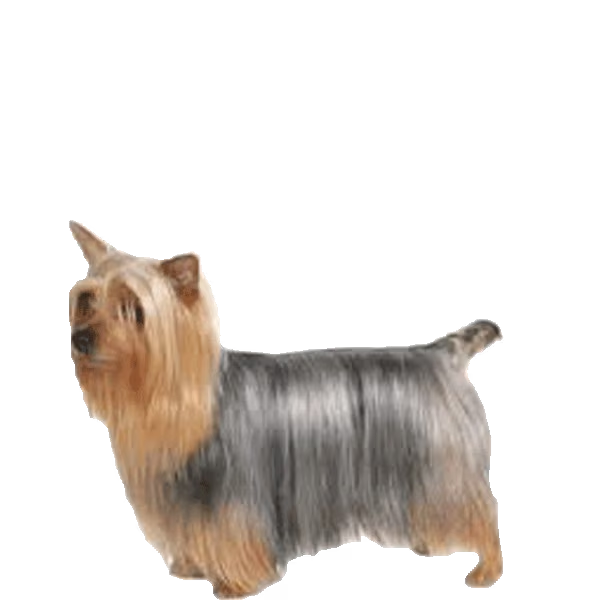
Silky Terrier
The Silky Terrier is a spirited, refined toy terrier that combines a keen, curious mind with a glossy, elegant coat.
- Size
- Toy
- Lifespan
- 13–15 years
- Origin
- Australia
- Temperament
- Spirited
- Standard colours
- Black, Grey and Blue and 3 more
Characteristics
Coat and grooming
How the Silky Terrier coat is built, and what that means when you groom it.
- Coat layers
- Single coat
- Coat texture
- Silky
- Coat length
- Long
- Shedding
- Low shedding
Grooming guidance
Caution: A Silky Terrier coat mats easily.
Fine or long hair tangles at the base of the coat, out of sight, where the mats tighten and pull on the skin. Brushing has to reach right down to the roots in sections, not just skim the surface.
Information: A Silky Terrier needs clipping every few weeks.
This coat keeps growing rather than shedding out, so it has to be trimmed every few weeks. Left to grow it mats down against the skin and traps moisture, dirt and heat.
Silky Terrier colours and patterns
What each club's breed standard says about every Silky Terrier colour and pattern. Point at a ruling to see the club's own wording.
Breed standards describe the Silky Terrier in Black, Grey, Blue, Silver, Tan and Fawn. Standard patterns: Tan point.
| Colour or pattern | FCI | AKC | UKC | KC | KUSA |
|---|---|---|---|---|---|
| Black | Standard (“Black colouring is permissible in puppies”) | Standard (“Black & Tan”) | Standard (“Black coloring is acceptable in puppies”) | Standard (“Black colouring permissible in puppies”) | Standard (“Black colouring is permissible in puppies”) |
| Grey | No ruling | Standard (“Gray & Tan”) | No ruling | Standard (“Grey Blue & Tan”) | No ruling |
| Blue | Standard (“All shades of blue”) | Standard (“Blue & Tan”) | Standard (“Blue”) | Standard (“All shades of blue”) | Standard (“All shades of blue”) |
| Silver | Not recognised (“Silver and white not acceptable”) | Standard (“Silver & Tan”) | Fault (“Silver or white”) | Standard (“Silver & Tan”) | Not recognised (“Silver and white not acceptable”) |
| Tan | Standard (“tan”) | Standard (“Blue & Tan”) | Standard (“tan”) | Standard (“tan”) | Standard (“tan”) |
| Fawn | Standard (“Silver blue or fawn top- knot desirable”) | Standard (“The topknot should be silver or fawn”) | Standard (“A silver-blue or fawn topknot is desirable”) | Standard (“Silver-blue or fawn top-knot”) | Standard (“Silver blue or fawn topknot desirable”) |
| White | Not recognised (“Silver and white not acceptable”) | No ruling | Fault (“Silver or white”) | Not recognised | Not recognised (“Silver and white not acceptable”) |
| Patterns | |||||
| Tan point | Standard (“Distribution of blue and tan”) | Standard (“Blue & Tan”) | Standard (“Blue and tan is the acceptable color combination”) | Standard (“Distribution of blue and tan”) | Standard (“Distribution of blue and tan”) |

| Colour or pattern | FCI | AKC | UKC | KC | KUSA |
|---|---|---|---|---|---|
| Dark brown | Standard (“dark as possible in colour”) | Standard (“dark”) | Standard (“dark”) | Standard (“dark”) | Standard (“dark as possible in colour”) |
| Light brown | No ruling | Fault (“Light eyes are a serious fault”) | Fault (“Light eyes”) | No ruling | No ruling |
| Colour or pattern | FCI | AKC | UKC | KC | KUSA |
|---|---|---|---|---|---|
| Black | Standard (“Black”) | Standard (“The nose is black”) | Standard (“The nose is black”) | Standard (“Nose black”) | Standard (“Black”) |
What the rulings mean
- Standard
- Described by the club's breed standard.
- Fault
- Named by the club's breed standard as a fault: the animal can be shown but is penalised.
- Not recognised
- The club does not accept this colour or pattern for the breed.
Colour changes
How a Silky Terrier's colours can change over its life.
Blackchanges toRust
Coat · With body condition · can change back
Blackchanges toGrey
Coat · Progressive
Blackchanges toBlue
Coat · Progressive · from 0 to 78 weeks
Blackchanges toBrown
Coat · In the sun · can change back
Whitechanges toRoan
Coat · With age · from 2 weeks
Tan pointchanges toSaddle
Coat · With age · from 6 to 156 weeks
Blackchanges toSnow nose
Nose · With the season · can change back
Blackchanges toPink
Nose · With the season · can change back


Sources
Each ruling comes from the club's published breed standard or colour list.
Silky Terrier breed standard
What each club's standard asks of the Silky Terrier: size, build and forms. A club speaks only for itself, and a figure no club published is left out.
Measurements


Conformation
Stop
Moderate
“Stop: Defined but moderate.”
Bite
Scissors bite
“the upper incisors fitting closely over the lower (scissor bite)”
Eye shape
Oval
“Shall be small, oval never round or prominent”
Ear carriage
Erect (prick)
“small, V-shaped with fine leather, set high on the skull, pricked”
Ear set
High
“set high on the skull”
Neck length
Medium
“Medium length, refined and slightly crested”
Topline
Level
“Level topline at all times (both standing and moving).”
Topline
Roach (arched)Fault
“SEVERE FAULTS: Topline showing roach or dip.”
Topline
SwaybackFault
“SEVERE FAULTS: Topline showing roach or dip.”
Chest
Moderate
“Chest: Of moderate depth and breadth.”
Hocks
Well let down
“the hocks should be well let down and parallel with each other”
Feet
Cat foot
“Small, well padded, cat-like with closely knit toes”
Tail set
High
“If docked, set on high”
Tail carriage
Raised (gay)
“carried erect but not over-gay”
Tail carriage
Curled over the backFault
“not curved over back. Must not be curled.”


Markings


Cropping, docking and other procedures
- Tail docking: Alternate “If docked, set on high ... Undocked: the first three vertebrae to be carried erect”
Parts of the body


Meet some of our Silky Terrier
A few of the Silky Terrier profiles members have added to United Pet Club.


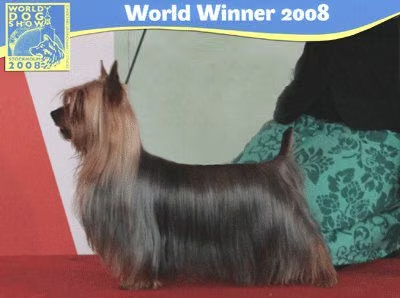


About the Silky Terrier
The Silky Terrier is a toy breed from Australia with a fine, glossy coat and an alert, curious temperament that suits flats and houses alike.
The Silky Terrier is a small companion dog developed in Australia in the late 1800s. It carries the build and instincts of a working terrier in a toy frame, standing about 23 to 25 cm at the shoulder and weighing roughly 3.5 to 5 kg. The breed is known for its long, flat, silk-textured coat parted down the back, and for a confident, busy manner that sets it apart from softer lap breeds.
Despite its size, the Silky Terrier behaves like a true terrier. It is alert to movement, vocal when something changes, and quick to investigate. Owners often describe it as a small dog that does not seem aware of being small. It bonds closely with its household and prefers to stay near its people through the day.
The coat is the breed's most recognisable feature. It hangs straight and parts naturally along the spine, giving the dog a tidy, refined outline. Colour is blue and tan in the adult coat, which deepens and settles as the dog matures from its darker puppy colouring. The single coat gives little protection from cold, so the breed appreciates a warm, dry spot through the damp Irish winter.
| Trait | Detail |
|---|---|
| Origin | Australia |
| Size | Toy (about 3.5 to 5 kg, 23 to 25 cm tall) |
| Lifespan | 13 to 15 years |
| Group/role | Toy companion (terrier ancestry) |
| Good with | Families, older children, attentive owners; supervise with very young children and small pets |
Who this breed suits
The Silky Terrier suits owners who want a small, lively companion and can give it daily attention. It does well in flats and houses, provided it gets regular walks and play. The coat needs routine brushing, so the breed fits people willing to keep up a grooming schedule. Its alertness makes it a ready watchdog, though the same trait can lead to barking that needs early training. Households with very small children or small caged pets should supervise interactions, since the breed keeps a terrier's chase instinct.
History and origin
The Silky Terrier was developed in Australia in the late 19th century by crossing Australian Terriers with Yorkshire Terriers to create a refined toy companion.
The Silky Terrier traces to Australia in the late 1800s. Breeders in and around Sydney crossed the Australian Terrier with the Yorkshire Terrier, aiming for a small companion dog that kept terrier character while gaining a longer, finer coat. The result drew features from both founding breeds and became distinct enough to be recorded on its own.
Early in its history the breed went by several names, including the Sydney Silky, reflecting its link to that city. Regional breed standards in Australia were drawn up in the early 20th century, and over time these were reconciled into a single national standard. The blue and tan colouring and the silk-textured coat became fixed points of the breed type.
The breed spread beyond Australia in the years after the Second World War, carried in part by service members and returning travellers, and settled into the toy group in kennel clubs abroad. In its home country and abroad the breed kept its standing as a companion rather than a working dog.
Though bred down to toy size, the Silky Terrier never lost the disposition of its terrier ancestors. Its history as a city companion shaped a dog meant to live close to people while keeping the alert, ready temperament of a ratting terrier.
Appearance
The Silky Terrier is a refined toy dog with a long, straight, silk-textured blue and tan coat parted along the back and small, erect ears.
The Silky Terrier is a compact, lightly built toy dog that is slightly longer than it is tall. The body is low set but not stocky, with fine bone and a level topline. The head is moderately long with a flat skull, small almond-shaped dark eyes, and small V-shaped ears carried erect. The overall impression is one of refinement rather than ruggedness, though the dog moves with a free, light gait.
| Feature | Standard |
|---|---|
| Height | About 23 to 25 cm at the shoulder |
| Weight | About 3.5 to 5 kg |
| Coat | Long, straight, fine, silk-textured; parted along the back |
| Colours | Blue and tan |
| Eyes | Small, almond-shaped, dark |
Coat and colours
The defining feature is the single-layer coat, which is flat, glossy and silk-like in texture. It falls straight on each side from a part that runs from behind the ears to the base of the tail. On the body the coat is kept long, about 13 to 15 cm, while the hair on the face and the lower legs is shorter. A topknot of fine hair sits on the head.
The adult colour is blue and tan. The blue can range from silver-blue to slate, and is set against tan markings on the muzzle, cheeks, legs and around the base of the tail. Puppies are born much darker, often nearly black, and the blue lightens gradually as the coat matures over the first one to two years.
What the Silky Terrier standard says, club by club
Height at the withers for the Silky Terrier: FCI 23-26 cm; KC 23-26 cm.
Clubs set their own figures for the Silky Terrier. These come from each club's published standard: AKC, CKC, FCI, KC, UKC.
Size
- Height at the withers, male: FCI 23-26 cm; KC 23-26 cm
- Height at the withers: AKC 22.9-25.4 cm; CKC 22.8-25.5 cm; UKC 22.9-25.4 cm
- Weight: CKC 3.8-4.5 kg
Sizes that count against it
- Height at the withers: Fault: CKC under 20.2 cm
Build and forms
At least one club accepts each of these:
- Stop: Moderate, Slight
- Bite: Scissors bite
- Dentition: Full dentition
- Eye shape: Oval, Almond
- Ear carriage: Erect (prick)
- Ear set: High
- Neck length: Medium
- Topline: Level
- Chest: Moderate
- Hocks: Well let down
Forms the clubs penalise
A fault or a disqualification is a judgment under a show standard. It can affect placings and, at some clubs, registration.
- Fault: Bite: Undershot (AKC, CKC, UKC); Bite: Overshot (AKC, CKC, UKC); Topline: Roach (arched) (AKC, CKC, FCI, UKC); Topline: Swayback (AKC, CKC, FCI, UKC); Tail carriage: Curled over the back (FCI, UKC)
Cropping, docking and other procedures
- Tail docking: Standard (AKC); Alternate (CKC, FCI, KC, UKC)
- Dewclaw removal: Standard (AKC)
This is each club's stance in the show ring, not the law. The law on these procedures differs by country.
Markings
Each club's ruling on the breed's named marks:
- Tan points: Standard (AKC, FCI, KC, UKC)
See every point side by side: compare the clubs.
Rulings come from each club's published breed standard, and clubs revise their standards. Before a show or a registration, check the current text with the club.
What does each club give for Height at the withers in the Silky Terrier?
Height at the withers, male: FCI 23-26 cm; KC 23-26 cm; Height at the withers: AKC 22.9-25.4 cm; CKC 22.8-25.5 cm; UKC 22.9-25.4 cm.
Which forms do clubs penalise in the Silky Terrier?
Fault: Bite: Undershot (AKC, CKC, UKC); Bite: Overshot (AKC, CKC, UKC); Topline: Roach (arched) (AKC, CKC, FCI, UKC); Topline: Swayback (AKC, CKC, FCI, UKC); Tail carriage: Curled over the back (FCI, UKC).
Which Silky Terrier colours the clubs accept
Every club we track accepts Black, Blue, Tan, Fawn for the Silky Terrier.
On the Silky Terrier, every club we track agrees on Black, Blue, Tan, Fawn. Clubs compared: AKC, FCI, KC, KUSA, UKC.
Patterns listed as standard for the Silky Terrier: Tan point.
Where the clubs split
At least one club accepts each of these, and at least one other penalises or refuses it.
- Silver: Standard (AKC, KC); Fault (UKC); Not recognised (FCI, KUSA)
Colours penalised in the show ring
A fault or a disqualification is a judgment under a show standard. It can affect placings and, at some clubs, registration.
- Fault: White (UKC), Silver (UKC)
Beyond the main colour
Standards rule on more than the main colour. These are listed as standard:
- Eyes: Dark brown
- Nose: Black
Rulings come from each club's published breed standard, and clubs revise their standards. Before a show or a registration, check the current text with the club.
Which Silky Terrier colours do all the clubs accept?
All of these clubs accept Black, Blue, Tan, Fawn: AKC, FCI, KC, KUSA, UKC.
Do clubs disagree about Silky Terrier colours?
Yes. Clubs rule differently on Silver.
Which Silky Terrier colours are faults or disqualifications?
Fault: White (UKC), Silver (UKC).
Temperament
The Silky Terrier is friendly, curious and spirited, bonding closely with its family while staying alert and quick to bark at anything unusual.
The Silky Terrier is a confident, energetic companion with a strong attachment to its household. It is affectionate with the people it knows and likes to stay involved in daily activity rather than resting apart. The breed is curious and busy by nature, often following its owners from room to room and investigating new sights and sounds.
With strangers the Silky Terrier tends to be alert and watchful. It will announce visitors readily, which makes it an effective small watchdog but also means barking needs managing from an early age. With proper introductions most settle quickly. Around children the breed is playful, though its fine build and terrier spirit make it better suited to households with older, gentle children than with toddlers.
With other pets the breed can be sociable, especially when raised alongside them. Its terrier ancestry leaves a chase drive, so small animals such as rodents and birds may trigger pursuit, and interactions with them should be supervised. Same-size dogs are usually accepted, though the Silky Terrier can be bold and may not back down from larger dogs, which calls for owner awareness.
| Trait | Rating |
|---|---|
| Affection | 5 |
| Energy | 4 |
| Trainability | 4 |
| Vocalness | 4 |
| Shedding | 2 |
Care and grooming
The Silky Terrier needs regular brushing of its long coat, daily walks and play, and a home where it can stay close to its people.
The Silky Terrier is an active toy breed with a coat that needs steady upkeep. Day-to-day care centres on coat maintenance, moderate exercise and close contact with the household.
Grooming
- Brush the coat several times a week, ideally daily, to prevent tangles and mats
- Bathe roughly every three to four weeks to keep the coat clean and glossy
- Check and gently part the coat along the back to keep its line tidy
- Trim hair around the eyes, ears and paws as needed
- Clean ears regularly and trim nails about every three to four weeks
- Brush teeth several times a week, since small breeds are prone to dental problems
Exercise
- Provide one to two short walks each day totalling about 30 minutes, along the footpath or in the park
- Add play sessions to satisfy the breed's curiosity and energy
- Offer puzzle toys or simple games to keep the mind occupied on wet days indoors
- Allow safe off-lead play in a fenced garden where possible
Environment
The Silky Terrier adapts well to flats and small homes as long as it gets daily activity and company. It is an indoor dog and is not suited to living outside, especially given the single coat and the cold, damp Irish winter. The breed prefers to be near its people and can become bored or noisy if left alone for long stretches. A secure garden is a plus, but check the fencing, since the breed can dig and slip through gaps.
Grooming a Silky Terrier
The Silky Terrier coat: Single coat, Silky, Long, Low shedding.
Most of what a Silky Terrier needs from grooming follows from its coat.
- Coat layers: Single coat
- Coat texture: Silky
- Coat length: Long
- Shedding: Low shedding
What this coat asks of you
- A single coat has no dense undercoat, so there is less to brush out and less insulation against the cold.
- A silky coat tangles where it rubs, so comb it through in layers instead of brushing over the top.
- Long hair mats from the base up. Work through it in sections and keep the areas around the eyes and the rear clean.
- Low shedding does not mean low upkeep. Hair that stays in the coat can still tangle unless it is brushed out.
What to tell a groomer
Mention these when you book. The coat notes on this page explain each one.
- Needs regular clipping
- Mats easily
A groomer who knows the breed can adapt all of this to the individual animal. Sore skin, mats pressed against the skin or a sudden change in the coat are worth showing to a vet.
What kind of coat does a Silky Terrier have?
On our records: Coat layers: Single coat; Coat texture: Silky; Coat length: Long; Shedding: Low shedding.
How much does a Silky Terrier shed?
Low shedding does not mean low upkeep. Hair that stays in the coat can still tangle unless it is brushed out.
What should a groomer know about a Silky Terrier?
These grooming rules apply: Needs regular clipping, Mats easily.
Nutrition and feeding
The Silky Terrier needs a measured diet of quality small-breed food split into two or three meals a day to maintain a lean weight.
As a small, active breed the Silky Terrier does well on a complete diet formulated for small or toy dogs. These foods carry the energy density and smaller kibble size that suit the breed. Because the dog is light, even small overfeeding can lead to weight gain, so portions should be measured rather than left out all day. Fresh water should always be available.
| Life stage | Amount per day | Meals |
|---|---|---|
| Puppy (2 to 6 months) | About 55 to 85 g | 3 to 4 |
| Puppy (6 to 12 months) | About 55 to 110 g | 2 to 3 |
| Adult | About 55 to 85 g | 2 |
| Senior | About 55 g, adjusted for activity | 2 |
Treats and supplements
Keep treats to about 10 percent of daily calories to protect against weight gain. Small, low-calorie treats work well for training given the breed's size. Most Silky Terriers on a complete commercial diet need no added supplements. Discuss any supplement, such as joint or dental support, with a vet before adding it, since needs vary by age and health.
Health
The Silky Terrier is generally healthy with a 13 to 15 year lifespan, though it can be prone to dental disease, patellar luxation, and certain knee and eye conditions.
The Silky Terrier is a generally sound breed with a typical lifespan of 13 to 15 years. As with many toy breeds, the main concerns relate to the knees, teeth and a few inherited conditions. Buying from breeders who screen their stock and keeping up with routine veterinary care reduces the risk of many problems.
| Condition | Signs | Note |
|---|---|---|
| Patellar luxation | Skipping gait, intermittent hind-leg lameness | Common in toy breeds; ranges from mild to surgical |
| Dental disease | Bad breath, tartar, loose teeth | Frequent in small breeds; managed with home and professional dental care |
| Legg-Calve-Perthes disease | Limping, hip pain, muscle loss in a young dog | Affects the hip joint in small breeds; often appears before one year |
| Progressive retinal atrophy | Night blindness, declining vision | Inherited eye disease; breeders can screen for it |
| Tracheal collapse | Honking cough, especially with excitement or pressure on the neck | Use a harness rather than a collar to reduce strain |
Preventive care
- Keep core and recommended vaccinations up to date
- Book annual veterinary exams, with twice-yearly visits for senior dogs
- Keep up a dental routine with regular brushing and professional cleanings
- Use a harness instead of a neck collar to protect the trachea
- Keep the dog at a lean weight to ease pressure on the knees and joints
- Maintain year-round parasite prevention for fleas, ticks and worms
Training
The Silky Terrier is intelligent and trainable but independent, responding best to short, consistent positive-reinforcement sessions with early focus on barking and socialisation.
The Silky Terrier is bright and learns quickly, but it carries a terrier's independent streak and can be wilful if training is inconsistent. It responds best to short, upbeat sessions that hold its interest and reward cooperation. Harsh correction tends to backfire and can make the dog stubborn or anxious. Early socialisation to people, places and other animals helps temper the breed's watchfulness, and barking should be addressed from the start before it becomes a habit.
Basics
- Start house training and crate training as soon as the puppy comes home
- Socialise early to a range of people, sounds and settings
- Teach core cues such as sit, stay, come and leave it
- Introduce a quiet cue to manage the breed's tendency to bark
- Keep sessions short, about 5 to 10 minutes, and end on a success
- Practise cues in different places so behaviour carries over to daily life
Breeding
The Silky Terrier reaches maturity around one to two years, carries small litters averaging three to five puppies, and benefits from health screening of breeding stock.
Breeding the Silky Terrier calls for the same care as other toy breeds, where small litter sizes and delicate puppies are the norm. Dogs should reach full physical and behavioural maturity before breeding, generally around one to two years of age, and both parents should be screened for the inherited conditions seen in the breed, including patellar and eye problems. Responsible breeding aims to keep the breed's sound temperament and correct coat type while reducing the risk of passing on hereditary disease.
Gestation runs about 63 days. Litters are small, often three to five puppies, and whelping should be monitored, since toy breeds can have difficulty delivering. Puppies are born much darker than their adult colour and develop the blue and tan coat over the first one to two years. Early handling and gentle socialisation in the first weeks help shape steady, confident adults. Puppies should stay with the dam until at least eight weeks of age.
| Metric | Value |
|---|---|
| Sexual maturity | About 6 to 12 months |
| Recommended breeding age | 1 to 2 years |
| Gestation | About 63 days |
| Average litter size | 3 to 5 puppies |
| Weaning age | About 6 to 8 weeks |
| Earliest rehoming age | 8 weeks or older |
Registering your Silky Terrier in Ireland, chip and record both
Irish law wants every dog chipped and recorded; United Pet Club keeps your Silky Terrier's record free, current, and there for life.
How to register a Silky Terrier in Ireland
A dog warden with a scanner can only follow the record, and a Silky Terrier whose record is current is home the same day. Register your dog free with United Pet Club: your contact details, his photo, and his chip number together on one profile that never lapses and never bills you.
Lodge your Silky Terrier's fifteen digit number with United Pet Club and the chip finally earns its keep: free registration for life, every brand accepted, and a record the ISPCA or any warden can turn into a phone call. Microchip registration takes minutes, and the free account covers the profile while you're at it.
How do I register my Silky Terrier in Ireland?
Set yourself up with a free United Pet Club account, key in your Silky Terrier's details and a photo, and save. The profile holds for the whole of his life without charge, and the chip number can be lodged whenever you have it.
How do I register my Silky Terrier's microchip?
Lodge the fifteen digit chip number in your free account along with your address and phone number. The lifetime plan covers the registration and every update after it, free, whatever brand the vet used.
Is microchipping a Silky Terrier required in Ireland?
It is. The 2015 Regulations require every dog to be chipped and registered, pup or rescue alike. Keeping the record current is the part that falls to you, and United Pet Club makes that part free.
What does it cost to register a Silky Terrier in Ireland?
Not a penny. Profile, chip record, and every amendment are covered for life, with no renewal ever.
Frequently asked questions
Common questions about the Silky Terrier cover its size, temperament, grooming needs, lifespan, suitability and availability.
How big does a Silky Terrier get?
It is a toy breed, standing about 23 to 25 cm at the shoulder and weighing roughly 3.5 to 5 kg when full grown.
What is the Silky Terrier's temperament like?
It is friendly, curious and spirited. The breed bonds closely with its family, stays alert and watchful, and will bark to announce anything unusual.
Is the Silky Terrier hard to care for?
Care is moderate. The long coat needs brushing several times a week, and the dog needs daily walks and play, but its small size keeps exercise needs manageable.
How long do Silky Terriers live?
The typical lifespan is 13 to 15 years, which is long even for a toy breed, especially with good dental care and a lean weight.
Is the Silky Terrier good for flats and families?
Yes to both, with conditions. It adapts well to flats if exercised daily, and it suits families with older, gentle children better than homes with toddlers.
Does the Silky Terrier shed much?
It sheds lightly. The single, silk-textured coat drops little hair, but it needs regular brushing to stay free of mats.
Are Silky Terriers easy to find?
The breed is established but less common than mainstream toy breeds. Puppies are usually available through dedicated Irish Kennel Club registered breeders, and dogs sometimes appear with breed-specific rescues.
From the community
Ask about the Silky TerrierNo questions about the Silky Terrier yet. Be the first to ask.
Browse Dog breeds