
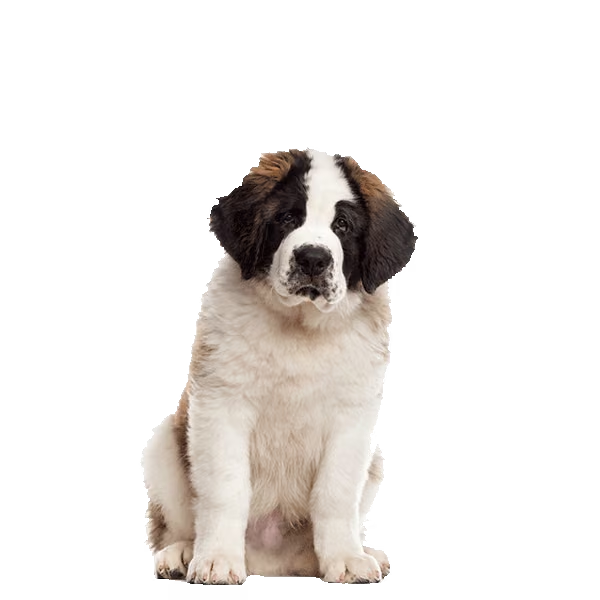
Saint Bernard
The Saint Bernard is a gentle, friendly giant famed for its alpine-rescue heritage and its calm, affectionate devotion to family.
- Size
- Giant
- Lifespan
- 8–10 years
- Origin
- Switzerland
- Temperament
- Gentle
- Standard colors
- Black, White and Brown and 3 more
Characteristics
Coat and grooming
How the Saint Bernard coat is built, and what that means when you groom it.
- Coat layers
- Double coat
- Coat texture
- Rough
- Coat length
- Medium
- Shedding
- Seasonal shedding
Grooming guidance
Critical: A Saint Bernard should not be shaved.
The undercoat keeps heat out as well as in, and the outer coat shields the skin from sun and insect bites. Clipping the whole coat off removes both. It often grows back patchy, soft or a different colour, and in some animals the guard hairs never return properly. Brush the undercoat out instead of cutting it off.
Information: A Saint Bernard drops its undercoat in heavy bursts.
The undercoat comes out in heavy bursts over a few weeks. An undercoat rake, or a bath followed by a proper blow-dry, clears it far faster than daily brushing. Clipping the coat down is not a shortcut for this.
Saint Bernard colors and patterns
What each club's breed standard says about every Saint Bernard color and pattern. Point at a ruling to see the club's own wording.
Breed standards describe the Saint Bernard in Black, White, Brown, Mahogany, Red and Orange. Standard patterns: Bicolour, Tricolour, Brindle, Piebald, Sable, Mantle and Reverse brindle.
| Color or pattern | FCI | UKC | KC | KUSA | AKC |
|---|---|---|---|---|---|
| Black | Standard (“Slight touch of black shading on body tolerated”) | Fault (“Black on any other part of the dog is a minor fault”) | Standard (“Orange Black & White”) | Standard (“Slight touch of black shading on body tolerated”) | No ruling |
| White | Standard (“Primary colour white”) | Standard (“All shades of red and white”) | Standard (“white with patches”) | Standard (“Primary colour white”) | Standard (“White & Red”) |
| Brown | Standard (“A broken reddish-brown mantle is of equal value”) | Standard (“any shade of brown and white”) | Standard (“Brown & White”) | Standard (“A broken reddish brown mantle is of equal value”) | Standard (“Brown & White”) |
| Mahogany | Standard (“clear to dark red mantle”) | Standard (“All shades of red”) | Standard (“mahogany-brindle”) | Standard (“clear to dark red mantle”) | Standard (“Mahogany & White”) |
| Red | Standard (“clear red patches ... clear to dark red mantle”) | Standard (“All shades of red”) | Standard (“Red & White”) | Standard (“clear red patches ... clear to dark red mantle”) | Standard (“Red & White”) |
| Orange | Standard (“Brownish-yellow tolerated”) | Standard (“All shades of red”) | Standard (“Orange”) | Standard (“Brownish-yellow tolerated”) | Standard (“Orange & White”) |
| Albino | Disqualifying | Disqualifying (“albinism”) | Not recognised | Disqualifying | No ruling |
| Patterns | |||||
| Bicolour | No ruling | Standard (“All shades of red and white”) | Standard (“Red & White”) | No ruling | Standard (“Red & White”) |
| Tricolour | No ruling | Fault (“Black on any other part of the dog is a minor fault”) | Standard (“Tricolour”) | No ruling | No ruling |
| Brindle | Standard (“A brindle reddish-brown colour permissible”) | Standard (“brindle and white”) | Standard (“mahogany-brindle, red-brindle”) | Standard (“A brindle reddish-brown colour permissible”) | Standard (“Brindle & White”) |
| Piebald | Standard (“white with smaller or larger clear red patches (splash-coated dogs)”) | No ruling | Standard (“white with patches on body of any of the above named colours”) | Standard (“white, with smaller or larger clear red patches (splash-coated dogs)”) | No ruling |
| Sable | Standard (“Dark shadings on head desirable. Slight touch of black shading on body tolerated”) | No ruling | Standard (“black shadings on face and ears”) | Standard (“Dark shadings on head desirable. Slight touch of black shading on body tolerated”) | No ruling |
| Mantle | Standard (“unbroken clear to dark red mantle covering back and flanks (mantle dogs)”) | No ruling | Not recognised | Standard (“unbroken, clear to dark red mantle covering back and flanks (mantle dogs)”) | No ruling |
| Reverse brindle | Standard (“A brindle reddish-brown colour permissible”) | Standard (“brindle and white”) | Standard (“mahogany-brindle, red-brindle”) | Standard (“A brindle reddish-brown colour permissible”) | Standard (“Brindle & White”) |
| Roan | Fault (“reddish-brown dots or ticks in the white”) | No ruling | Not recognised | Fault (“reddish-brown dots or ticks in the white”) | No ruling |
| Solid | Disqualifying (“Solid white or solid reddish-brown coat (absence of the primary colour)”) | Disqualifying (“Solid-colored dog”) | Not recognised | Disqualifying (“Solid white or solid reddish-brown coat (absence of the primary colour)”) | No ruling |


| Color or pattern | FCI | UKC | KC | KUSA |
|---|---|---|---|---|
| Brown | Standard (“dark brown to nut-brown”) | No ruling | No ruling | Standard (“dark brown to nut brown”) |
| Dark brown | Standard (“dark brown to nut-brown”) | Standard (“dark brown in color”) | Standard (“Dark in colour”) | Standard (“dark brown to nut brown”) |
| Blue | No ruling | Disqualifying (“Blue eyes”) | No ruling | No ruling |
| Color or pattern | FCI | UKC | KC | KUSA |
|---|---|---|---|---|
| Black | Standard (“Black, broad and square”) | Standard (“Nose leather is black”) | Standard (“Nose large and black”) | Standard (“Black, broad, and square”) |
| Pink | Disqualifying (“flesh coloured nostrils (nostrils without pigmentation)”) | Disqualifying | No ruling | Disqualifying (“flesh-coloured nostrils (nostrils without pigmentation)”) |
| Patterns | ||||
| Butterfly nose | Fault (“Incomplete or totally absent pigmentation on nose leather”) | Fault (“Incomplete nose pigment”) | No ruling | Fault (“Incomplete or totally absent pigmentation on nose leather”) |

What the rulings mean
- Standard
- Described by the club's breed standard.
- Fault
- Named by the club's breed standard as a fault: the animal can be shown but is penalised.
- Disqualifying
- The club's breed standard disqualifies an animal of this colour or pattern.
- Not recognised
- The club does not accept this colour or pattern for the breed.
Color changes
How a Saint Bernard's colors can change over its life.
Blackchanges toRust
Coat · With body condition · can change back
Blackchanges toGrey
Coat · Progressive
Blackchanges toBrown
Coat · In the sun · can change back
Whitechanges toRoan
Coat · With age · from 2 weeks
Blackchanges toSnow nose
Nose · With the season · can change back
Blackchanges toPink
Nose · With the season · can change back

Sources
Each ruling comes from the club's published breed standard or color list.
Health
Conditions recorded as more common in the Saint Bernard than in its species as a whole. A higher risk is not a diagnosis: many never develop any of them, and your vet can say which screening tests are worth doing.
High risk
- Gastrointestinal system
Gastric dilatation-volvulus
Moderate evidence
This content is for educational purposes and is not a substitute for professional veterinary advice. If you are worried about your pet, contact your veterinarian.
All health conditionsMeet some of our Saint Bernard
A few of the Saint Bernard profiles members have added to United Pet Club.

About the Saint Bernard
A giant working dog from the Swiss Alps, the Saint Bernard is calm, gentle and deeply attached to its family.
The Saint Bernard is a giant breed that developed in the western Alps, in the border country between Switzerland and northern Italy. A grown dog typically stands 26 to 30 inches at the shoulder, and males often weigh between 140 and 180 lb. Placid, affectionate and patient by nature, the breed carries a long history of alpine rescue work at the hospice on the Great St Bernard Pass.
Indoors, most Saint Bernards are even tempered and unhurried, moving about at their own steady pace. They form close bonds with their household and are generally good with children. Given the dog's eventual size, though, early training and consistent handling matter from the first weeks in the home.
This is a breed best suited to owners with plenty of room, time, and a good sense of humour about drool and heavy seasonal shedding. The Saint Bernard doesn't need strenuous exercise, but it does need space to move about, plus a household ready for the cost of feeding and looking after a giant dog.
| Attribute | Detail |
|---|---|
| Origin | Switzerland |
| Size | Giant (typically 140 to 180 lb for males) |
| Lifespan | 8 to 10 years |
| Group / role | Working dog; historic alpine rescue and draft work |
| Good with | Children and family members; usually good with other pets when socialised |
Who it suits
The Saint Bernard fits a settled household with enough indoor and outdoor space for a very large dog. It suits families with children who can supervise interactions, given the dog's weight. Prospective owners should be prepared for a relatively short lifespan, regular grooming, and the higher feeding and veterinary costs that come with a giant breed.
History and origins of the Saint Bernard
The Saint Bernard was bred at a hospice on the Great St Bernard Pass in the Swiss Alps, used for companionship, draft work and mountain rescue.
The breed takes its name from the hospice on the Great St Bernard Pass, a high crossing in the western Alps between Switzerland and Italy. Founded in the 11th century as a refuge for travellers, the hospice kept dogs as working animals from an early date, and written and pictorial records of large hospice dogs survive from the late 17th and early 18th centuries.
The monks put the dogs to several uses: guarding the buildings, pulling carts, turning the kitchen spit, and simply providing warmth. In time the dogs were also sent out to find travellers lost in deep snow along the pass. Working in groups, they could locate people buried after a storm, and the monks would then dig them out and bring them to shelter.
Harsh winters and disease took a heavy toll on the hospice line in the early 19th century. To rebuild the numbers, the monks crossed their dogs with other large breeds, including longhaired types. Because a longer coat held ice and snow, the shorthaired dogs remained the preferred workers at the pass, while longhaired pups were more often placed in the valleys below.
The name Saint Bernard was settled on by the middle of the 19th century, and a Swiss breed club followed in 1884. Barry, the celebrated rescue dog who worked at the hospice in the early 1800s, remains the best known individual of the line and is still cited whenever the breed's rescue history comes up. Today the Irish Kennel Club, Ireland's national registry for pedigree dogs, is the body through which Saint Bernards bred here are registered.
Appearance and breed standard
A powerful, large-headed dog with a deep chest, the Saint Bernard comes in short and long coats marked in white with red or brown.
The Saint Bernard is tall and heavily built, with a broad, deep chest and strong bone throughout. The head is large and wide, the muzzle short, the stop well defined, and the loose flews are largely responsible for the breed's tendency to drool. The eyes are dark, set fairly deep, and give a soft expression, while the ears are medium sized and hang close to the head.
| Trait | Description |
|---|---|
| Height | Males about 28 to 30 in; females about 26 to 28 in at the shoulder |
| Weight | Males about 140 to 180 lb; females about 120 to 140 lb |
| Coat | Two varieties: shorthaired (smooth, dense) and longhaired (medium length, slightly wavy) |
| Colours | White with red or brown markings, or red and brown with white markings; brindle shading is common |
| Eyes | Dark, medium sized, with a gentle expression |
Coat and colour
Both coat types carry the same colour pattern: a white base combined with red or brown, and many dogs have a dark mask over the eyes and ears. The shorthaired coat lies flat and is dense to the touch, while the longhaired coat grows out over the body, legs and tail without becoming curly. Both varieties shed heavily, with a marked coat change each spring and autumn.
Temperament and behaviour
Calm, friendly and devoted, the Saint Bernard is generally gentle with children and tolerant of other animals when raised alongside them.
The Saint Bernard is known above all for a steady, easygoing nature. Indoors it's usually a quiet dog, content to settle near its family rather than seek attention. It forms strong attachments to the people it lives with and will often follow them from room to room.
Most Saint Bernards are patient and gentle with children, though given the dog's size, young children should always be supervised around it. Strangers are usually met with calm acceptance rather than suspicion, and the breed isn't a natural guard dog by temperament. A Saint Bernard raised alongside other dogs and cats generally lives with them without any bother.
This isn't a highly active or excitable breed. It can be slow to mature, and some puppy behaviour may persist well past the first year, so early, consistent socialisation helps a giant dog grow into a manageable adult.
| Trait | Rating |
|---|---|
| Affection | 5 |
| Energy | 2 |
| Trainability | 3 |
| Vocalness | 2 |
| Shedding | 4 |
Care and grooming
The Saint Bernard needs regular brushing, moderate daily exercise and a cool living space, with extra attention to its heavy coat and drool.
Grooming
- Brush the coat several times a week, and daily during the spring and autumn shed.
- Wipe the flews and facial folds regularly to manage drool and keep the skin clean.
- Check and clean the ears weekly, as the hanging ears can trap moisture.
- Trim the nails every few weeks and brush the teeth several times a week.
- Bathe as needed, usually every one to two months depending on how active the dog is.
Exercise
- Provide moderate daily exercise, such as two walks of 20 to 30 minutes.
- Avoid hard running, jumping and stairs while a puppy is still growing, to protect the developing joints.
- Keep activity light in warm weather, as the breed overheats easily.
- Let the dog move at its own pace rather than pushing high intensity sessions.
Environment
The Saint Bernard does best in a home with room indoors and access to a secure garden. The breed copes well with cold, which suits Ireland's own cool, damp climate reasonably well for a dense-coated Alpine breed, but it struggles in heat, so a cool, shaded, well-ventilated space matters over summer. Despite its size, this is an indoor companion and shouldn't be left outside alone for long spells.
Nutrition and feeding
The Saint Bernard needs a complete diet sized for a giant breed, fed in measured meals to support steady growth and a healthy weight.
A Saint Bernard needs a complete and balanced diet formulated for large or giant breeds. During growth, a large-breed puppy food with controlled calcium and energy levels supports a slower, steadier rate of growth, which helps protect the joints. Adult portions depend on weight, age and activity, so amounts should be adjusted to keep the dog at a healthy body condition. Feeding two meals a day rather than one large one is standard practice for the breed.
| Life stage | Amount per day | Meals |
|---|---|---|
| Puppy (2 to 6 months) | Per large-breed puppy formula, divided | 3 to 4 |
| Puppy (6 to 12 months) | Per large-breed puppy formula | 2 to 3 |
| Adult | About 6 to 10 cups of dry food, by weight and activity | 2 |
| Senior | Reduced to maintain condition | 2 |
Treats and supplements
Keep treats to a small share of the daily calorie count, as extra weight puts real strain on a giant dog's joints. Fresh water should always be available. Discuss any joint or other supplement with a vet before adding it, since a balanced complete food usually covers a healthy dog's needs already.
Health and lifespan
The Saint Bernard typically lives 8 to 10 years and is prone to joint problems, bloat and certain heart and eye conditions common in giant breeds.
The Saint Bernard has an average lifespan of 8 to 10 years, typical for a giant breed. Most health concerns relate to its size and rapid growth, including joint disorders and the risk of gastric dilatation and volvulus, better known as bloat. Responsible breeders screen their breeding stock for hip, elbow, heart and eye conditions before mating them.
| Condition | Signs | Note |
|---|---|---|
| Hip and elbow dysplasia | Limping, stiffness, reluctance to get up | Screened for in breeding stock; weight control helps |
| Gastric dilatation and volvulus (bloat) | Swollen abdomen, retching, restlessness | A medical emergency; seek care immediately |
| Dilated cardiomyopathy | Tires easily, coughing, fainting | Heart screening recommended |
| Eye conditions (entropion, ectropion) | Eye irritation, discharge, drooping lids | May need veterinary correction |
| Osteosarcoma (bone cancer) | Lameness, swelling on a limb | More common in giant breeds |
Preventive care
- Keep the dog at a lean, healthy weight to ease strain on the joints and heart.
- Feed measured meals and avoid strenuous exercise straight after eating, to lower the risk of bloat.
- Stay on top of routine vaccinations and parasite prevention.
- Book regular veterinary check-ups, with closer monitoring in the senior years.
- Ask the breeder for the parents' health screening results before taking a puppy.
Training the Saint Bernard
Willing and food motivated but slow to mature, the Saint Bernard needs early, consistent, reward-based training given its eventual size.
The Saint Bernard is generally cooperative and responds well to calm, consistent handling. It can take longer to mature than many breeds, so patience is needed through the first year or two. Because a grown dog is very large and strong, basics such as walking on a loose lead and not jumping up should be taught while the puppy is still small enough to manage. Reward-based methods work best, as the breed doesn't respond well to harsh handling.
Basics
- Start socialisation early, introducing the puppy to people, places and other animals.
- Teach name recognition and a reliable recall.
- Get loose-lead walking sorted before the dog reaches full weight.
- Practise sit, down and stay in short, regular sessions.
- Discourage jumping up and mouthing from the outset.
- Build calm behaviour around doors, food and visitors.
Breeding the Saint Bernard
Saint Bernards mature slowly, often have large litters, and need careful health screening of breeding stock given the risks of a giant breed.
Saint Bernards reach physical maturity later than smaller breeds, and responsible breeders wait until a dog is fully grown and health tested before using it for breeding. Gestation in dogs runs to about 63 days. The breed tends towards large litters, and whelping in giant breeds can carry higher risk, so veterinary support around the birth is worth arranging in advance.
Newborn pups grow and gain weight quickly, which makes early nutrition and a clean, warm whelping area important from day one. Breeding dogs should be screened for hip and elbow dysplasia, heart disease and eye conditions, and a breeder should be open about both parents' results. Given the breed's size and comparatively short lifespan, careful selection for health and temperament counts for a great deal.
| Metric | Value |
|---|---|
| Sexual maturity | Later than small breeds; only breed once fully grown |
| Gestation | About 63 days |
| Average litter size | Commonly 6 to 10 puppies, sometimes more |
| Weaning age | About 6 to 8 weeks |
| Recommended health screening | Hips, elbows, heart, eyes |
Registering your Saint Bernard in Ireland, chip and record both
Irish law wants every dog chipped and recorded; United Pet Club keeps your Saint Bernard's record free, current, and there for life.
How to register a Saint Bernard in Ireland
Get the profile sorted first: your Saint Bernard's name, his date of birth, a photo, and your phone number, saved in a couple of minutes. The record is free for the whole of his life, and the chip number slots in whenever the vet has done his part. Dog registration is where it starts.
Lodge your Saint Bernard's fifteen digit number with United Pet Club and the chip finally earns its keep: free registration for life, every brand accepted, and a record the ISPCA or any warden can turn into a phone call. Microchip registration takes minutes, and the free account covers the profile while you're at it.
How do I register my Saint Bernard in Ireland?
Set yourself up with a free United Pet Club account, key in your Saint Bernard's details and a photo, and save. The profile holds for the whole of his life without charge, and the chip number can be lodged whenever you have it.
How do I register my Saint Bernard's microchip?
Lodge the fifteen digit chip number in your free account along with your address and phone number. The lifetime plan covers the registration and every update after it, free, whatever brand the vet used.
Is microchipping a Saint Bernard required in Ireland?
It is. The 2015 Regulations require every dog to be chipped and registered, pup or rescue alike. Keeping the record current is the part that falls to you, and United Pet Club makes that part free.
What does it cost to register a Saint Bernard in Ireland?
Not a penny. Profile, chip record, and every amendment are covered for life, with no renewal ever.
Frequently asked questions about the Saint Bernard
Common questions about the Saint Bernard's size, temperament, care needs, lifespan and suitability as a family dog.
How big does a Saint Bernard get?
It's a giant breed. Males usually stand 28 to 30 inches at the shoulder and weigh about 140 to 180 lb, with females somewhat smaller.
Are Saint Bernards good with children?
Most are calm and gentle with children. Given the dog's weight, young children should always be supervised when they're together.
How much work is a Saint Bernard to look after?
The care itself is moderate, but the scale of it isn't. The breed needs regular brushing, drool management, moderate exercise, a cool space in summer, and the higher feeding and vet costs that come with a giant dog.
How long do Saint Bernards live?
The average lifespan is 8 to 10 years, which is typical for a giant breed.
Do Saint Bernards drool and shed a lot?
Yes. The loose flews mean noticeable drool, and both coat types shed heavily, especially during the spring and autumn coat change.
Is a Saint Bernard a good family dog?
It suits families with enough space, time for grooming, and a budget for a large dog. Its calm, devoted nature makes it a good companion in the right home.
Do Saint Bernards need a lot of exercise?
No. Moderate daily walks are enough. Hard running and stairs should be limited while a puppy is growing, and activity kept light in hot weather.
From the community
Ask about the Saint BernardNo questions about the Saint Bernard yet. Be the first to ask.
Browse Dog breeds