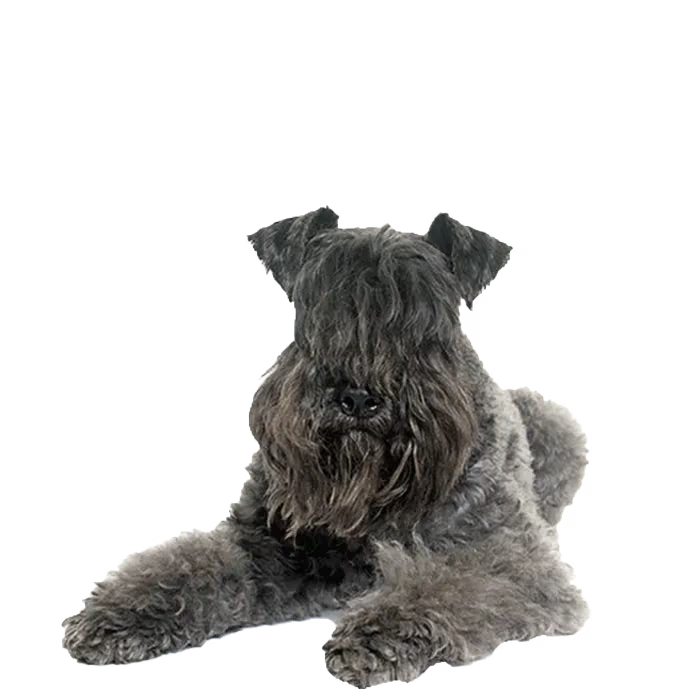
The Kerry Blue Terrier is a spirited, intelligent Irish breed known for its distinctive soft blue coat and devoted, alert nature.
How the Kerry Blue Terrier coat is built, and what that means when you groom it.
Caution: A Kerry Blue Terrier coat mats easily.
Fine or long hair tangles at the base of the coat, out of sight, where the mats tighten and pull on the skin. Brushing has to reach right down to the roots in sections, not just skim the surface.
Information: A Kerry Blue Terrier needs clipping every few weeks.
This coat keeps growing rather than shedding out, so it has to be trimmed every few weeks. Left to grow it mats down against the skin and traps moisture, dirt and heat.
A few of the Kerry Blue Terrier profiles members have added to United Pet Club.
The Kerry Blue Terrier is a medium-sized working terrier from Ireland, recognized for its soft blue-gray coat and its loyal, spirited, alert temperament.
The Kerry Blue Terrier is a medium-sized terrier that originated in the mountainous regions of County Kerry, Ireland. It was bred as an all-purpose farm dog, handling vermin, herding livestock, guarding the property, and retrieving from water. That working background shows in the breed today: it is energetic, quick to learn, and watchful of its surroundings.
The most identifiable feature is the coat. Puppies are born black and gradually change over the first 12 to 18 months to the mature blue-gray that gives the breed its name. The coat is soft, dense, and wavy rather than wiry, and it does not shed heavily, which appeals to owners who want a low-shedding terrier.
Kerry Blues are devoted to their families and tend to bond closely with the people they live with. They are alert and protective, which makes them attentive watchdogs, though they need consistent socialization to remain even-tempered around strangers and other dogs.
| Attribute | Detail |
|---|---|
| Origin | Ireland (County Kerry) |
| Size | Medium |
| Lifespan | 12 to 15 years |
| Group / role | Terrier; historic farm and vermin dog |
| Good with | Committed families; older children; single-dog homes with early socialization |
The Kerry Blue suits active owners who can provide daily exercise, regular grooming, and consistent training. It does best with people who enjoy an engaged, interactive dog and who can manage its terrier drive around small animals and unfamiliar dogs. It is less suited to households that want a low-effort or hands-off pet.
The Kerry Blue Terrier developed in County Kerry, Ireland, as a working farm dog and became one of the country's national breeds in the early 20th century.
The breed takes its name from County Kerry in southwestern Ireland, where it was established by the 19th century as a working dog on small farms. Local people used it for a wide range of tasks: killing rats and other vermin, herding cattle and sheep, guarding the homestead, and retrieving game on land and from water. Its exact ancestry is not documented, and several theories about contributing breeds exist, but no single account is firmly established.
For much of its early history the Kerry Blue was a farmer's dog rather than a show dog. It gained wider attention in Ireland in the early 1900s, and the first breed clubs were formed in that period. The Dublin Irish Blue Terrier Club was founded in 1920, which helped formalize the breed and promote it beyond its home region.
The Kerry Blue is associated with Irish national identity and is sometimes linked in popular accounts with figures of the Irish independence era. It was recognized by The Kennel Club in Britain in the early 1920s and by the American Kennel Club in 1922.
From Ireland the breed spread to Britain, the United States, and continental Europe. Today it is kept mainly as a companion, show, and sporting dog, though it retains the energy and instincts of its working origins.
The Kerry Blue Terrier is a compact, muscular medium dog with a soft, wavy blue-gray coat, a long head, and a level topline.
The Kerry Blue Terrier is a well-proportioned, muscular dog of medium size. It has a long head, small dark eyes, a strong jaw, and small to medium ears that fold forward toward the skull. The body is short-coupled and compact with a level topline, and the tail is carried upright. The overall impression is of a balanced, sturdy terrier built for work rather than for show alone.
| Trait | Standard |
|---|---|
| Height | Males about 46 to 48 cm (18 to 19.5 in); females slightly smaller |
| Weight | About 15 to 18 kg (33 to 40 lb) |
| Coat | Soft, dense, wavy; non-shedding; single-layered |
| Colors | Any shade of blue-gray, with or without black points |
| Eyes | Small, dark, well placed |
Kerry Blue puppies are born black. The coat lightens over the first 12 to 18 months and settles into the mature blue-gray that defines the breed. Acceptable shades range from a deep slate to a lighter blue-gray, and some dogs carry black points on the muzzle, ears, feet, or tail. A coat that has not finished clearing to blue by about 18 months is a fault under most standards. The texture is soft and wavy rather than harsh, and because the coat grows continuously it needs regular trimming to keep its shape.
The Kerry Blue Terrier is loyal, spirited, and intelligent, deeply attached to its family and alert toward strangers, with a strong terrier drive around other animals.
The Kerry Blue is an animated, confident terrier with a strong attachment to its household. It is affectionate and playful with the people it knows and tends to want to be involved in family activity. Its intelligence makes it quick to learn, but the same intelligence means it can become bored or willful without enough mental work.
With strangers the breed is naturally watchful and reserved, which makes it an effective watchdog. Early and ongoing socialization helps it tell the difference between a real threat and ordinary visitors. With children it is usually good when raised together, and it tends to suit older children who understand how to interact with a lively dog.
The breed's terrier history shows most clearly around other animals. Many Kerry Blues have a high prey drive toward small pets and can be assertive with unfamiliar dogs, particularly of the same sex. Careful introductions and consistent management are important in multi-pet homes, and some Kerry Blues do best as the only dog.
| Trait | Rating |
|---|---|
| Affection | 5 |
| Energy | 4 |
| Trainability | 4 |
| Vocalness | 3 |
| Shedding | 1 |
The Kerry Blue Terrier needs frequent grooming to manage its growing coat, daily exercise to use its energy, and an environment with secure boundaries.
Caring for a Kerry Blue centers on coat maintenance and exercise. The coat grows continuously and does not shed much, so loose hair stays in the coat and mats if it is not managed. Physical and mental activity are equally important, because an under-exercised Kerry Blue can become restless and destructive.
The Kerry Blue adapts to house or apartment living if it gets enough daily exercise, but it prefers a home with a securely fenced yard where it can move and explore. It is an indoor dog that wants to be near its family and is not suited to being left alone outdoors for long periods.
The Kerry Blue Terrier does well on a complete diet matched to its life stage, fed in measured meals to maintain a lean, muscular build.
A Kerry Blue should eat a complete, balanced diet formulated for its size and life stage. As an active, muscular breed it benefits from good-quality protein, but portions must be controlled to keep it lean, since extra weight strains the joints. Split the daily ration into two meals to support steady energy and reduce the risk of digestive upset. Always provide fresh water, and clean the dog's beard after meals to keep the muzzle area dry.
| Life stage | Amount per day | Meals |
|---|---|---|
| Puppy (2 to 6 months) | Per puppy-food label, divided | 3 to 4 |
| Young dog (6 to 12 months) | Per puppy/junior label | 2 to 3 |
| Adult (1 to 7 years) | About 200 to 300 g dry food | 2 |
| Senior (7+ years) | Reduced calories, maintain weight | 2 |
Keep treats to no more than about 10 percent of daily calories and account for them in the total ration. Most Kerry Blues on a complete commercial diet do not need supplements, though a vet may recommend joint support for older or very active dogs. Introduce any diet change gradually over about a week to avoid stomach upset.
The Kerry Blue Terrier is generally healthy with a lifespan of 12 to 15 years, though it has some breed-associated conditions worth monitoring.
The Kerry Blue Terrier is a generally robust breed with a typical lifespan of 12 to 15 years. As with any breed, certain conditions appear more often, and responsible breeders screen for the ones with a hereditary basis. Routine veterinary care, weight control, and attention to the coat and skin help keep most Kerry Blues healthy through life.
| Condition | Signs | Note |
|---|---|---|
| Hip dysplasia | Stiffness, limping, reluctance to exercise | Screen breeding stock; keep dog lean |
| Progressive neuronal abiotrophy | Loss of coordination, head tremor in pups | Rare inherited neurological disorder |
| Eye disorders (e.g. cataracts, KCS) | Cloudiness, redness, excess tearing | Regular eye checks recommended |
| Skin and coat issues (cysts, dermatitis) | Lumps, itching, irritation | Common in the breed; monitor the coat |
| Hypothyroidism | Weight gain, lethargy, coat changes | Diagnosed by blood test; manageable |
The Kerry Blue Terrier is intelligent and trainable but independent, so it responds best to consistent, reward-based training started early.
The Kerry Blue learns quickly and enjoys having a job to do, which makes it capable in obedience, agility, and other dog sports. Its terrier independence means it can also test boundaries, so training needs to be consistent, fair, and engaging. Short, varied sessions hold its attention better than long, repetitive drills. Early socialization is especially important given the breed's watchfulness toward strangers and its drive around other animals.
Kerry Blue Terriers reach maturity around one to two years, carry average-sized litters, and benefit from health screening of the parents before mating.
Kerry Blue Terriers reach physical maturity at around one to two years of age, though breeders generally wait until a dog is fully mature and health-tested before mating. Females cycle roughly twice a year. Gestation lasts about 63 days, and litters are of moderate size for a medium breed.
Responsible breeding starts with screening the parents for hereditary hip, eye, and neurological conditions, and with attention to temperament. Pregnant females need a quiet space, a complete diet adjusted for the demands of pregnancy and nursing, and veterinary monitoring through whelping.
Newborn puppies are born black and depend fully on the mother for the first weeks. Weaning usually begins around three to four weeks, with puppies moving to solid food gradually. Socialization should start early in the litter, since exposure to handling, sounds, and gentle new experiences in the first weeks shapes adult temperament. Puppies typically go to new homes from about eight weeks, by which time the coat will not yet have cleared to its mature blue.
| Metric | Value |
|---|---|
| Sexual maturity | About 12 to 24 months |
| Heat cycles | About twice a year |
| Gestation | About 63 days |
| Average litter size | About 4 to 8 puppies |
| Weaning | About 3 to 6 weeks |
| Coat color at birth | Black, clearing to blue over 12 to 18 months |
Irish law wants every dog chipped and recorded; United Pet Club keeps your Kerry Blue Terrier's record free, current, and there for life.
Get the profile sorted first: your Kerry Blue Terrier's name, his date of birth, a photo, and your phone number, saved in a couple of minutes. The record is free for the whole of his life, and the chip number slots in whenever the vet has done his part. Dog registration is where it starts.
Lodge your Kerry Blue Terrier's fifteen digit number with United Pet Club and the chip finally earns its keep: free registration for life, every brand accepted, and a record the ISPCA or any warden can turn into a phone call. Microchip registration takes minutes, and the free account covers the profile while you're at it.
Set yourself up with a free United Pet Club account, key in your Kerry Blue Terrier's details and a photo, and save. The profile holds for the whole of his life without charge, and the chip number can be lodged whenever you have it.
Lodge the fifteen digit chip number in your free account along with your address and phone number. The lifetime plan covers the registration and every update after it, free, whatever brand the vet used.
It is. The 2015 Regulations require every dog to be chipped and registered, pup or rescue alike. Keeping the record current is the part that falls to you, and United Pet Club makes that part free.
Not a penny. Profile, chip record, and every amendment are covered for life, with no renewal ever.
Common questions about the Kerry Blue Terrier's size, temperament, grooming needs, lifespan, suitability, and availability.
It is a medium breed. Males stand about 46 to 48 cm (18 to 19.5 in) at the shoulder, females a little less, and most weigh about 15 to 18 kg (33 to 40 lb).
It is loyal, spirited, intelligent, and alert. It bonds closely with its family, is watchful toward strangers, and has a strong terrier drive around other animals that calls for early socialization.
It is moderate to demanding. The continuously growing coat needs brushing several times a week and trimming every four to six weeks, and the dog needs daily exercise and consistent training to stay balanced.
Most live 12 to 15 years with good care, regular veterinary checks, and a healthy weight.
It sheds very little. The soft, single-layered coat holds loose hair rather than dropping it, which is why regular brushing and trimming are needed to prevent matting.
It can be, in an active home that provides exercise, grooming, and training. It generally suits older children and does best with early socialization, and some individuals prefer to be the only dog.
They are relatively uncommon compared with mainstream breeds. Prospective owners often join a waiting list with a reputable breeder who health-tests the parents.



