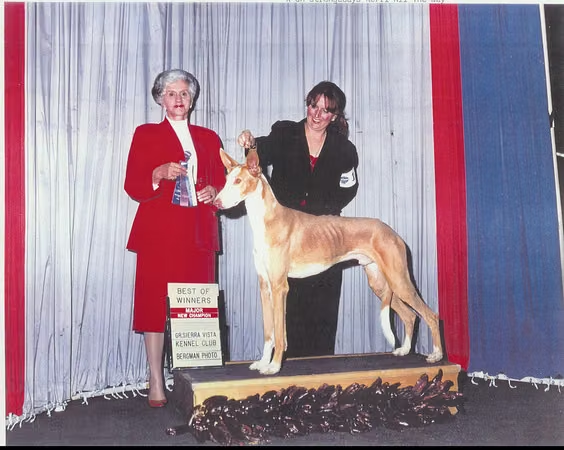
The Ibizan Hound is a graceful, agile sighthound known for its remarkable jumping ability and independent, dignified spirit.
How the Ibizan Hound coat is built, and what that means when you groom it.
A few of the Ibizan Hound profiles members have added to United Pet Club.
The Ibizan Hound is a medium-sized Spanish sighthound known for its high jump, keen senses and an independent, dignified nature suited to confident owners.
The Ibizan Hound is a rangy, long-legged sighthound that hunts mostly by sight and movement, backed up by sharp hearing and a decent nose. The tall, upright ears and amber eyes give the breed its distinctive look, and the body is built for speed over rough, rocky ground. Dogs of the breed come in deer red, white, or a mix of both, and stay slender even as adults.
The breed hails from Spain and is linked most closely with the island of Ibiza and the rest of the Balearic Islands. There it worked to course and flush rabbits over difficult terrain, a job that shaped its stamina, its vertical leap and its quick reactions. Those same instincts show up in companion dogs today, so a securely fenced garden and steady daily exercise matter a great deal.
At home the Ibizan Hound is quiet, tidy and reserved around strangers, though affectionate with its own family. It is an independent thinker that will make up its own mind about things, which suits owners who fancy a thoughtful, sensitive dog rather than one that is desperate to please.
| Attribute | Detail |
|---|---|
| Origin | Spain (Balearic Islands) |
| Size | Medium |
| Lifespan | 12 to 14 years |
| Group / role | Sighthound, rabbit hunter |
| Good with | Older children and considerate families; supervise around small pets |
The Ibizan Hound suits active people who can offer it daily running room behind a tall, secure fence and who like an independent companion. It is sensitive to rough handling and does best with patient, even-tempered owners. Households with small animals such as rabbits, cats or other pocket pets need to manage introductions with care, since the breed's chase drive runs strong.
The Ibizan Hound developed on Spain's Balearic Islands as a rabbit-hunting sighthound, later reaching Ireland and other countries as a companion and show dog.
The Ibizan Hound takes its name from Ibiza, one of Spain's Balearic Islands out in the western Mediterranean. It belongs to a wider family of lean, prick-eared hunting dogs found right around the Mediterranean basin, and for generations it earned its keep on the islands as a working rabbit dog.
On the islands the dogs hunted in packs, using sight, sound and scent together to find and flush rabbits across rocky, broken ground. Their worth lay in stamina and an exceptional vertical jump, which let them clear walls and scrubby brush without breaking stride. Because they earned their place through hunting rather than looks, breeding favoured function over a uniform appearance, and both smooth and wire coats turned up in litters.
The breed reached the United States in the 1950s, when imported dogs founded a breeding population outside the Mediterranean, and it later gained recognition from major kennel clubs, including the American Kennel Club toward the end of the twentieth century. In Ireland the breed remains rare, registered through the Irish Kennel Club rather than kept in any great numbers, and most Irish owners will come across it at sighthound shows or lure coursing meets rather than in the local park.
Today the Ibizan Hound is kept mainly as a companion and for lure coursing and other sighthound sports, though it is still worked as a hunting dog in parts of its homeland.
The Ibizan Hound is a tall, slender sighthound with large upright ears, amber eyes and a coat of red, white or red-and-white in smooth or wire varieties.
The Ibizan Hound has a finely built, athletic frame with a deep chest, a tucked-up abdomen and long, clean legs. The head is long and narrow, and the breed's most recognisable feature is a pair of large, erect ears that move expressively with every sound. The eyes are amber and the nose is flesh-coloured, which gives the breed its open, alert expression. The overall impression is one of elegance and pace rather than bulk.
| Trait | Standard |
|---|---|
| Height | Roughly 56 to 74 cm (22 to 29 in) at the shoulder |
| Weight | Roughly 20 to 29 kg (45 to 65 lb) |
| Coat | Two varieties: smooth (short) and wire (rough, longer) |
| Colours | Red, white, or red and white |
| Eyes | Amber, oval, giving an alert expression |
The breed comes in two coat types. The smooth coat is short and hard to the touch, while the wire coat is rougher and longer, sometimes with a slight beard. Neither takes much upkeep. Accepted colours are deer red, solid white, or any mix of red and white, with no preference given to one pattern over the other. The flesh-coloured nose, rims and lips match the pale colouring around the muzzle and round off the breed's characteristic look.
The Ibizan Hound is independent, wary of strangers and affectionate with its family, pairing athletic energy outdoors with a quiet, sensitive nature at home.
The Ibizan Hound is independent and carries itself with a certain dignity, traits that come down from generations of working at a distance from the hunter rather than at his heel. With its own family it is gentle and affectionate, often forming close bonds and seeking out soft, warm spots to curl up in. With strangers it tends to hang back rather than turn aggressive, taking its time to come round.
The breed is alert and quick to spot movement, and its strong chase instinct means small, fast-moving animals can set off a pursuit in an instant. With dog-savvy children and other dogs it generally gets on well, though early socialisation helps matters along. Indoors it is calm and tidy, but it needs genuine outlets for its energy and athleticism, not just a stroll round the block.
This is a sensitive breed that does not respond well to harsh corrections. It can turn reserved or shy if it is under-socialised, so steady, positive exposure to people and places in the first year pays off for life.
| Trait | Rating |
|---|---|
| Affection | 4 |
| Energy | 4 |
| Trainability | 3 |
| Vocalness | 2 |
| Shedding | 2 |
The Ibizan Hound needs daily vigorous exercise, secure fencing and only light grooming, plus a coat for cold snaps given its lean frame and thin coat.
The Ibizan Hound is a low-maintenance breed where grooming is concerned, but a demanding one when it comes to exercise and containment. Its short or wire coat sheds little and stays reasonably clean of its own accord.
The Ibizan Hound settles into home life well enough once its exercise needs are met, and it is quiet indoors. Given the lean body and thin coat, it feels the cold badly through a wet, changeable Irish winter, so a coat or jumper earns its keep on damp, raw days. A soft bed goes down well with this slim, lightly padded breed.
The Ibizan Hound thrives on a complete, high-quality diet measured to keep its naturally lean frame, usually fed as two meals a day once grown.
The Ibizan Hound is built to stay slim, with ribs that are only lightly covered and a clear waist. Feed a complete and balanced diet suited to the dog's age and activity level, and adjust portions to keep that lean shape rather than sticking to a fixed cup measure. Active or coursing dogs may need a bit more, while quieter pets need less. Because the breed has a deep chest, splitting the daily ration into two meals and holding off on hard exercise straight after eating are sensible precautions.
| Life stage | Amount per day | Meals |
|---|---|---|
| Puppy (2 to 6 months) | Per product guide for growth, divided | 3 to 4 |
| Junior (6 to 12 months) | Per product guide, tapering | 2 to 3 |
| Adult | Roughly 2 to 3 cups of quality dry food | 2 |
| Senior | Reduced to match lower activity | 2 |
Keep treats to a small share of the daily calories so the dog stays lean. A complete commercial diet usually needs no extra supplements; check with a vet before adding anything, particularly for growing pups. Fresh water should be on hand at all times.
The Ibizan Hound is a generally healthy breed living 12 to 14 years, though owners should watch for anaesthesia sensitivity plus eye and joint issues.
The Ibizan Hound is considered a hardy, generally healthy breed, with a typical lifespan of 12 to 14 years. As with other sighthounds, its low body fat affects how it copes with anaesthesia, so vets who know the breed type take extra care during procedures. Responsible breeders screen for eye and joint conditions, and routine care keeps most dogs in good shape throughout their lives.
| Condition | Signs | Note |
|---|---|---|
| Anaesthesia sensitivity | Slow recovery, unusual reaction during procedures | Common in lean sighthounds; tell the vet the breed type |
| Eye disorders (including retinal disease and cataracts) | Cloudiness, loss of night vision, bumping into things | Breeding stock should have eye screening |
| Hip dysplasia | Stiffness, reluctance to jump, altered gait | Less common than in heavier breeds but worth screening for |
| Allergies and skin sensitivity | Itching, redness, recurring ear trouble | Manage with veterinary guidance |
The Ibizan Hound is clever but independent, so it learns best through short, positive sessions and solid containment rather than off-lead recall in open spaces.
The Ibizan Hound is bright and capable but thinks for itself, a hangover from generations of working well away from direct human control. It is not a natural people-pleaser, so training rewards patience and consistency above all else. The breed is sensitive and shuts down under harsh methods, doing far better with food, play and praise. Recall is the hardest skill to make solid, since a moving rabbit, squirrel or cat will usually win out over any command. For that reason, off-lead freedom should be kept to fully enclosed areas only.
Ibizan Hounds reach breeding maturity around two years, carry litters of roughly six to eight pups after a typical nine-week pregnancy, and do best from health-screened parents.
Responsible breeding of the Ibizan Hound starts with health-screened parents, including eye and hip evaluation, and holds off until both dogs are physically and mentally mature, generally around two years of age. A standard canine pregnancy runs about 63 days from conception. Litters commonly range from six to eight pups, though smaller and larger litters do occur.
Pups are born helpless and depend entirely on the dam for the first few weeks. Gentle early handling and exposure to ordinary household sights and sounds matter a great deal for this sensitive breed, since temperament and confidence take shape during the early socialisation window. Pups usually go to new homes after eight weeks, well socialised and started on vaccinations and parasite control. Breeders should match this active, independent breed to homes ready for its exercise and containment needs, and in Ireland that often means a wait, given how few litters are bred here in any given year.
| Metric | Value |
|---|---|
| Breeding maturity | Around 2 years |
| Gestation | Approximately 63 days |
| Average litter size | 6 to 8 puppies |
| Weaning | Around 6 to 8 weeks |
| Recommended health screening | Eyes and hips |
Irish law wants every dog chipped and recorded; United Pet Club keeps your Ibizan Hound's record free, current, and there for life.
Get the profile sorted first: your Ibizan Hound's name, his date of birth, a photo, and your phone number, saved in a couple of minutes. The record is free for the whole of his life, and the chip number slots in whenever the vet has done his part. Dog registration is where it starts.
The implant is the vet's job; the record is down to you, and the 2015 rules assume you'll keep it current. Register the microchip free on the lifetime plan: whatever brand the vet reached for is grand, a house move costs nothing to record, and the number stays searchable day and night. Create your free account and have the pair of jobs done before the tea goes cold.
Set yourself up with a free United Pet Club account, key in your Ibizan Hound's details and a photo, and save. The profile holds for the whole of his life without charge, and the chip number can be lodged whenever you have it.
Lodge the fifteen digit chip number in your free account along with your address and phone number. The lifetime plan covers the registration and every update after it, free, whatever brand the vet used.
It is. The 2015 Regulations require every dog to be chipped and registered, pup or rescue alike. Keeping the record current is the part that falls to you, and United Pet Club makes that part free.
Not a penny. Profile, chip record, and every amendment are covered for life, with no renewal ever.
Common questions about the Ibizan Hound cover its size, temperament, care needs, lifespan, suitability for Irish homes, and how easy it is to find here.
It is a medium-sized sighthound, standing roughly 22 to 29 inches (56 to 74 cm) at the shoulder and weighing about 45 to 65 pounds (20 to 29 kg). The build is tall and slender rather than heavy.
It is independent, alert and reserved with strangers, while affectionate and quiet with its own family. Indoors it is calm and tidy, but outdoors it is full of energy and driven to chase.
Grooming is easy, with little shedding from its short or wire coat. The real challenge is meeting its exercise needs and putting up tall, secure fencing, since the breed is a remarkable jumper with a strong chase instinct.
The typical lifespan is 12 to 14 years. It is a generally healthy breed, though it is sensitive to anaesthesia and benefits from eye and joint screening in breeding stock.
It can be, for active families with older or dog-savvy children. It is gentle at home but needs patient, positive handling and careful management around small pets, given its prey drive.
Only in fully enclosed areas. Its recall is unreliable around moving animals, so freedom in open spaces is risky. A good daily run in a secure area is the safer way to burn off its energy.
They are an uncommon breed outside their Mediterranean homeland, and Ireland is no exception. Prospective owners often join a waiting list with a reputable breeder abroad or through the Irish Kennel Club, or look to breed-specific rescue instead.