
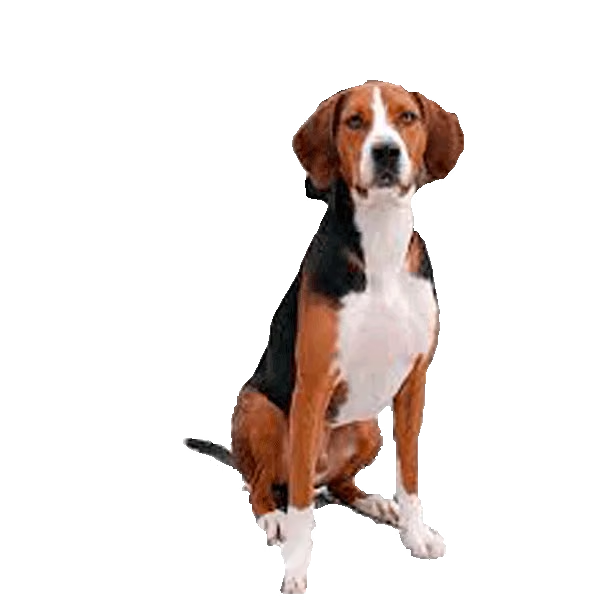
Hamiltonstovare
The Hamiltonstovare is a friendly, even-tempered Swedish scenthound that combines a keen nose with an affectionate home life.
- Size
- Medium
- Lifespan
- 12–15 years
- Origin
- Sweden
- Temperament
- Friendly
- Standard colors
- Black, White and Tan
Characteristics
Coat and grooming
How the Hamiltonstovare coat is built, and what that means when you groom it.
- Coat layers
- Double coat
- Coat texture
- Smooth
- Coat length
- Short
- Shedding
- Seasonal shedding
Grooming guidance
Critical: A Hamiltonstovare should not be shaved.
The undercoat keeps heat out as well as in, and the outer coat shields the skin from sun and insect bites. Clipping the whole coat off removes both. It often grows back patchy, soft or a different colour, and in some animals the guard hairs never return properly. Brush the undercoat out instead of cutting it off.
Information: A Hamiltonstovare drops its undercoat in heavy bursts.
The undercoat comes out in heavy bursts over a few weeks. An undercoat rake, or a bath followed by a proper blow-dry, clears it far faster than daily brushing. Clipping the coat down is not a shortcut for this.
Hamiltonstovare colors and patterns
What each club's breed standard says about every Hamiltonstovare color and pattern. Point at a ruling to see the club's own wording.
Breed standards describe the Hamiltonstovare in Black, White and Tan. Standard patterns: Tricolour.
| Color or pattern | FCI | AKC | UKC | KC | KUSA |
|---|---|---|---|---|---|
| Black | Standard (“black colour to form a mantle”) | Standard (“Tri-Colored”) | Standard (“black”) | Standard (“black colour to form a mantle over body”) | Standard (“black colour to form a mantle”) |
| White | Standard (“White markings as a blaze, on throat, upper side of neck”) | Standard (“Tri-Colored”) | Standard (“tip of tail and lower part of legs and feet white”) | Standard (“White colouring as a blaze on muzzle, on throat, brisket, tip of tail”) | Standard (“White markings as a blaze on throat, upper side of neck”) |
| Tan | Standard (“The tan colour can range from a golden tint to a rich, deep rusty red”) | Standard (“Tri-Colored”) | Standard (“Tan can range from golden tint to a rich, deep reddish-brown”) | Standard (“Tan ranges from golden to a rich, deep, rusty red”) | Standard (“The tan colour can range from a golden tint to a rich, deep, rusty red”) |
| Yellow | Disqualifying (“Two-coloured (yellow-white”) | Disqualifying (“Two-coloured (yellow-white”) | Fault (“Two colored (yellow and white”) | Not recognised | Disqualifying (“Bi-coloured (yellow-white”) |
| Albino | Disqualifying | Disqualifying | Disqualifying (“Albinism”) | Not recognised | Disqualifying |
| Patterns | |||||
| Tricolour | Standard (“Tricolour”) | Standard (“Tri-Colored”) | Standard (“Tri-color”) | Standard (“Tricolour”) | Standard (“Tricolour”) |
| Bicolour | Disqualifying (“Two-coloured (yellow-white, black-white, black-tan)”) | Disqualifying (“Two-coloured (yellow-white, black-white, black-tan)”) | Fault (“Two colored (yellow and white, black and white, black and tan)”) | Not recognised | Disqualifying (“Bi-coloured (yellow-white, black-white, black-tan)”) |
| Sable | Fault (“Undefined mantle with strong mixture of black and tan hairs”) | Fault (“Undefined mantle with strong mixture of black and tan hairs”) | Fault (“Black and brown hairs mixed together”) | Fault (“Lack of clear division between black and tan undesirable in an adult dog”) | Fault (“Undefined mantle with strong mixture of black and tan hairs”) |
| Tan point | Disqualifying (“Two-coloured (... black-tan)”) | Disqualifying (“Two-coloured (... black-tan)”) | Fault (“Two colored (... black and tan)”) | Fault (“Lack of white markings highly undesirable”) | Disqualifying (“Bi-coloured (... black-tan)”) |


| Color or pattern | FCI | AKC | UKC | KC | KUSA |
|---|---|---|---|---|---|
| Dark brown | Standard (“dark brown”) | Standard (“dark brown”) | Standard (“dark brown”) | Standard (“dark brown”) | Standard (“dark brown”) |
| Light brown | Fault (“Light eyes”) | Fault (“Light eyes”) | Fault (“Light eyes”) | No ruling | Fault (“Light eyes”) |
| Blue | Disqualifying (“Blue eyes, one or both”) | Disqualifying (“Blue eyes, one or both”) | No ruling | No ruling | Disqualifying (“Blue eyes, one or both”) |
| Patterns | |||||
| Odd-eyed | Disqualifying (“Blue eyes, one or both”) | Disqualifying (“Blue eyes, one or both”) | No ruling | No ruling | Disqualifying (“Blue eyes, one or both”) |

| Color or pattern | FCI | AKC | UKC | KC | KUSA |
|---|---|---|---|---|---|
| Black | Standard (“Black”) | Standard (“Black”) | Standard (“Black, fully pigmented”) | Standard (“Nose always black”) | Standard (“Black”) |
What the rulings mean
- Standard
- Described by the club's breed standard.
- Fault
- Named by the club's breed standard as a fault: the animal can be shown but is penalised.
- Disqualifying
- The club's breed standard disqualifies an animal of this colour or pattern.
- Not recognised
- The club does not accept this colour or pattern for the breed.
Color changes
How a Hamiltonstovare's colors can change over its life.
Blackchanges toRust
Coat · With body condition · can change back
Blackchanges toGrey
Coat · Progressive
Blackchanges toBrown
Coat · In the sun · can change back
Whitechanges toRoan
Coat · With age · from 2 weeks
Tan pointchanges toSaddle
Coat · With age · from 6 to 156 weeks
Blackchanges toSnow nose
Nose · With the season · can change back
Blackchanges toPink
Nose · With the season · can change back


Sources
Each ruling comes from the club's published breed standard or color list.
About the Hamiltonstovare
The Hamiltonstovare is a medium-sized Swedish scenthound, good-humoured and settled at home, with a strong nose that still wants proper daily work outdoors.
The Hamiltonstovare is a medium-sized scenthound from Sweden, bred to track hare and fox across snow-covered forest ground. It works alone rather than as part of a pack, following a scent trail and giving tongue so the hunter knows where the chase has gone. Like a good few European hounds, it wears a tricolour coat: black, brown (or tan), and white in a clearly marked pattern.
Off duty, the Hamiltonstovare is good-humoured and affectionate, the kind of dog that settles into family life without much fuss and grows attached to the people around it. It stays active and alert, with the stamina you would expect of a working hound, so it suits an owner who can manage daily exercise and give it something to occupy its head as well as its legs.
There are two sides to this breed that a prospective owner should weigh up: an easy, calm companion indoors and a determined tracker once it is out the back gate. A securely fenced garden and solid recall training matter here, since a hound with its nose down can switch off to everything else.
| Attribute | Detail |
|---|---|
| Origin | Sweden |
| Size | Medium |
| Lifespan | 12 to 15 years |
| Group/role | Scenthound, hunts hare and fox alone |
| Good with | Families and older children; keep an eye on it around small pets, given the hunting drive |
Who it suits
The Hamiltonstovare suits an active household able to offer long daily walks, runs, or proper scent work. Indoors it is well behaved, but it needs a decent outlet for its energy and its nose. Owners who hillwalk, run, or hunt will find it a steady partner underfoot. Anyone short on time for exercise, or keeping small animals that roam free in the garden, should think carefully about the breed's strong prey drive before taking one on.
History and origin
The Hamiltonstovare was bred in Sweden in the late nineteenth century, crossing English Foxhound and German hound lines to produce a hare hound suited to Swedish hunting country.
The breed is named after Count Adolf Patrick Hamilton, one of the founders of the Swedish Kennel Club, who developed the type in the late nineteenth century. He was after a scenthound that could hunt hare and fox across Swedish ground and stand up to a proper cold winter, something Irish owners can sympathise with even if our winters run wetter than cold.
To build the breed, Hamilton worked with imported hounds, including English Foxhounds and a number of German hound types. Careful crossing produced a tricolour dog with the nose, voice, and stamina to track game on its own rather than as part of a pack, which matched how hunting was done in Sweden at the time.
The Hamiltonstovare was shown to the public for the first time at a dog show in Stockholm in 1886, appearing under an earlier name before being renamed in honour of its creator. From there it went on to become one of the most common hunting hounds in Sweden.
At home the breed is still mainly a working hound, prized for its nose, though it also has a solid record as a companion. It is far less common outside Scandinavia, and in Ireland it stays a rare sight. It is recognised through the FCI system that the Irish Kennel Club also works under, so an Irish owner keen on the breed is more likely to be dealing with a Scandinavian or continental breeder than a home-grown litter.
Appearance
The Hamiltonstovare is a medium-sized, well-balanced tricolour scenthound with a black, brown, and white coat, drop ears, and a build made for going the distance rather than sprinting.
The Hamiltonstovare is a rectangular, well-balanced hound built for stamina rather than speed, more a distance runner than a sprinter. The head is fairly long, the nose black, and the eyes dark brown with a calm, steady expression. The ears sit high, hang close to the cheeks, and are of moderate length. The tail is carried more or less level with the back, not curled over it.
| Trait | Detail |
|---|---|
| Height | Dogs stand about 53 to 61 cm (about 21 to 24 in) at the withers; bitches about 49 to 57 cm (about 19 to 22.5 in) |
| Weight | About 23 to 27 kg (about 51 to 60 lb) |
| Coat | Short, close-lying double coat with a dense undercoat |
| Colour | Tricolour: black, brown (tan), and white |
| Eyes | Dark brown, calm expression |
Coat and colour
The coat lies short and flat against the body, with a weather-resistant undercoat that thickens up for winter, useful enough on a wet Irish day even if it was built with Swedish snow in mind. The defining pattern is tricolour: black across the top of the neck, back, and sides, brown markings on the head and legs, and white on the muzzle, a blaze, the neck, the chest, the feet, and the tip of the tail. The black saddle should be sharply defined, not mottled or patchy. That double coat sheds rain well and copes with damp better than most short-coated breeds, which suits Irish conditions even though it was originally developed for Scandinavian cold.
Temperament and behaviour
The Hamiltonstovare is friendly, even-tempered, and good-humoured at home, yet stays an active, alert worker with a strong scent drive once it is out and about.
The Hamiltonstovare is known for an even temper and a friendly, good-humoured manner. With its own family it is affectionate and settled, and it generally gets on well with children who have grown up alongside it. It makes a poor guard dog; most are sociable with people and greet strangers calmly rather than kicking up a fuss.
With other dogs the breed is usually easygoing, which fits a hound bred to work close to people and livestock. Small pets are another matter entirely. Built to chase hare and fox, the breed carries a strong prey drive, so cats and small animals need careful introductions and supervised time together, not a chance meeting in the back garden.
The Hamiltonstovare is alert and free with its voice. On a trail it bays to let the hunter know where it is, and at home it may bark at anything that catches its attention. Left to its own devices it can grow noisy and restless, so it does best with regular exercise and something to occupy its mind. It is a clever dog but an independent one, bred over generations to hunt alone and make its own calls on a scent.
| Trait | Rating |
|---|---|
| Affection | 5 |
| Energy | 4 |
| Trainability | 3 |
| Vocalness | 4 |
| Shedding | 3 |
Care and grooming
Grooming the Hamiltonstovare is no bother, but it needs plenty of daily exercise and a secure garden to keep its hunting drive in check.
Grooming
- Brush weekly with a bristle brush or grooming mitt to lift loose hair and spread the skin's natural oils.
- Expect a heavier shed during the seasonal coat change, when brushing more often helps keep on top of it.
- Bathe only when the dog is genuinely dirty; the short coat sheds dried mud easily enough on its own, which is handy given how often Irish ground is wet underfoot.
- Check the drop ears regularly and clean them as needed, since hanging ears trap moisture, and Irish damp does them no favours.
- Trim nails every few weeks and brush teeth several times a week.
Exercise
- Give at least an hour or two of activity daily, split between walks and time off lead to run properly.
- Offer scent games, tracking, or trailing work to use the breed's nose and tire the mind as well as the legs.
- Keep the dog on the lead or inside a fenced area out in open country, since a scent can override recall in an instant.
- Build a reliable recall early and reward it every single time.
Environment
The Hamiltonstovare suits a house with a securely fenced garden far better than a flat, mostly down to its exercise needs and its habit of giving voice when something interests it. The double coat copes well with cold, in keeping with its Swedish background, and handles an Irish winter's damp without much trouble either, though the dog still needs proper shelter and should not be left outdoors alone for long stretches. It is happiest living in close quarters with its family, with daily access to the outdoors rather than a garden it only sees through a window.
Diet and feeding
As an active medium scenthound, the Hamiltonstovare does well on a complete diet matched to its energy level, fed in measured meals so it does not creep up in weight.
The Hamiltonstovare needs a complete, balanced diet suited to a medium-sized, active dog. A working dog or one exercised hard will need more food than a companion kept on a lighter routine, so portions should be judged by the dog's body condition rather than a fixed figure on a bag. You should be able to feel the ribs without seeing them, and there should be a visible waist when you look down at the dog from above. Adjust the amount up or down according to weight, age, and activity level.
| Life stage | Amount per day | Meals |
|---|---|---|
| Puppy (2 to 6 months) | Follow the product guide for growth | 3 to 4 |
| Junior (6 to 12 months) | Tapering down toward the adult amount | 2 to 3 |
| Adult | Roughly 250 to 350 g of quality dry food | 2 |
| Senior | Slightly reduced, keep an eye on weight | 2 |
Treats and supplements
Treats should stay within roughly ten percent of daily calories, which matters for a food-motivated hound used regularly in scent-based training. Use small, low-calorie rewards during sessions and knock them off the meal portions for that day. A complete commercial diet usually covers nutritional needs without extra supplements, so check with a vet before adding anything for joints, skin, or other purposes, and make sure fresh water is out for the dog at all times.
Health and lifespan
The Hamiltonstovare is generally a hardy breed with a typical lifespan of 12 to 15 years, and routine care plus regular ear checks are the main ongoing jobs for an owner.
The Hamiltonstovare is regarded as a robust, healthy breed without a long list of conditions particular to it. With good care it typically lives 12 to 15 years. As with most medium-sized dogs, the concerns owners should watch for are general rather than specific to the breed, and responsible breeding together with routine veterinary care keeps the population sound. The drop ears deserve real attention, since they trap moisture easily, particularly in an Irish climate, and that can lead to infection if left unchecked.
| Condition | Signs | Note |
|---|---|---|
| Ear infections | Head shaking, scratching, odour, discharge | Drop ears need regular checking and cleaning |
| Hip dysplasia | Stiffness, reluctance to exercise, altered gait | Choose breeders who screen their breeding stock |
| Weight gain | Loss of waistline, low energy | Watch portion sizes; the breed is food-driven |
| Minor injuries | Limping, cuts, thorns or burrs caught in coat or pads | Active outdoor work means more chances of scrapes |
Preventive care
- Keep vaccinations and parasite control (fleas, ticks, worms) up to date.
- Check and clean the ears regularly, especially after a walk in wet weather, which in Ireland is often enough.
- Keep the dog at a healthy weight with measured meals and daily exercise.
- Book an annual veterinary check-up, with more frequent visits once the dog is a senior.
- Brush teeth regularly to keep on top of dental health.
Training
The Hamiltonstovare is intelligent but independent, so early, consistent, reward-based training works best, with recall getting the lion's share of the attention.
The Hamiltonstovare is a clever dog, but it was bred to hunt alone and follow its own nose, which makes it more independent than the eager-to-please breeds. Training works best when it is consistent, patient, and rewarding rather than repetitive. Short, varied sessions hold the dog's attention far better than long drills ever will. Recall deserves special effort, because a hound with its nose down on a scent can tune out commands completely; start training it as a pup and keep reinforcing it for life. Early socialisation with people, other dogs, and any animals already in the household helps the breed grow into a steady, sensible adult.
Basics
- Start socialisation and gentle handling as a pup.
- Teach name response and attention before moving on to harder skills.
- Build a strong recall with high-value food rewards in a quiet setting first, then add distractions bit by bit.
- Practise lead walking to manage pulling once a scent catches its attention.
- Add scent or tracking games to channel the breed's natural drive properly.
- Keep sessions short, end on a success, and repeat daily.
Breeding
The Hamiltonstovare reaches breeding maturity in its second year, carries an average-sized litter after roughly two months, and does best with health-screened parents on both sides.
Hamiltonstovare bitches generally should not be bred from until they are physically and mentally mature, usually after their first year and often well into the second. As with most dogs, pregnancy runs roughly 63 days from mating to whelping. Litter sizes are typical for a medium breed, commonly six to eight puppies, though this varies from one dam to the next.
Responsible breeders select for the breed's even temperament and working ability, and screen both dam and sire for general health, including hip status, before any mating takes place. Puppies should stay with the dam and littermates until around eight weeks old, which supports early socialisation. Rearing pups involves gradual weaning, early handling, exposure to household sights and sounds, and the start of toilet and crate routines. Anyone looking to get a puppy should seek out breeders who raise litters in the home and can provide health and temperament information on both parents. Since the breed is scarce in Ireland, that search may well lead to a breeder in Sweden or elsewhere in Scandinavia, so ask about import paperwork and Irish Kennel Club registration requirements in good time.
| Metric | Value |
|---|---|
| Breeding maturity | Typically the second year |
| Gestation | About 63 days |
| Average litter size | About 6 to 8 puppies |
| Weaning | Around 4 to 8 weeks |
| Leaving for a new home | About 8 weeks |
Registering your Hamiltonstovare in Ireland, chip and record both
Irish law wants every dog chipped and recorded; United Pet Club keeps your Hamiltonstovare's record free, current, and there for life.
How to register a Hamiltonstovare in Ireland
Irish law has required every dog to be chipped and registered since the 2015 Regulations came in, and it expects the details behind the chip to stay current, not gather dust. A free United Pet Club profile does that for your Hamiltonstovare, for life. Registering your dog is a few minutes' work and costs nothing at all.
Lodge your Hamiltonstovare's fifteen digit number with United Pet Club and the chip finally earns its keep: free registration for life, every brand accepted, and a record the ISPCA or any warden can turn into a phone call. Microchip registration takes minutes, and the free account covers the profile while you're at it.
How do I register my Hamiltonstovare in Ireland?
Set yourself up with a free United Pet Club account, key in your Hamiltonstovare's details and a photo, and save. The profile holds for the whole of his life without charge, and the chip number can be lodged whenever you have it.
How do I register my Hamiltonstovare's microchip?
Lodge the fifteen digit chip number in your free account along with your address and phone number. The lifetime plan covers the registration and every update after it, free, whatever brand the vet used.
Is microchipping a Hamiltonstovare required in Ireland?
It is. The 2015 Regulations require every dog to be chipped and registered, pup or rescue alike. Keeping the record current is the part that falls to you, and United Pet Club makes that part free.
What does it cost to register a Hamiltonstovare in Ireland?
Not a penny. Profile, chip record, and every amendment are covered for life, with no renewal ever.
Frequently asked questions
Common questions Irish owners ask about the Hamiltonstovare cover its size, temperament, care needs, lifespan, suitability, and how easy it is to find one here.
How big do Hamiltonstovares get?
It is a medium-sized hound. Dogs stand about 53 to 61 cm (about 21 to 24 in) at the shoulder and bitches about 49 to 57 cm (about 19 to 22.5 in), with most weighing somewhere between 23 and 27 kg (about 51 to 60 lb).
What is a Hamiltonstovare's temperament like?
It is friendly, even-tempered, and good-humoured at home, and affectionate with its own family. It also stays active and alert outdoors, with a strong hunting nose and a habit of giving voice when something interests it.
Are Hamiltonstovares hard work to look after?
Grooming is no bother thanks to the short coat, but the breed needs plenty of daily exercise and mental stimulation. The real challenge is meeting its activity needs and managing its scent drive, not the coat care.
How long do Hamiltonstovares live for?
The typical lifespan is 12 to 15 years. The breed is generally hardy, and routine veterinary care, a healthy weight, and regular ear checks all help towards a long life.
Are Hamiltonstovares good with children?
Yes, for an active family. It is sociable and good with children it has grown up around, but its prey drive means small pets need careful introductions and supervision.
Do Hamiltonstovares get on with other dogs?
They are usually easygoing with other dogs, which fits a hound bred to work close to people. Early socialisation still helps it grow into a confident, well-mannered adult.
Where can I get a Hamiltonstovare in Ireland?
The breed is scarce here. It is far more common in Sweden and the rest of Scandinavia, so an Irish owner will likely need to contact breed clubs abroad or wait on a litter from a reputable breeder and arrange an import, including Irish Kennel Club paperwork.
From the community
Ask about the HamiltonstovareNo questions about the Hamiltonstovare yet. Be the first to ask.
Browse Dog breeds