
Great Pyrenees
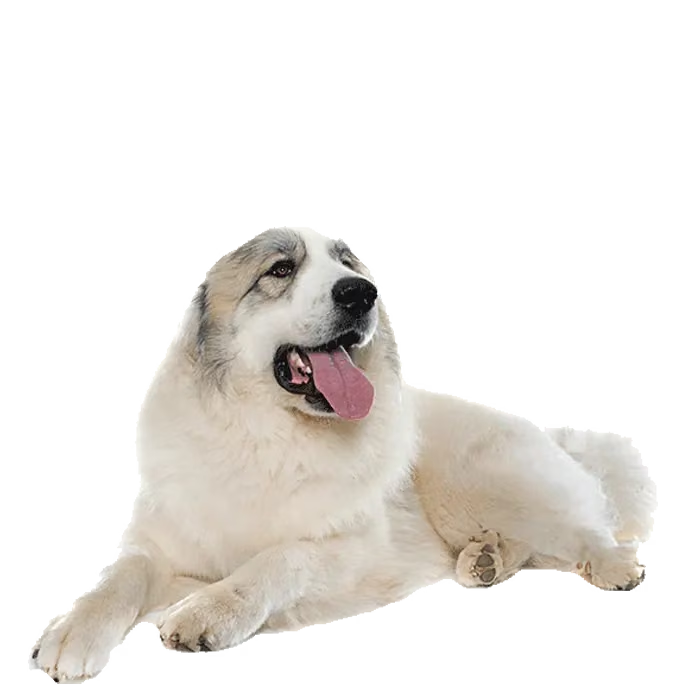
The Great Pyrenees is a calm, majestic livestock guardian known for its gentle devotion to family and unwavering protective instincts.
- Size
- Giant
- Lifespan
- 10–12 years
- Origin
- France
- Temperament
- Calm
- Standard colors
- White, Grey and Badger grey and 5 more
Characteristics
Coat and grooming
How the Great Pyrenees coat is built, and what that means when you groom it.
- Coat layers
- Double coat
- Coat texture
- Rough
- Coat length
- Long
- Shedding
- Seasonal shedding
Grooming guidance
Critical: A Great Pyrenees should not be shaved.
The undercoat keeps heat out as well as in, and the outer coat shields the skin from sun and insect bites. Clipping the whole coat off removes both. It often grows back patchy, soft or a different colour, and in some animals the guard hairs never return properly. Brush the undercoat out instead of cutting it off.
Caution: A Great Pyrenees coat mats easily.
Fine or long hair tangles at the base of the coat, out of sight, where the mats tighten and pull on the skin. Brushing has to reach right down to the roots in sections, not just skim the surface.
Information: A Great Pyrenees drops its undercoat in heavy bursts.
The undercoat comes out in heavy bursts over a few weeks. An undercoat rake, or a bath followed by a proper blow-dry, clears it far faster than daily brushing. Clipping the coat down is not a shortcut for this.
Great Pyrenees colors and patterns
What each club's breed standard says about every Great Pyrenees color and pattern. Point at a ruling to see the club's own wording.
Breed standards describe the Great Pyrenees in White, Grey, Badger grey, Brown, Tan, Orange, Lemon and Beige. Standard patterns: Solid, Bicolour and Agouti.
| Color or pattern | FCI | UKC | KC | KUSA | AKC |
|---|---|---|---|---|---|
| White | Standard (“White”) | Standard (“Solid white”) | Standard (“White”) | Standard (“White”) | Standard (“White”) |
| Grey | Standard (“patches appearing grey (badger or wolf)”) | Standard (“grey (badger or wolf)”) | Standard (“wolf-grey”) | Standard (“patches appearing grey (badger or wolf)”) | Standard (“Gray Markings”) |
| Badger grey | Standard (“The most appreciated are badger grey patches”) | No ruling | No ruling | No ruling | No ruling |
| Brown | Disqualifying | Disqualifying | Fault | Disqualifying | Standard (“Reddish Brown Markings”) |
| Tan | Standard (“pale yellow or orange (arrouye)”) | Standard (“pale yellow or orange (shades of tan)”) | Standard (“tan”) | Standard (“pale yellow or orange (arrouye)”) | Standard (“Tan Markings”) |
| Orange | Standard (“orange (arrouye)”) | Standard (“orange (shades of tan)”) | Standard (“orange”) | Standard (“orange (arrouye)”) | No ruling |
| Lemon | Standard (“pale yellow”) | Standard (“pale yellow”) | Standard (“paler shades of lemon”) | Standard (“pale yellow”) | No ruling |
| Beige | Disqualifying | Disqualifying | Standard (“White & Beige”) | Disqualifying | No ruling |
| Black | Disqualifying | Disqualifying | Fault (“Black patches going right down to the roots highly undesirable”) | Disqualifying | No ruling |
| Patterns | |||||
| Solid | Standard (“White”) | Standard (“Solid white”) | Standard (“White”) | Standard (“White”) | Standard (“White”) |
| Bicolour | Standard (“white with patches”) | Standard (“white with color patches”) | Standard (“White with patches”) | Standard (“white with patches”) | Standard (“white with markings”) |
| Agouti | Standard (“grey (badger or wolf)”) | Standard (“grey (badger or wolf)”) | Standard (“wolf-grey”) | Standard (“grey (badger or wolf)”) | No ruling |


| Color or pattern | FCI | UKC | KC | KUSA | AKC |
|---|---|---|---|---|---|
| Dark brown | No ruling | No ruling | No ruling | No ruling | Standard (“rich dark brown”) |
| Amber | Standard (“amber-brown”) | Standard (“amber-brown”) | Standard (“dark amber-brown”) | Standard (“amber-brown”) | No ruling |
| Yellow | Disqualifying (“Yellow eyes”) | Fault (“Yellow eyes”) | No ruling | Disqualifying (“Yellow eyes”) | No ruling |
| Color or pattern | FCI | UKC | KC | KUSA | AKC |
|---|---|---|---|---|---|
| Black | Standard (“Totally black”) | Standard (“Always completely black”) | Standard (“Black nose”) | Standard (“Totally black”) | Standard (“The nose and lips are black”) |
| Liver | Disqualifying | Disqualifying | Fault (“Liver or pink pigmentation highly undesirable”) | Disqualifying | No ruling |
| Pink | Disqualifying | Disqualifying | Fault (“Liver or pink pigmentation highly undesirable”) | Disqualifying | Fault (“Missing pigmentation on nose”) |
| Patterns | |||||
| Butterfly nose | Disqualifying (“Nose: Not completely black”) | Disqualifying (“Nose not completely black”) | No ruling | Disqualifying (“Nose: Not completely black”) | Fault (“Missing pigmentation on nose”) |

What the rulings mean
- Standard
- Described by the club's breed standard.
- Fault
- Named by the club's breed standard as a fault: the animal can be shown but is penalised.
- Disqualifying
- The club's breed standard disqualifies an animal of this colour or pattern.
Color changes
How a Great Pyrenees's colors can change over its life.
Blackchanges toRust
Coat · With body condition · can change back
Blackchanges toGrey
Coat · Progressive
Blackchanges toBrown
Coat · In the sun · can change back
Whitechanges toRoan
Coat · With age · from 2 weeks
Blackchanges toSnow nose
Nose · With the season · can change back
Blackchanges toPink
Nose · With the season · can change back


Sources
Each ruling comes from the club's published breed standard or color list.
Meet some of our Great Pyrenees
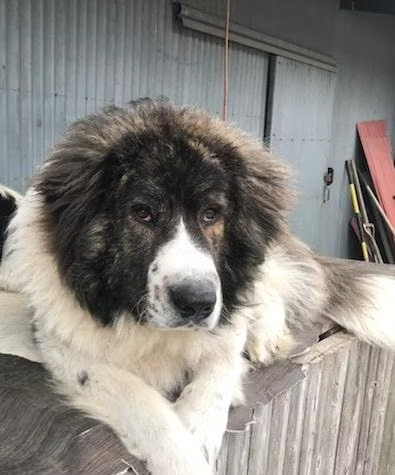
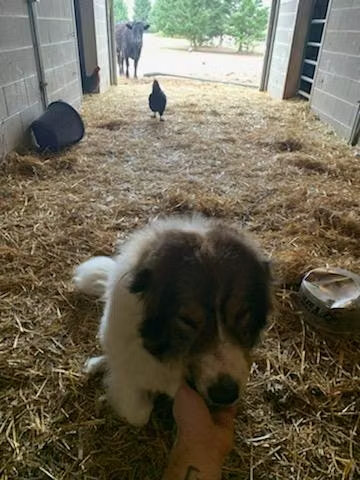
A few of the Great Pyrenees profiles members have added to United Pet Club.
About the Great Pyrenees
A giant French flock guardian, the Great Pyrenees is gentle and settled with its household while remaining alert to anything it treats as a threat.
The Great Pyrenees is a giant working breed raised in the Pyrenees range that marks the border of France and Spain. Shepherds kept these dogs at altitude for centuries to hold wolves and bears away from sheep and goats. The result is a dog that spends most of its day quietly, then acts without hesitation once it judges something to be wrong.
Grown dogs are among the tallest and heaviest of all breeds, wrapped in a dense white coat suited to raw upland weather that would not feel out of place in an Irish winter. For all its bulk the breed is soft in manner with the people and animals it takes into its care, and it usually gets on well with children.
What comes with the guarding instinct is a mind of its own. The Pyrenees was bred to reach decisions alone on a hillside, so it tends to consider a request before answering it. Owners speak of a warm, placid dog by the fireside that will still bark overnight and walk the boundary of the garden to its own routine.
| Attribute | Detail |
|---|---|
| Origin | France (Pyrenees Mountains) |
| Size | Giant |
| Lifespan | 10 to 12 years |
| Group / role | Working group, livestock guardian |
| Good with | Family, children, livestock; supervise around small unfamiliar animals |
Who it suits
The breed suits a household with space, ideally a securely fenced garden or a smallholding, that wants a calm companion and a natural watchdog. It does best with people who can accept heavy shedding, regular barking, and a dog that will not always come when called. It is a poor match for a flat, off-lead freedom in open country, or anyone expecting brisk, parade-ground obedience.
History and origin
From the French Pyrenees, the breed guarded flocks for generations before it was taken up by the French court and later recognised as a show and working dog.
The Great Pyrenees, called the Chien de Montagne des Pyrenees in France, is named for the mountains dividing France and Spain. Large white guardian dogs of this kind are very old, with remains of similar upland dogs in the region dating back thousands of years. Shepherds in the French Pyrenees settled the working breed much as it stands today.
Generation after generation the dogs lived out with the flocks through the seasons. They worked in pairs or small teams, minding the sheep against wolves and bears while shepherds and herding dogs directed movement. A white coat let the shepherd tell his guardians from predators at range.
The seventeenth century brought status. The dog became fashionable at the French court, where it was named a guardian of the chateau, and that favour carried the breed across France and raised its standing.
Broader recognition came through the nineteenth and twentieth centuries, with working dogs still on the mountains as show lines took shape in parallel. Today the Great Pyrenees lives as a companion and, in many places, still guards stock on farms and hill grazing, including on Irish holdings.
Appearance and breed standard
A giant dog under a weatherproof white double coat, with a broad head, dark eyes, and double dewclaws on the hind legs.
The Great Pyrenees is large and strongly made without looking heavy or awkward. The body runs a little longer than tall, and the dog moves at a steady, unhurried pace. The head is wedge-shaped with a slightly rounded crown, medium triangular ears held close to the head, and a black nose and lip edges. One clear breed marker is the double dewclaws on each hind leg.
| Trait | Standard |
|---|---|
| Height | Males 69 to 81 cm (27 to 32 in); females 63 to 74 cm (25 to 29 in) |
| Weight | Males 45 kg (100 lb) and up; females 39 kg (85 lb) and up |
| Coat | Thick weatherproof double coat, coarse outer, dense undercoat |
| Colours | White, or white with markings of grey, tan, reddish-brown, or badger |
| Eyes | Medium, almond-shaped, dark brown |
Coat and colours
The coat is the feature most people notice first. The outer layer is long, flat, and coarse, while the undercoat is soft and dense for warmth. Males often carry a fuller mane about the neck and shoulders. The base colour is white, and markings of grey, tan, reddish-brown, or badger may appear on the head, ears, and tail base, all allowed in the standard. The coat resists matting better than its length suggests, but it sheds heavily, above all during the seasonal change of coat.
Temperament and personality
Calm and affectionate with its own people, naturally cautious of strangers, and protective, with an independent streak rooted in its guardian past.
Indoors the Great Pyrenees is quiet and unruffled, content to lie near the family and watch the room. It is usually gentle with children and patient with the animals it was reared alongside, and it grows deeply attached to the people it minds.
Strangers meet a reserved dog rather than a friendly one. It reads a new person before it accepts them and is naturally suspicious of anyone coming onto its ground, which makes for a sound watchdog but means steady socialisation from early on is important.
Guarding runs through the daily pattern. The Pyrenees barks to see off what it treats as a threat, most of all after dark, and patrols the ground by itself. Bred to act without direction, it does not always yield to a command. Around small unfamiliar animals it may be predatory or simply wary, so introductions call for supervision.
| Trait | Rating |
|---|---|
| Affection | 5 |
| Energy | 2 |
| Trainability | 2 |
| Vocalness | 5 |
| Shedding | 5 |
Everyday care
Regular brushing for a heavy coat, moderate daily exercise, and a secure garden with room to patrol.
Grooming
- Brush the coat once or twice weekly, and daily through the seasonal shed
- Use an undercoat rake and slicker brush to reach the dense undercoat
- Check and clean the ears often, as they lie close to the head
- Trim nails every few weeks, the hind double dewclaws included
- Bathe now and then; the coat sheds dirt fairly well between baths
Exercise
- Give a daily walk plus a securely fenced garden to use
- Keep activity moderate; this is a steady worker, not a runner
- Keep the dog on the lead or behind a fence, since recall is unreliable and it will wander
- Avoid hard exercise in warm spells, above all for pups whose joints are still forming
Environment
The Great Pyrenees is built for cold and copes poorly with real heat. The mild, damp Irish climate suits it well, though shade, fresh water, and a cool spot still matter on the warmer summer days. It wants outdoor space to patrol and is not a flat dog. A secure fence is essential, because the breed roams and may try to push its boundary outward. Night barking is normal and worth planning for where a footpath or neighbours run close to the garden.
Feeding and nutrition
A giant breed needing a complete diet, controlled growth in puppyhood, and measured portions to protect the joints and reduce bloat risk.
Feed a complete, balanced diet made for large or giant breeds. Despite its size the Pyrenees is not a busy dog, so it needs fewer calories per kilo than a working gundog and gains weight readily if overfed. Amounts depend on age, weight, and activity, so treat the label as a starting point and adjust to keep the dog lean.
Giant-breed pups need particular care. They should grow slowly on a large-breed puppy formula with controlled calcium and energy, since fast growth raises the risk of joint and bone trouble. Offer several smaller meals a day rather than one large feed.
| Life stage | Amount per day | Meals |
|---|---|---|
| Puppy (2 to 12 months) | Per large-breed puppy formula, controlled growth | 3 to 4 |
| Adult | Roughly 4 to 8 cups depending on weight and activity | 2 |
| Senior | Slightly fewer calories, watch the weight | 2 |
Treats and supplements
Keep treats to a small share of the daily calories to head off weight gain on a frame already carrying a great deal of mass. Many owners and vets consider joint support such as glucosamine for a giant breed, but raise any supplement with your vet rather than adding it on assumption. Keep fresh water available at all times.
Health and common conditions
Typically 10 to 12 years of life, with the giant-breed risks of hip dysplasia, bloat, and joint problems that good care can help manage.
The Great Pyrenees generally lives 10 to 12 years, which is normal for a giant breed. Most stay healthy with good care, but the big frame brings the risks common to large dogs, chiefly around the joints and the stomach. A breeder who screens breeding stock and an owner who keeps the dog lean both cut the odds of trouble.
| Condition | Signs | Note |
|---|---|---|
| Hip and elbow dysplasia | Limping, stiffness, trouble rising | Common in giant breeds; ask about parent screening |
| Bloat (gastric torsion) | Swollen abdomen, retching, distress | Life-threatening emergency; act at once |
| Patellar luxation | Skipping or hopping on a hind leg | Affects the kneecap; severity varies |
| Bone and joint issues from fast growth | Lameness in young dogs | Controlled puppy diet lowers the risk |
Preventive care
- Keep up routine veterinary checkups and core vaccinations
- Hold the dog at a lean weight to ease the joints
- Feed measured meals and avoid hard activity straight after eating to lower bloat risk
- Keep up dental care and parasite control
- Ask the breeder about hip, elbow, and other screening of the parents
Training and socialisation
Intelligent but independent, so training rewards early socialisation, patience, and steady reward-based methods over drilling.
The Great Pyrenees is clever but was bred to work alone and decide for itself, so it does not train like a biddable collie or gundog. It may know a command and still weigh up whether to obey. Training asks for patience and consistency, and harsh correction tends to make the breed switch off or resist. Broad, early socialisation is the most valuable thing an owner can do, since it tempers the natural wariness of strangers.
Recall is the particular weak spot. Many of these dogs never become reliable off the lead, so secure fencing and lead control beat trusting a trained recall.
Basics
- Begin socialisation early, meeting many people, places, and animals
- Teach name response and a sit before harder skills
- Keep sessions short and end on a success to hold the dog's interest
- Reward calm, settled behaviour, which suits the temperament
- Manage roaming and barking with fencing and routine, not command alone
Breeding and raising young
Large litters and giant-breed pups that need slow, controlled growth and early socialisation to become stable adults.
Breeding a giant guardian is a serious undertaking and is best left to experienced breeders who screen for health. Bitches are usually bred only once fully mature, which comes later in giant breeds than in small dogs. Careful breeders test the parents for hip, elbow, and other heritable problems before any pairing.
Gestation runs about 63 days. The Pyrenees often has large litters, and the pups grow fast into very big dogs. Because quick growth raises the risk of joint and bone problems, pups should be reared on a controlled giant-breed diet rather than pushed for size.
Early handling and socialisation count for a great deal. Guardian pups that meet many people and situations in their first months are far likelier to settle into stable, manageable adults. Pups usually stay with the litter to at least eight weeks so they learn normal behaviour from the dam and littermates.
| Metric | Value |
|---|---|
| Gestation | Approximately 63 days |
| Typical litter size | 6 to 9 puppies |
| Weaning age | Around 6 to 8 weeks |
| Recommended go-home age | 8 weeks or later |
| Maturity | Slow; full growth and breeding maturity later than small breeds |
Registering your Great Pyrenees in Ireland, chip and record both
Irish law wants every dog chipped and recorded; United Pet Club keeps your Great Pyrenees's record free, current, and there for life.
How to register a Great Pyrenees in Ireland
A dog warden with a scanner can only follow the record, and a Great Pyrenees whose record is current is home the same day. Register your dog free with United Pet Club: your contact details, his photo, and his chip number together on one profile that never lapses and never bills you.
The implant is the vet's job; the record is down to you, and the 2015 rules assume you'll keep it current. Register the microchip free on the lifetime plan: whatever brand the vet reached for is grand, a house move costs nothing to record, and the number stays searchable day and night. Create your free account and have the pair of jobs done before the tea goes cold.
How do I register my Great Pyrenees in Ireland?
Set yourself up with a free United Pet Club account, key in your Great Pyrenees's details and a photo, and save. The profile holds for the whole of his life without charge, and the chip number can be lodged whenever you have it.
How do I register my Great Pyrenees's microchip?
Lodge the fifteen digit chip number in your free account along with your address and phone number. The lifetime plan covers the registration and every update after it, free, whatever brand the vet used.
Is microchipping a Great Pyrenees required in Ireland?
It is. The 2015 Regulations require every dog to be chipped and registered, pup or rescue alike. Keeping the record current is the part that falls to you, and United Pet Club makes that part free.
What does it cost to register a Great Pyrenees in Ireland?
Not a penny. Profile, chip record, and every amendment are covered for life, with no renewal ever.
Frequently asked questions
Common questions on the size, temperament, care, lifespan, and suitability of the Great Pyrenees.
How big does a Great Pyrenees get?
It is a giant breed. Males stand about 69 to 81 cm at the shoulder and weigh from 45 kg upward; females stand about 63 to 74 cm and weigh from 39 kg upward.
Is the Great Pyrenees good with families and children?
Yes. The breed is generally calm, gentle, and patient with children and devoted to its family. As with any large dog, time around small children should be supervised.
Is a Great Pyrenees hard to care for?
It is moderately demanding. The heavy coat needs regular brushing and sheds heavily, the dog barks and roams, and recall is unreliable. Exercise needs are moderate, but a secure garden and time for grooming are essential.
How long do Great Pyrenees live?
Most live about 10 to 12 years, which is typical for a giant breed.
Is the Great Pyrenees a good guard dog?
It is an excellent watchdog and flock guardian by nature: alert, protective, and wary of strangers, and it barks to warn off what it treats as a threat, above all at night.
Does the Great Pyrenees do well in flats or hot climates?
Not in either. The breed needs room to patrol and a secure garden, and its thick double coat means it copes poorly with real heat. The mild Irish climate suits it, but shade and water still matter on warm days.
Are Great Pyrenees easy to train?
They are intelligent but independent, so they do not obey as readily as some breeds. Early socialisation and patient, positive, consistent training give the best results, and off-lead recall often stays unreliable.
From the community
Ask about the Great PyreneesNo questions about the Great Pyrenees yet. Be the first to ask.
Browse Dog breeds