The Clumber Spaniel is a dignified, heavy-boned English gun dog, known for its mellow, gentle nature and devoted companionship.
How the Clumber Spaniel coat is built, and what that means when you groom it.
Critical: A Clumber Spaniel should not be shaved.
The undercoat keeps heat out as well as in, and the outer coat shields the skin from sun and insect bites. Clipping the whole coat off removes both. It often grows back patchy, soft or a different colour, and in some animals the guard hairs never return properly. Brush the undercoat out instead of cutting it off.
Caution: A Clumber Spaniel coat mats easily.
Fine or long hair tangles at the base of the coat, out of sight, where the mats tighten and pull on the skin. Brushing has to reach right down to the roots in sections, not just skim the surface.
A few of the Clumber Spaniel profiles members have added to United Pet Club.
The Clumber Spaniel is a long, low, heavy-boned English gun dog with a quiet, affectionate temperament, built for steady work and suited to a calm household.
The Clumber Spaniel is a long, low, heavy-boned spaniel developed in England as a gun dog. It is the heaviest of the spaniel breeds by build, sitting low to the ground compared with field and springer types. The breed is known for a steady, unhurried manner both in the field and in the home.
Clumbers were bred to work close to the gun, pushing through dense cover at a slow, deliberate pace. That working style shapes the modern dog, which is methodical rather than fast and is content with a moderate level of activity.
At home the Clumber is quiet and people-focused. It forms strong attachments to its family and is generally gentle with children and other animals. The breed sheds and drools, and the heavy coat needs routine care.
| Attribute | Detail |
|---|---|
| Origin | England |
| Size | Medium (heavy-boned, low to the ground) |
| Lifespan | 10 to 12 years |
| Group/role | Gundog Group (IKC); flushing spaniel |
| Good with | Children, other dogs, and household pets when socialised |
The Clumber Spaniel suits owners who want a calm, affectionate companion and can accept regular grooming, shedding, and some drool. Its unhurried, dignified character is a good fit for quieter households, older owners, or families with settled routines. The breed is not common in Ireland, but those who find one will have a devoted, good-natured dog that asks for steady daily walks rather than high-intensity exercise.
The Clumber Spaniel takes its name from Clumber Park in Nottinghamshire and was developed as a gun dog on English aristocratic estates from the 18th century.
The breed is named after Clumber Park, the Nottinghamshire estate of the Dukes of Newcastle. The exact origins are not fully documented, but the breed took shape in England in the late 18th and early 19th centuries among large country estates that kept dogs for shooting game.
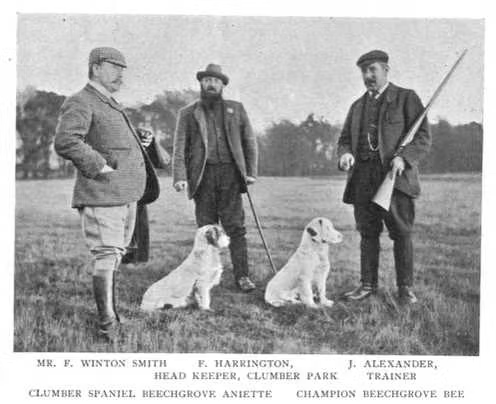
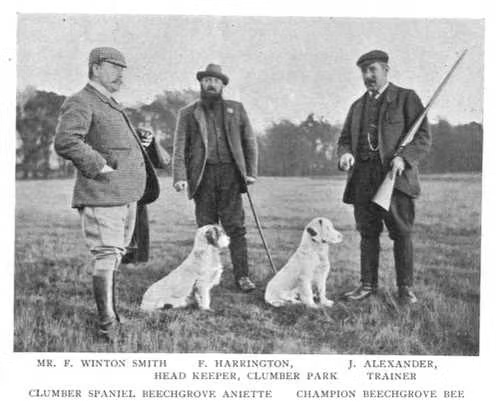
A common account credits the Duke of Newcastle's gamekeeper, William Mansell, with developing and refining the breed at Clumber Park. The dogs were used to flush game from heavy cover and to work close to the gun in a slow, quiet style suited to driven shoots and rough ground.
The Clumber was among the first breeds recognised by The Kennel Club in England in the 19th century and was also among the first breeds registered in formal records in North America. It is recognised by the Irish Kennel Club (IKC) in the Gundog Group. The breed has a small but genuine following among Irish dog owners, though IKC-registered breeders remain rare.
In Ireland, the Clumber can work woodcock in deciduous and conifer woodland during the season (October to January, as regulated by the NPWS). Its slow, methodical pace suits bushy terrain and dense cover, though the breed is rarely seen in competitive Irish field trials, where the English Springer and Cocker Spaniel are far more common.
The Clumber has stayed uncommon throughout the 20th century and into the present. Dedicated breed clubs in England and elsewhere maintain the standard and support responsible breeding programmes.
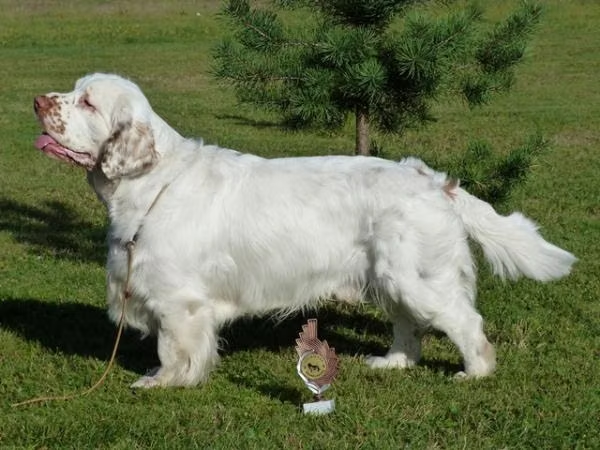
The Clumber Spaniel is a long, low, heavily built dog with a broad head, a predominantly white coat with lemon or orange markings, and a deliberate, rolling gait.
The Clumber Spaniel has a substantial, rectangular outline. The body is long and the legs are short and thick, giving the dog a low centre of gravity. The head is large and heavy with a broad muzzle, a pronounced brow, and loose facial skin. The eyes are deep-set and the ears are large and triangular, set low and hanging close to the head.
The overall impression is of strength and weight rather than speed. The breed moves with a steady, rolling stride that reflects its long body and short legs.
| Trait | Detail |
|---|---|
| Height | Roughly 17 to 20 inches (43 to 51 cm) at the shoulder |
| Weight | About 55 to 85 pounds (25 to 39 kg), males heavier than females |
| Coat | Dense, straight, flat coat with feathering on the legs, chest, and ears |
| Colour | Predominantly white with lemon or orange markings |
| Eyes | Deep-set, amber to dark, with some visible haw |
The coat is mainly white, which made the dog easy to spot when working in dense cover. Markings are limited to lemon (pale tan) or orange and usually appear on the head and around the base of the tail, with freckling sometimes present on the muzzle and legs. The coat is weather-resistant and well suited to Ireland's cool, damp conditions, but it needs regular brushing to manage shedding and prevent matting in the feathered areas.
The Clumber Spaniel is affectionate, gentle, and calm, devoted to its household, quietly reserved with strangers, and generally easygoing with other pets.
The Clumber Spaniel is a quiet, good-natured dog that bonds closely with its household. It is affectionate and likes to stay near its people, often following family members from room to room. The breed is calm indoors and is not prone to restlessness or excessive activity.
With strangers the Clumber tends to be reserved rather than nervous or aggressive. It often warms up slowly and may simply observe newcomers before approaching. The breed is not a strong watchdog and does not bark a great deal.
Clumbers are usually gentle with children and tolerant of other dogs and household pets, especially when raised together. Their easygoing nature makes them well suited to settled, quieter households. They can be stubborn at times and respond best to patient, consistent handling. Because they are so attached to their people, they do not do well if left alone for long periods.
| Trait | Rating |
|---|---|
| Affection | 5 |
| Energy | 2 |
| Trainability | 3 |
| Vocalness | 2 |
| Shedding | 4 |
The Clumber Spaniel needs regular brushing, moderate daily exercise, and careful weight management, and is happiest kept as an indoor companion close to its family.
The Clumber Spaniel is an indoor dog that wants to be with its family. It adapts to houses and apartments as long as it gets daily walks, but it should not be left alone for long stretches. The breed prefers cooler conditions and needs shade and water in warm weather. Its short legs and long body mean stairs and slick floors should be managed to reduce strain on the back and joints.
Feed the Clumber Spaniel a balanced dog food in measured meals, watch portions carefully because the breed gains weight easily, and avoid foods toxic to dogs.
The Clumber Spaniel does well on a complete and balanced commercial dog food suited to its age and activity level. Because the breed is prone to weight gain, portions should be measured and meals kept to a schedule rather than left out for free feeding. Daily amounts depend on the dog's weight, age, and activity level, so the figures below are general guidance. Fresh water should be available at all times.
| Life stage | Amount per day | Meals per day |
|---|---|---|
| Puppy (2 to 6 months) | Per food label for growth, divided across meals | 3 to 4 |
| Adolescent (6 to 12 months) | About 2 to 3 cups, adjusted to growth | 2 to 3 |
| Adult | About 2 to 3 cups, based on weight and activity | 2 |
| Senior | Adjusted slightly lower to prevent weight gain | 2 |
Keep treats to no more than about 10 percent of daily calories and subtract them from meal portions to avoid overfeeding. A balanced complete diet usually meets a healthy dog's needs without extra supplements. Joint supplements or specific additions should be used only on the advice of a vet, particularly given the breed's heavy build and joint sensitivity.
The Clumber Spaniel lives 10 to 12 years and is prone to joint problems, ear and eye issues, and weight gain; preventive care and a healthy weight matter greatly.
The Clumber Spaniel generally lives 10 to 12 years. The breed's long body and heavy bone make it more prone to joint and back problems than lighter dogs, and its build also makes weight control important. Responsible breeders screen for inherited conditions, and anyone buying a puppy should ask to see health test results for both parents.
| Condition | Signs | Note |
|---|---|---|
| Hip dysplasia | Stiffness, limping, reluctance to rise or climb stairs | Joint malformation; managed with weight control and veterinary care |
| Elbow dysplasia | Front-leg lameness, especially after exercise | Screened by breeders through joint evaluation |
| Ear infections | Head shaking, odour, scratching at the ears | The long, low ears trap moisture; regular cleaning helps |
| Eye problems | Redness, discharge, cloudiness, rubbing at the eyes | Includes entropion and ectropion linked to loose lids |
| Obesity | Excess weight, low stamina, difficulty feeling the ribs | Adds strain to the back and joints; manage diet and exercise |
The Clumber Spaniel is intelligent but can be stubborn, so it trains best with patient, reward-based methods, short sessions, and early socialisation.
The Clumber Spaniel is a thinking dog that learns well but can be independent and slow to comply when it sees no reason to cooperate. It does not respond to harsh handling. Short, consistent sessions with clear rewards work better than repetition or pressure. The breed's strong food motivation can be used to keep training productive, with care taken not to overfeed.
Clumber Spaniels reach sexual maturity around 12 months, carry litters for about 63 days, and produce litters averaging roughly three to seven puppies.
Female Clumber Spaniels typically reach sexual maturity between about 6 and 12 months of age, but responsible breeders wait until the female is physically mature and has passed health screening before breeding, usually around two years. Mating is timed to the female's heat cycle. Gestation lasts about 63 days from conception.
Litter size varies, with an average of roughly three to seven puppies. Puppies are born without sight or hearing and depend fully on the mother in the early weeks. Weaning usually begins around three to four weeks, and puppies stay with the mother and littermates until at least eight weeks to support healthy social development.
Because the breed is uncommon in Ireland, planned litters from health-tested parents may involve a waiting list. Anyone seeking a Clumber puppy in Ireland should contact IKC-registered breeders or the Clumber Spaniel Club of Great Britain for breeder referrals. Breeding should be left to experienced, responsible breeders who screen for hip, elbow, and eye conditions and who follow the breed standard.
| Metric | Value |
|---|---|
| Sexual maturity | About 6 to 12 months |
| Recommended first breeding | Around 2 years, after health testing |
| Gestation | About 63 days |
| Average litter size | Roughly 3 to 7 puppies |
| Weaning age | About 3 to 4 weeks, begins gradually |
| Leave for new home | 8 weeks or later |
Irish law wants every dog chipped and recorded; United Pet Club keeps your Clumber Spaniel's record free, current, and there for life.
Irish law has required every dog to be chipped and registered since the 2015 Regulations came in, and it expects the details behind the chip to stay current, not gather dust. A free United Pet Club profile does that for your Clumber Spaniel, for life. Registering your dog is a few minutes' work and costs nothing at all.
The implant is the vet's job; the record is down to you, and the 2015 rules assume you'll keep it current. Register the microchip free on the lifetime plan: whatever brand the vet reached for is grand, a house move costs nothing to record, and the number stays searchable day and night. Create your free account and have the pair of jobs done before the tea goes cold.
Set yourself up with a free United Pet Club account, key in your Clumber Spaniel's details and a photo, and save. The profile holds for the whole of his life without charge, and the chip number can be lodged whenever you have it.
Lodge the fifteen digit chip number in your free account along with your address and phone number. The lifetime plan covers the registration and every update after it, free, whatever brand the vet used.
It is. The 2015 Regulations require every dog to be chipped and registered, pup or rescue alike. Keeping the record current is the part that falls to you, and United Pet Club makes that part free.
Not a penny. Profile, chip record, and every amendment are covered for life, with no renewal ever.
Common questions about the Clumber Spaniel in Ireland cover its size, temperament, grooming, lifespan, suitability for families, and where to find a breeder.
The Clumber is a medium-sized but heavy-boned breed. Most stand about 17 to 20 inches at the shoulder and weigh roughly 55 to 85 pounds, with males larger than females. The long body and short legs make the dog heavier than it looks for its height.
Yes. The breed is affectionate, gentle, and calm, and is generally good with children and other pets when socialised. It bonds closely with its family and prefers company, so it suits households where someone is home for much of the day.
They are not difficult, but they do need routine grooming. Expect to brush the coat several times a week, clean the long ears regularly, manage shedding, and wipe drool. Keeping the dog lean is important because the breed gains weight easily.
The typical lifespan is 10 to 12 years. Regular vet checks, a healthy weight, and attention to joint and ear health all support a full life.
Yes to both. The dense coat sheds year round, more heavily at times, and the breed drools, especially around meals. Owners who want a low-shedding, dry-mouthed dog may find this breed challenging.
Moderate exercise suits the breed. One or two walks a day with time to sniff and explore is usually enough. The Clumber is calmer than most spaniels and is prone to overheating, so strenuous activity in warm weather should be avoided. Ireland's cool climate is generally comfortable for the breed.
Clumber Spaniel breeders are very rare in Ireland. Check the Irish Kennel Club (IKC) breed register and contact the Clumber Spaniel Club of Great Britain for breeder referrals. Importing from the UK is a common route; it requires a microchip, rabies vaccination, and an EU or UK pet passport under the Pet Travel Scheme.