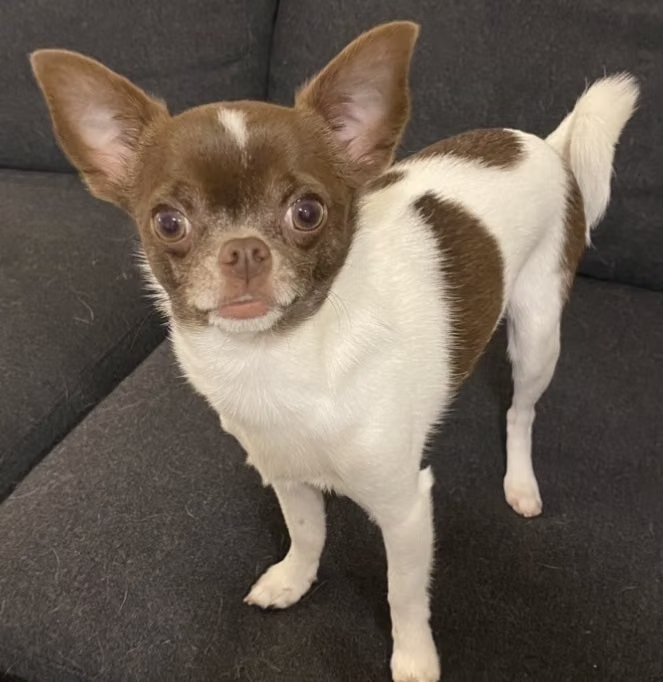
The Chihuahua is a devoted, big-personality toy breed known for its spirited charm, alertness, and intense loyalty to its chosen person.
How the Chihuahua coat is built, and what that means when you groom it.
A few of the Chihuahua profiles members have added to United Pet Club.
The Chihuahua is a toy dog from Mexico, known for its tiny frame, big personality and close bond with one person. It typically lives 14 to 16 years.
The Chihuahua ranks among the smallest dog breeds anywhere in the world. A typical adult tips the scales at under 6 lb and stands somewhere between 5 and 8 inches at the shoulder. For all that, the breed carries itself with a bold, alert confidence that catches out anyone expecting a timid lapdog.
Chihuahuas attach themselves fiercely to their people, and it is common for a dog to settle on one favourite in the household. They keep a sharp eye on anything unfamiliar and will bark to say so, which makes them surprisingly good little watchdogs. Two coat types exist, smooth and long, and the breed appears in a huge range of colours.
Their size makes Chihuahuas a natural fit for flats and smaller homes. They get by on far less space and exercise than a bigger dog would need, though they still need a daily walk, some training and regular company to stay settled and confident.
| Attribute | Detail |
|---|---|
| Origin | Mexico |
| Size | Toy (under 6 lb) |
| Lifespan | 14 to 16 years |
| Group / role | Toy / companion and watchdog |
| Good with | Adults, gentle older children, calm households |
A Chihuahua suits someone after a small, portable companion who can offer it consistent time and attention. It is a sound choice for apartment or flat dwellers, people living alone, and older owners who want a dog with modest exercise needs. Households with very young children are less suitable, since the breed is delicate and can be hurt by rough handling.
The Chihuahua originated in Mexico and takes its name from the Mexican state of Chihuahua, where the modern type first appeared in the mid-1800s.
Most agree the Chihuahua is a native Mexican breed, most likely descended from the Techichi, a small companion dog kept by central Mexican peoples long before Europeans arrived. Carvings and pottery from these cultures depict small dogs with features close to today's Chihuahua.
The breed's name comes from the Mexican state of Chihuahua. Around the mid-19th century, American visitors are said to have bought small dogs from the region, and interest in the type spread once they were brought north.
The American Kennel Club registered its first Chihuahua in 1904, a step that helped settle the breed standard and build its popularity in the United States. The earliest registered dogs were mostly smooth-coated, with the long-coated variety recognised later on.
By the middle of the 20th century the Chihuahua had become one of the most popular toy breeds in North America, and it has stayed a fixture in Ireland too: the Irish Kennel Club (IKC), the national registry for pedigree dogs here, lists the Chihuahua among its recognised toy breeds. Both coat varieties are judged to the same standard, differing only in coat length.
The Chihuahua is a tiny, compact dog with a rounded apple-shaped head, large upright ears and prominent eyes, in smooth or long coats and many colours.
The Chihuahua has a small, well-balanced body, slightly longer than it is tall. Its defining feature is the apple-shaped head with a clear stop, set off by large, fully erect ears and round, expressive eyes. The tail is moderately long and carried up or curled over the back.
| Trait | Detail |
|---|---|
| Height | 5 to 8 in (13 to 20 cm) |
| Weight | Up to 6 lb (2.7 kg) |
| Coat | Smooth (short) or long |
| Colours | Any colour, solid, marked or splashed |
| Eyes | Large, round, set well apart |
The smooth coat lies close to the body, soft and glossy. The long coat is soft too, flat or slightly wavy, with feathering on the ears, legs and tail. Colour is unrestricted under the standard, so dogs turn up in fawn, black, white, chocolate, cream, blue and countless combinations, including merle in some registries. Coat type has no bearing on temperament, only on how much grooming a dog needs.
The Chihuahua is affectionate, devoted and spirited, with a confident, alert nature. It bonds tightly with its owner and can be wary or vocal with strangers.
The Chihuahua is deeply affectionate and fiercely loyal, and it often singles out one favourite person to stick close to. Within the family it is playful and devoted. Around strangers it tends to be guarded and will bark to announce a visitor, which keeps it alert but occasionally a bit noisy for the neighbours.
Confidence runs through the breed, sometimes to the point where a Chihuahua will square up to a dog many times its size. Early socialisation goes a long way towards softening that suspicion and cutting down on nervy or snappy behaviour. Around other pets, a well-socialised Chihuahua can settle in fine, although it often prefers the company of its own kind.
With children, the breed does best around gentle, older kids who understand how fragile it is. Rough or sudden handling can frighten a Chihuahua and provoke a defensive nip.
| Trait | Rating |
|---|---|
| Affection | 5 |
| Energy | 3 |
| Trainability | 3 |
| Vocalness | 4 |
| Shedding | 2 |
The Chihuahua needs light grooming, short daily exercise and a warm environment. Its small size means it chills quickly and needs careful handling.
The Chihuahua suits apartment living and smaller homes well. It feels the cold fast, and Ireland's damp, cool climate is a real change from the warm conditions the breed comes from in Mexico, so a jumper on winter walks and a warm bed indoors make a real difference. The breed likes to stay close to its owner and does not cope well with being left alone for long stretches.
The Chihuahua needs a small daily amount of quality food, split across several meals, to support a fast metabolism and avoid low blood sugar.
The Chihuahua's metabolism runs fast for its size, and the breed can be prone to low blood sugar, particularly as a puppy. Pick a complete food made for small or toy breeds, with kibble small enough to chew comfortably. Measure portions carefully, because even a small amount of overfeeding shows up as weight gain on such a tiny frame.
| Life stage | Amount per day | Meals |
|---|---|---|
| Puppy (2 to 6 months) | Small amounts, free access or 4 meals | 3 to 4 |
| Junior (6 to 12 months) | About 1/4 to 1/2 cup | 3 |
| Adult | About 1/4 to 1/2 cup | 2 to 3 |
| Senior | Adjusted for activity, slightly less | 2 |
Keep treats to roughly 10 percent of daily calories at most. Small training treats, or a few pieces of the dog's own kibble held back from its meal, work well. Most Chihuahuas on a complete diet need no supplements, though a vet may recommend dental or joint support for individual dogs. Fresh water should be available at all times.
The Chihuahua is generally long-lived at 14 to 16 years, but prone to dental disease, luxating patella, heart issues and hypoglycaemia.
The Chihuahua is on the whole a healthy, long-lived breed, typically reaching 14 to 16 years of age. Most of its health risks trace back to its small size: crowded teeth, a fragile skeleton, and a tendency toward low blood sugar in young or particularly small dogs. Responsible breeding and routine veterinary care keep most of these risks in check.
| Condition | Signs | Note |
|---|---|---|
| Dental disease | Bad breath, tartar, loose teeth | Toy breeds crowd teeth; brush and clean regularly |
| Luxating patella | Skipping, occasional hind-leg hopping | Kneecap slips; mild cases managed, severe may need surgery |
| Heart disease | Coughing, tiring, reduced stamina | Includes valve disease in older dogs |
| Hypoglycaemia | Weakness, shaking, collapse | Mainly puppies and very small adults; feed frequently |
| Tracheal collapse | Honking cough, especially on a collar | Use a harness to reduce throat pressure |
The Chihuahua is intelligent and trainable but can be stubborn and slow to housetrain. Consistent, gentle, reward-based methods work best.
The Chihuahua is a bright little dog, capable of picking up a good range of commands and tricks. It can also be strong-willed, and many owners find housetraining the slowest part of raising one, partly because such a small bladder needs frequent trips outside. Short, consistent sessions and a clear routine bring the best results. Since the breed can turn timid or sharp under pressure, harsh corrections tend to backfire, making a dog more fearful or snappy rather than better behaved.
Chihuahua breeding calls for care because of the breed's small size, which raises whelping risks. Litters are small, usually one to three pups.
Breeding Chihuahuas takes care, since the breed's small size raises the risk of a difficult birth. Females can reach sexual maturity within their first year, but responsible breeders hold off until a bitch is fully physically mature and has cleared health screening for patella and heart conditions before any mating goes ahead.
Gestation runs to about 63 days, and litters tend to be small, commonly one to three pups. Narrow pelvic dimensions in some lines mean a caesarean section comes up more often in this breed than in larger dogs, so veterinary supervision around the due date matters.
Newborn pups are tiny and vulnerable to chilling and low blood sugar. They need a warm, draught-free whelping area, frequent nursing and close monitoring of weight gain. Pups should stay with the dam until at least eight weeks old, with gentle early handling to help socialisation along.
| Metric | Value |
|---|---|
| Sexual maturity | Around 6 to 12 months |
| Recommended first breeding | After full physical maturity |
| Gestation | About 63 days |
| Average litter size | 1 to 3 puppies |
| Weaning age | About 4 to 7 weeks |
| Leave dam | 8 weeks or later |
Irish law wants every dog chipped and recorded; United Pet Club keeps your Chihuahua's record free, current, and there for life.
A dog warden with a scanner can only follow the record, and a Chihuahua whose record is current is home the same day. Register your dog free with United Pet Club: your contact details, his photo, and his chip number together on one profile that never lapses and never bills you.
The implant is the vet's job; the record is down to you, and the 2015 rules assume you'll keep it current. Register the microchip free on the lifetime plan: whatever brand the vet reached for is grand, a house move costs nothing to record, and the number stays searchable day and night. Create your free account and have the pair of jobs done before the tea goes cold.
Set yourself up with a free United Pet Club account, key in your Chihuahua's details and a photo, and save. The profile holds for the whole of his life without charge, and the chip number can be lodged whenever you have it.
Lodge the fifteen digit chip number in your free account along with your address and phone number. The lifetime plan covers the registration and every update after it, free, whatever brand the vet used.
It is. The 2015 Regulations require every dog to be chipped and registered, pup or rescue alike. Keeping the record current is the part that falls to you, and United Pet Club makes that part free.
Not a penny. Profile, chip record, and every amendment are covered for life, with no renewal ever.
Common questions about the Chihuahua cover its size, temperament, care needs, lifespan, suitability for families and availability.
The Chihuahua is a toy breed. Adults usually weigh under 6 lb and stand about 5 to 8 inches at the shoulder, which makes it one of the smallest dog breeds around.
It is affectionate, devoted and spirited, with a confident, alert nature. The breed bonds closely with its owner and is often watchful and vocal around strangers.
Day-to-day care is modest. Grooming is light, exercise needs are low, and the breed suits smaller homes well. The main demands are dental care, gentle handling, and keeping the dog warm, since it chills quickly.
Chihuahuas are long-lived for dogs, typically reaching 14 to 16 years when kept at a healthy weight and given routine veterinary and dental care.
They do best with gentle, older children, since their small frame is fragile and rough handling can cause injury or a defensive nip. With early socialisation, they can get along with other pets too.
They are intelligent but can be stubborn, and housetraining often takes patience. Short, consistent, reward-based sessions bring the best results.
The Chihuahua is one of the more common toy breeds, available through breeders and turning up regularly in rescues and shelters. Look for breeders registered with the Irish Kennel Club who screen for patella and heart conditions.