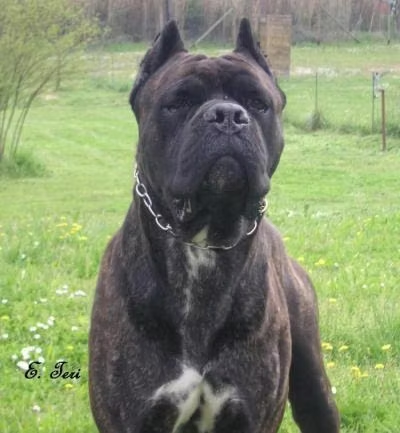
The Cane Corso is a protective, confident Italian mastiff renowned for its imposing presence and deep devotion to its family.
How the Cane Corso coat is built, and what that means when you groom it.
Critical: A Cane Corso should not be shaved.
The undercoat keeps heat out as well as in, and the outer coat shields the skin from sun and insect bites. Clipping the whole coat off removes both. It often grows back patchy, soft or a different colour, and in some animals the guard hairs never return properly. Brush the undercoat out instead of cutting it off.
Information: A Cane Corso drops its undercoat in heavy bursts.
The undercoat comes out in heavy bursts over a few weeks. An undercoat rake, or a bath followed by a proper blow-dry, clears it far faster than daily brushing. Clipping the coat down is not a shortcut for this.
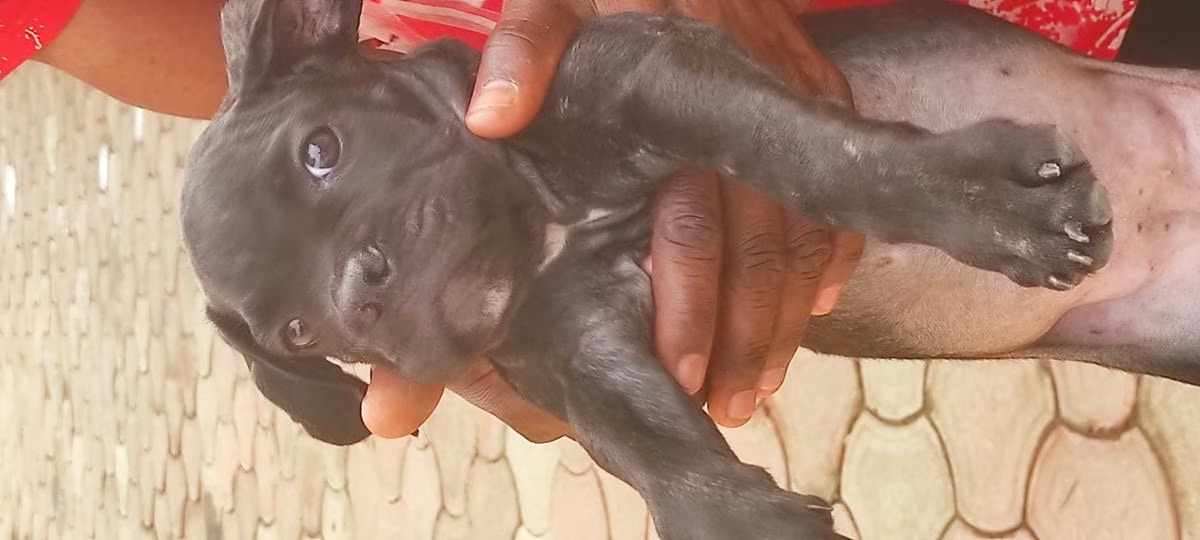
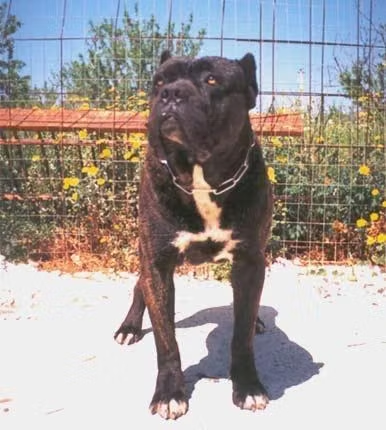
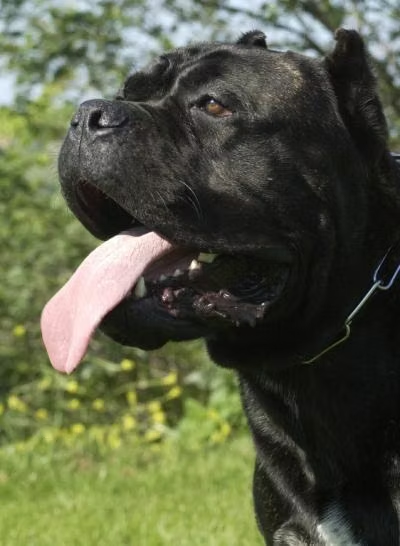
A few of the Cane Corso profiles members have added to United Pet Club.
The Cane Corso is a large Italian mastiff bred for guarding, with a powerful frame and a close bond to its family.
The Cane Corso is a big, powerfully built working dog that originated in Italy, one of several mastiff types developed on the Italian peninsula. Males generally stand 25 to 27.5 inches at the shoulder and weigh around 100 to 110 pounds, with females somewhat smaller. The build is muscular and solid, with a broad skull and a short, dense coat.
Its name comes from the Latin cohors, meaning guardian or protector, and for generations the breed earned its keep on Italian farms and estates, guarding property and stock and helping to manage larger animals. That working background still shows through in the dog you meet today: self-assured, watchful, and devoted to its own people.
At home a Cane Corso tends to be settled and undemanding, but it stays alert to anything out of place. It is a clever, biddable dog, though its size and protective streak mean it needs an owner willing to provide firm, consistent handling and plenty of early socialisation.
| Attribute | Detail |
|---|---|
| Origin | Italy |
| Size | Large (100 to 110 lb for males) |
| Lifespan | 9 to 12 years |
| Group / role | Working dog, guard dog |
| Good with | Its own family and, with early socialisation, children; supervise around strangers and unfamiliar dogs |
The Cane Corso suits an experienced owner who can commit to daily exercise, ongoing training and consistent leadership. A home with secure fencing and enough room for a large dog to move about suits it best. It is not the right choice for first-time owners or for households that cannot keep a close eye on visitors and other animals around the dog.
The Cane Corso descends from Roman-era working mastiffs of Italy and was rescued from near extinction by Italian breeders in the late twentieth century.
The Cane Corso's roots go back to the working mastiffs of ancient Italy, generally linked to the canis pugnax kept by the Roman army and to the wider family of mastiff breeds that spread around the Mediterranean. Once the Roman period ended, these dogs settled into rural life, guarding farms, driving livestock and helping hunt large game such as wild boar.
For centuries it stayed a regional working dog, most common in the south of Italy, particularly Puglia and the districts around it. Its survival had nothing to do with any formal register and everything to do with how useful it was on the farm, so it developed as a working guardian rather than a show dog.
The move to mechanised farming, together with the upheavals of the twentieth century, cut the need for farm guardians, and the breed's numbers fell sharply. By the 1970s the Cane Corso was on the brink of disappearing altogether. A group of Italian enthusiasts, among them breeders linked to Giovanni Bonatti and the Society Amorati Cane Corso, founded in 1983, tracked down surviving dogs and set about a structured recovery.
The Italian kennel club, ENCI, recognised the breed in 1994, and the Federation Cynologique Internationale followed in 2007. The American Kennel Club recognised the Cane Corso in 2010. Today it is also registered through national bodies such as the Irish Kennel Club, Ireland's registry for pedigree dogs, and the breed has gone from a farm dog on the edge of extinction to an established breed kept both as a guardian and as a companion.
The Cane Corso is a large, muscular mastiff with a broad head, a short dense coat and colours ranging from black and fawn to brindle and grey.
The Cane Corso is a big, athletic mastiff built for strength rather than sheer bulk. The body is slightly longer than it is tall, with heavy bone, a deep chest and clearly defined muscle. The head is broad with a marked stop, and the muzzle is wide and close to square. The overall expression is alert and serious rather than soft.
The ears are naturally dropped and sit close to the cheeks. Cropping has traditionally been practised in some regions, though it is restricted or banned in a number of countries. The tail is set high and is sometimes docked where the law allows it.
| Trait | Standard |
|---|---|
| Height | Males 25 to 27.5 in; females 23.5 to 26 in at the shoulder |
| Weight | Roughly 100 to 110 lb (males); 88 to 99 lb (females) |
| Coat | Short, dense and stiff, with a light undercoat |
| Colours | Black, fawn, red, grey (blue) and brindle variants |
| Eyes | Medium, oval, dark preferred; shade varies with coat colour |
The coat is short, dense and lies flat against the body, with a light undercoat that thickens up in cold weather. Accepted colours include black, several shades of fawn and red, and grey, often called blue. Brindle patterns show over fawn or grey bases, and fawn or red dogs usually carry a dark mask on the muzzle. Small white markings on the chest, throat, toes or chin are common and generally acceptable.
The Cane Corso is loyal, confident and protective, calm with its family but naturally wary of strangers, so it needs early socialisation.
The Cane Corso attaches itself firmly to its family and settles quickly into the rhythm of the household. Indoors it is usually quiet and calm, happy to stay close to its owners rather than seek out activity for its own sake. It keeps a natural watch over the home without any prompting.
Around people it doesn't know, the breed tends to be reserved and watchful rather than immediately friendly. It rarely warms to strangers on first meeting, which is exactly why ongoing socialisation matters: a well-socialised dog can tell an ordinary visitor from an actual threat. With children in its own family it is generally gentle and patient, though given its size, time with young children is best supervised.
It can be territorial with other dogs and animals, and some individuals show aggression toward dogs of the same sex. Rearing it alongside other pets from an early age and managing introductions with care cuts down on friction. This is a confident, strong-minded breed, and it needs an owner who sets boundaries and sticks to them.
| Trait | Rating |
|---|---|
| Affection (with family) | 5 |
| Energy | 3 |
| Trainability | 4 |
| Vocalness | 2 |
| Shedding | 3 |
The Cane Corso needs daily exercise and firm handling, but its short coat keeps grooming straightforward, with a weekly brush and routine upkeep.
The Cane Corso does best in a home with secure fencing and space to move about. Ireland's cool, damp climate for much of the year is manageable enough outdoors, but the short coat gives limited protection against the cold, and the heavy build makes the dog prone to overheating in warm spells, so a genuinely warm, dry indoor space matters more than people might expect for a dog this size. It bonds closely with its people and does not cope well with being left alone for long stretches.
The Cane Corso needs a complete diet suited to large breeds, fed in measured meals to support muscle without piling on weight or growing too fast.
Feed a complete, balanced diet formulated for large or giant breeds. Most adults do well on roughly 4 to 8 cups of good-quality dry food a day, split into two meals, with the exact amount depending on age, weight and activity level. Splitting the daily ration into two meals rather than one large one is generally recommended for deep-chested breeds, as it helps lower the risk of bloat.
Puppies need a large-breed puppy formula that supports slow, steady growth rather than a rapid growth spurt, which can put strain on developing joints. Keep fresh water down at all times, and measure out food rather than leaving it available all day, to keep the dog at a lean body condition.
| Life stage | Amount per day | Meals |
|---|---|---|
| Puppy (2 to 6 months) | Per large-breed puppy formula label | 3 to 4 |
| Adolescent (6 to 18 months) | 3 to 6 cups | 2 to 3 |
| Adult | 4 to 8 cups | 2 |
| Senior | Adjusted down for activity level | 2 |
Keep treats to around ten per cent of daily calories, since it's easy for a dog this size to put on weight. Some owners add joint supplements such as glucosamine and chondroitin, given the breed's tendency toward hip and elbow problems, but check with a vet before introducing any supplement.
The Cane Corso is generally robust, living 9 to 12 years, but as a large mastiff it is prone to hip dysplasia, bloat and certain joint and eye conditions.
The Cane Corso is, on the whole, a sound breed, but like most large mastiffs it has a comparatively short lifespan of around 9 to 12 years and carries a handful of breed-related health risks. Responsible breeders screen their stock for orthopaedic and other inherited conditions, and anyone buying a puppy should ask to see the health-test results for both parents.
| Condition | Signs | Note |
|---|---|---|
| Hip and elbow dysplasia | Stiffness, limping, reluctance to get up | Confirmed by X-ray; screen breeding stock |
| Gastric dilatation-volvulus (bloat) | Swollen abdomen, retching, restlessness | A medical emergency; act straight away |
| Eyelid disorders (entropion, ectropion, cherry eye) | Irritation, discharge, visible third-eyelid gland | May need surgical correction |
| Heart disease | Tiring easily, coughing, weakness | Picked up on veterinary exam |
| Demodectic mange | Patchy hair loss, skin irritation | More common in young dogs |
The Cane Corso is intelligent and trainable but strong-willed, so it does best with consistent, reward-based training started early.
The Cane Corso picks things up quickly, but it is also independent-minded and self-assured, so it needs an owner who trains with consistency and clear expectations. It looks to its owner for steady leadership and can become hard to manage if the rules keep shifting. Given its size and protective nature, training and socialisation should start in puppyhood and carry on into adulthood.
Introduce the dog early to a wide range of people, places and other animals so it learns to stay settled in new situations. Keep training sessions short and focused, and get basic cues solid before moving on to anything more advanced.
Cane Corso breeding relies on health-tested parents, a pregnancy of about nine weeks, and litters that typically run to six or eight puppies.
Cane Corsos reach physical and behavioural maturity later than smaller breeds, and most breeders hold off until a dog is around two years old before breeding, to allow time for health screening, including hip and elbow evaluation, to be completed. Both parents should be tested for the breed's known inherited conditions before any mating takes place.
Pregnancy lasts about 63 days, in line with other breeds. Litters commonly run to six or eight puppies, though larger litters do happen. Because the breed is large and the puppies grow fast, the dam needs good nutrition all through pregnancy and nursing, and the breeder should be ready to help at whelping if needed.
Early handling and socialisation of the litter matters for a guardian breed. Breeders who do this properly start gentle exposure to people, sounds and different surfaces within the first weeks, and place puppies only with homes that are ready for a large, protective dog.
| Metric | Value |
|---|---|
| Breeding maturity | Around 2 years (after health testing) |
| Gestation | Approximately 63 days |
| Average litter size | 6 to 8 puppies |
| Weaning | Around 6 to 8 weeks |
| Recommended health screening | Hips, elbows, heart, eyes |
Irish law wants every dog chipped and recorded; United Pet Club keeps your Cane Corso's record free, current, and there for life.
Get the profile sorted first: your Cane Corso's name, his date of birth, a photo, and your phone number, saved in a couple of minutes. The record is free for the whole of his life, and the chip number slots in whenever the vet has done his part. Dog registration is where it starts.
Lodge your Cane Corso's fifteen digit number with United Pet Club and the chip finally earns its keep: free registration for life, every brand accepted, and a record the ISPCA or any warden can turn into a phone call. Microchip registration takes minutes, and the free account covers the profile while you're at it.
Set yourself up with a free United Pet Club account, key in your Cane Corso's details and a photo, and save. The profile holds for the whole of his life without charge, and the chip number can be lodged whenever you have it.
Lodge the fifteen digit chip number in your free account along with your address and phone number. The lifetime plan covers the registration and every update after it, free, whatever brand the vet used.
It is. The 2015 Regulations require every dog to be chipped and registered, pup or rescue alike. Keeping the record current is the part that falls to you, and United Pet Club makes that part free.
Not a penny. Profile, chip record, and every amendment are covered for life, with no renewal ever.
Common questions about the Cane Corso, covering size, temperament, care needs, lifespan, suitability and availability.
It's a large breed. Males typically stand 25 to 27.5 inches at the shoulder and weigh about 100 to 110 pounds, with females somewhat smaller at roughly 88 to 99 pounds.
It can be devoted and gentle with its own family, including children, when it has been raised and socialised properly. Given its size and protective nature, time with young children and visitors is best supervised.
Grooming is straightforward thanks to the short coat, but the breed needs daily exercise, consistent training and early socialisation. It suits experienced owners better than first-time dog owners.
The typical lifespan is around 9 to 12 years, which is normal for a large mastiff breed.
It can be territorial, and some individuals show aggression toward dogs of the same sex. Early socialisation and careful introductions help, but interactions with other animals should still be managed.
The breed is well established and recognised by major kennel clubs, so puppies are available from breeders in Ireland and further afield. Choose a breeder who health-tests the parents for hip, elbow, heart and eye conditions.
Plan for at least an hour of activity a day, combining walks with play and training. Mental work such as obedience or scent games helps keep this intelligent breed settled at home.