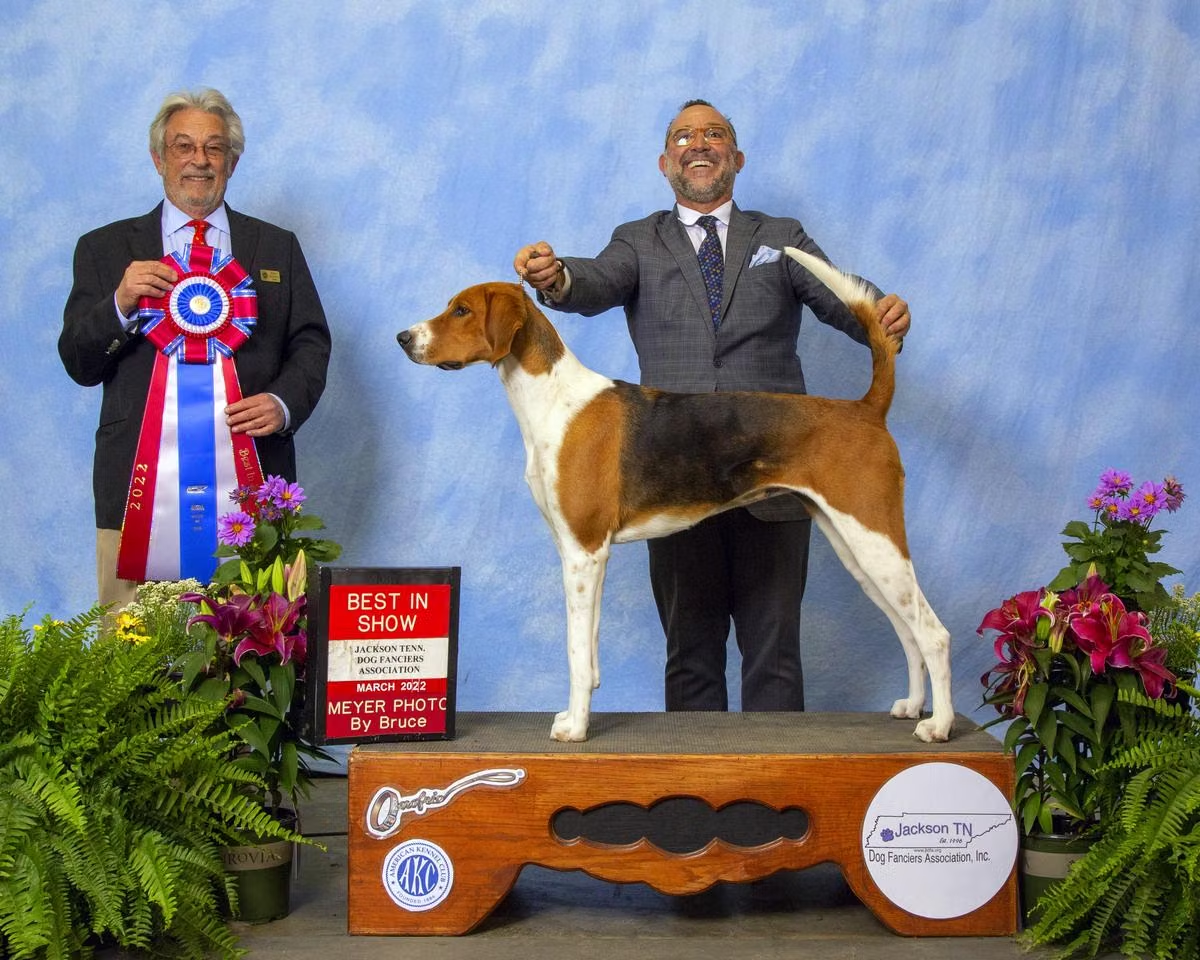
The American Foxhound is a good-natured, easygoing pack hound known for its stamina and sweet, musical voice.
How the American Foxhound coat is built, and what that means when you groom it.
A few of the American Foxhound profiles members have added to United Pet Club.
The American Foxhound is a big, good-humoured pack hound from the United States, prized for stamina, an easy nature, and a carrying, musical voice.
The American Foxhound is a big scenthound bred in the United States to run fox over long distances, and it is built exactly for that job: tall, lean, and able to hold a steady pace for hours across open ground. In the house it is a good deal quieter and more settled than the working image suggests, though underneath that calm sits a serious appetite for exercise that shapes every part of keeping one.
Temperament is what sets the breed apart. Generations spent living and working in packs bred a dog that is good-humoured, sociable, and patient, the kind that gets on with other dogs, usually the family cat too, and tends to be gentle around children. That same pack upbringing also produced an independent streak: once a Foxhound picks up a scent it follows its own head rather than yours, which can look like stubbornness at a training class.
The voice is as much a part of the breed as the coat. American Foxhounds have a deep, far-carrying bay that hunters relied on to track the pack across a valley, and in a housing estate that same bay travels just as well through thin walls and over garden fences. It suits a smallholding or a house on the edge of town better than a terrace in the middle of one.
| Attribute | Detail |
|---|---|
| Origin | United States |
| Size | Large |
| Lifespan | 11 to 13 years |
| Group/role | Hound, scent hunting |
| Good with | Other dogs, pets and children |
The American Foxhound suits an active household with space to spare, ideally a house with a secure garden or land to walk on rather than anywhere with a shared stairwell. It is a strong match for anyone who runs, hikes the hills, or cycles regularly and wants steady company for it. It does not suit apartment blocks, households near neighbours who will not tolerate baying, or owners hoping for quick, precise obedience. A well-fenced garden matters a great deal, because a Foxhound that catches a scent on the wind will follow it and ignore every call home.
The American Foxhound descends from English hounds shipped to the American colonies in the 1600s, then developed over the following centuries into a leaner, faster fox hunting dog.
The breed's roots lie in English foxhounds brought across the Atlantic to the American colonies. Robert Brooke is recorded as bringing a pack of hunting hounds to the colony of Maryland in 1650, and those dogs became an early foundation for hound breeding in the region. Over the decades that followed, colonists used the hounds to hunt fox across the wide, open country of the eastern seaboard, terrain with none of the hedgerows and stone walls familiar from hunting country in Ireland.
George Washington kept and bred foxhounds at Mount Vernon and worked carefully to improve his pack through selective breeding. In 1785 the Marquis de Lafayette sent him French hounds, and crosses of that stock fed into the developing American type. Breeders of the period wanted more speed and stamina than the English hounds offered, a dog able to cover long distances at a working pace rather than a short, sharp run.
Through the 1700s and 1800s, regional strains took shape in Virginia, Maryland, and other states, shaped by local terrain and whatever quarry each pack hunted. Selection favoured nose, stamina, and pack drive over a uniform look, which is why working lines still vary in build and style today.
The American Kennel Club recognised the American Foxhound in 1886. The breed is not commonly registered through the Irish Kennel Club, and it remains far more closely tied to hunting packs than to home life, even in the United States, so anyone looking for one in Ireland is more likely to end up talking to a specialist importer than a local litter.
The American Foxhound is a tall, lean scenthound with long legs, a short hard coat, and the big drop ears typical of hunting hounds.
The American Foxhound is built for distance rather than a short burst of speed. It is taller and lighter in bone than the English Foxhound, with long straight legs, a chest that is deep without being heavy, and a slightly arched loin that gives it a long, ground-covering stride. The overall look is athletic and balanced, with nothing exaggerated about it. The head is fairly long, with a wide, gently domed skull and a straight muzzle. The ears are long, set moderately low, and lie close to the head. The tail is carried up with a slight curve, with a light brush of longer hair underneath.
| Trait | Standard |
|---|---|
| Height | 53 to 64 cm (21 to 25 in) at the shoulder |
| Weight | 27 to 32 kg (60 to 70 lb) |
| Coat | Short, hard, close lying |
| Colours | Any colour; tricolour and tan and white are common |
| Eyes | Large, wide set, brown or hazel |
The coat is short, hard, and dense enough to cope with a day out in Irish weather while staying easy to look after. The standard puts no limit on colour, so any hound colour is acceptable. The most familiar patterns are the classic tricolour of black, white, and tan, along with tan or red combined with white. The hard texture sheds mud and dirt well, so it asks for little beyond a regular brush.
American Foxhounds are good-natured, sociable, and independent, friendly with people and other animals but driven by scent and given to a loud, carrying voice.
At home the American Foxhound is even-tempered and easygoing, with a soft, affectionate side for its own family. Generations of pack life bred a dog that is comfortable in company and rarely aggressive. Around children it is usually patient and tolerant, though its size and energy mean playtime with small children needs supervision.
With strangers it tends toward friendly rather than watchful, so it makes a poor guard dog for all its loud voice. With other dogs it is highly sociable, a straight result of being bred to live and hunt in packs, and it generally settles in well with other household pets once raised alongside them. Some individuals keep a strong prey drive toward small animals on the run outdoors, cats and hares included.
Independence is the trait most owners notice first. A Foxhound on a scent follows its own nose and switches off to commands, which can come across as stubbornness. The breed is intelligent, but it is motivated by its own interests as much as by whoever is holding the lead. Without enough exercise and company it turns bored, restless, and vocal, and that bay carries a long way on a still evening.
| Trait | Rating |
|---|---|
| Affection | 4 |
| Energy | 5 |
| Trainability | 2 |
| Vocalness | 5 |
| Shedding | 3 |
The American Foxhound has low grooming needs but very high exercise needs, and does best with secure outdoor space and steady daily activity.
The American Foxhound suits a house with a large, well-fenced garden and is a poor match for apartment living. The fence needs to be solid and high, since the breed will find a way under or over a weak boundary once it is onto a trail. That carrying voice means the breed sits better on a smallholding or in the countryside than in a housing estate. As a pack animal it does best with regular company and can struggle badly with long stretches left on its own.
American Foxhounds need a complete diet that supports a large, very active body, with portions matched to their workload to keep them lean.
The American Foxhound does well on a complete, balanced diet formulated for large, active dogs. As an athletic working breed, a hard-working or field hound burns a good deal of energy and may need more food than a less active pet of the same size. Adjust portions to keep the dog lean, with a visible waist and ribs you can feel easily under a light covering of muscle. Fresh water should be available at all times, especially after exercise.
| Life stage | Amount per day | Meals |
|---|---|---|
| Puppy (2 to 6 months) | Per label, divided into small feeds | 3 to 4 |
| Adolescent (6 to 12 months) | 2.5 to 3.5 cups | 2 to 3 |
| Adult | 2.5 to 3.5 cups | 2 |
| Senior | Adjust down for lower activity | 2 |
Keep treats to around ten percent of daily calories to guard against weight gain, a real risk in a food-motivated hound. Use small, low-calorie treats for training and scent games. A dog on a complete commercial diet usually needs nothing extra, but check with a vet before adding joint supplements or similar products, particularly for older or hard-working dogs.
The American Foxhound is a generally healthy, long-lived breed with a lifespan of 11 to 13 years and a small number of conditions worth watching for.
The American Foxhound is one of the sturdier purebred dogs, with relatively few inherited problems compared with many breeds. Typical lifespan runs 11 to 13 years. The most useful health measures are keeping the dog at a lean weight, giving it regular exercise, and keeping up with routine veterinary care. The long ears and the breed's appetite are the two areas that most often need watching.
| Condition | Signs | Note |
|---|---|---|
| Hip dysplasia | Stiffness, limping, trouble rising | Less common than in many large breeds, but still possible |
| Ear infections | Head shaking, odour, scratching at ears | Linked to long drop ears that trap moisture |
| Thrombocytopathy | Easy bruising, prolonged bleeding | A platelet disorder reported in the breed |
| Obesity | Excess weight, loss of waistline | Driven by a strong food drive; manage portions carefully |
American Foxhounds are intelligent but independent, so training takes patience, consistency, and reward-based methods that compete with a powerful nose.
Training an American Foxhound calls for realistic expectations. The breed is sharp and capable, but it was developed to work at a distance and make its own calls on a trail, so it does not offer the eager, handler-focused obedience you would get from many companion breeds. Once a scent takes hold, recall and commands tend to lose out to the nose every time. Short, varied sessions hold its attention better than long drills, and a securely fenced area is essential for any work off the lead. Early socialisation with people, dogs, and other animals builds on the breed's naturally sociable streak.
American Foxhounds reach breeding maturity at around one to two years, with an average gestation of about 63 days and typical litters of five to seven pups.
Responsible breeding of American Foxhounds centres on temperament, working ability, and health. Both parents should be fully mature before breeding, generally not before females have reached about 18 to 24 months, even though they may come into season earlier. Pre-breeding health screening, including a hip evaluation, helps cut the risk of passing on problems. Females usually come into season about twice a year.
Gestation runs about 63 days on average. Litters commonly number five to seven pups, though larger litters happen, in keeping with the breed's history of producing working pack dogs. The dam needs a quiet, clean whelping area and close watching through delivery and the early days after.
Raising the litter benefits from the breed's strong social nature. Early handling and exposure to household sounds, people, and other animals support the friendly, even temperament the breed is known for. Pups typically stay with the dam and littermates until at least eight weeks old, which helps them learn normal dog behaviour before heading to new homes.
| Metric | Value |
|---|---|
| Breeding maturity | About 1 to 2 years |
| Cycle frequency | Roughly twice a year |
| Gestation | About 63 days |
| Average litter size | 5 to 7 pups |
| Weaning age | Around 6 to 8 weeks |
Irish law wants every dog chipped and recorded; United Pet Club keeps your American Foxhound's record free, current, and there for life.
Get the profile sorted first: your American Foxhound's name, his date of birth, a photo, and your phone number, saved in a couple of minutes. The record is free for the whole of his life, and the chip number slots in whenever the vet has done his part. Dog registration is where it starts.
Lodge your American Foxhound's fifteen digit number with United Pet Club and the chip finally earns its keep: free registration for life, every brand accepted, and a record the ISPCA or any warden can turn into a phone call. Microchip registration takes minutes, and the free account covers the profile while you're at it.
Set yourself up with a free United Pet Club account, key in your American Foxhound's details and a photo, and save. The profile holds for the whole of his life without charge, and the chip number can be lodged whenever you have it.
Lodge the fifteen digit chip number in your free account along with your address and phone number. The lifetime plan covers the registration and every update after it, free, whatever brand the vet used.
It is. The 2015 Regulations require every dog to be chipped and registered, pup or rescue alike. Keeping the record current is the part that falls to you, and United Pet Club makes that part free.
Not a penny. Profile, chip record, and every amendment are covered for life, with no renewal ever.
Common questions about the American Foxhound cover its size, temperament, care demands, lifespan, suitability, and availability.
It is a large breed. Adults stand about 53 to 64 cm (21 to 25 in) at the shoulder and usually weigh 27 to 32 kg (60 to 70 lb), with a tall, lean, athletic build.
Yes, in the right home. They are good-natured, sociable, and gentle with children, and they get on well with other dogs and pets. They need a great deal of exercise and do not suit quiet, closely packed neighbourhoods well, given their loud voice.
Grooming is easy thanks to the short coat, but exercise needs are high. The breed needs one to two hours of hard activity a day and a securely fenced space, so the real demand is time and energy rather than coat care.
Typical lifespan is 11 to 13 years. The breed is generally healthy, and keeping the dog lean and well exercised supports a long life.
They are intelligent but independent, bred to follow a scent on their own terms. Training takes patience and reward-based methods, and recall is unreliable once the dog has picked up an interesting trail, so secure fencing matters.
They have a loud, carrying bay that was prized for hunting. They can be vocal, especially when bored or under-exercised, which suits homes with space far better than close quarters.
They are uncommon as household pets and are far more often kept in working and field packs. Finding one takes patience, and many come from hunting lines rather than show or companion breeders, so expect to look abroad.