
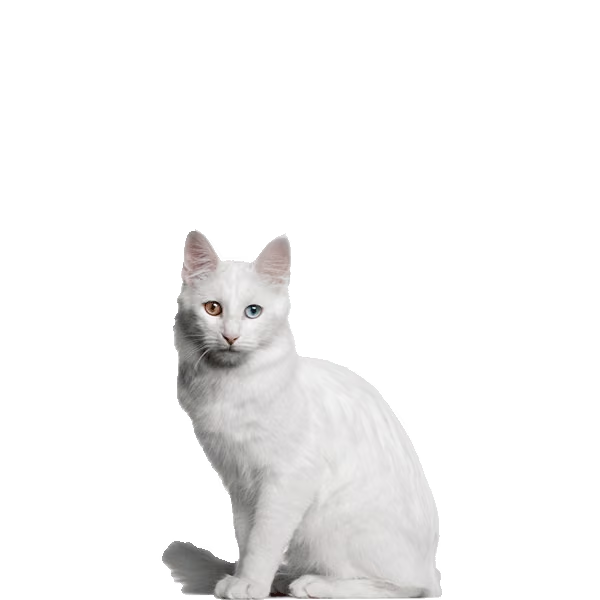
Turkish Angora
The Turkish Angora is an elegant, silky-coated breed admired for its playful, affectionate personality and graceful intelligence.
- Size
- Medium
- Lifespan
- 12–18 years
- Origin
- Turkey
- Temperament
- Playful
- Standard colors
- Black, White and Blue and 9 more
Characteristics
Coat and grooming
How the Turkish Angora coat is built, and what that means when you groom it.
- Coat layers
- Single coat
- Coat texture
- Silky
- Coat length
- Long
- Shedding
- Seasonal shedding
Grooming guidance
Caution: A Turkish Angora coat mats easily.
Fine or long hair tangles at the base of the coat, out of sight, where the mats tighten and pull on the skin. Brushing has to reach right down to the roots in sections, not just skim the surface.
Information: A Turkish Angora drops its undercoat in heavy bursts.
The undercoat comes out in heavy bursts over a few weeks. An undercoat rake, or a bath followed by a proper blow-dry, clears it far faster than daily brushing. Clipping the coat down is not a shortcut for this.
Turkish Angora colors and patterns
What each club's breed standard says about every Turkish Angora color and pattern. Point at a ruling to see the club's own wording.
Breed standards describe the Turkish Angora in Black, White, Blue, Lilac, Silver, Brown, Chocolate, Cinnamon, Red, Gold, Cream and Fawn. Standard patterns: Solid, Bicolour, Harlequin, Tabby, Mackerel tabby, Classic tabby, Spotted tabby, Ticked tabby, Tortoiseshell, Calico, Torbie, Van, Smoke, Shaded, Chinchilla and Caliby.
| Color or pattern | TICA | CFA | FIFE |
|---|---|---|---|
| Black | Standard | Standard (“Black”) | Standard (“black”) |
| White | Standard | Standard (“White”) | Standard (“white”) |
| Blue | Standard | Standard (“Blue”) | Standard (“blue”) |
| Lilac | Standard | Disqualifying (“lilac”) | Not recognised (“lilac”) |
| Silver | No ruling | Standard (“Silver”) | Standard (“silver”) |
| Brown | No ruling | Standard (“Brown Tabby”) | Standard (“black tabby”) |
| Chocolate | Standard | Disqualifying (“chocolate”) | Not recognised (“chocolate”) |
| Cinnamon | Standard | Standard | Not recognised (“cinnamon”) |
| Red | Standard | Standard (“Red”) | Standard (“red”) |
| Gold | No ruling | No ruling | Standard (“golden”) |
| Cream | Standard | Standard (“Cream”) | Standard (“cream”) |
| Fawn | Standard | Standard | Not recognised (“fawn”) |
| Patterns | |||
| Solid | No ruling | Standard (“Other Solid Colors”) | Standard (“solid”) |
| Bicolour | No ruling | Standard (“Bi-Color”) | Standard (“bicolour”) |
| Harlequin | No ruling | No ruling | Standard (“harlequin”) |
| Tabby | No ruling | No ruling | Standard (“tabby”) |
| Mackerel tabby | No ruling | Standard (“Mackerel Tabby”) | Standard (“mackerel”) |
| Classic tabby | No ruling | Standard (“Classic Tabby”) | Standard (“blotched”) |
| Spotted tabby | No ruling | Standard (“Spotted Tabby”) | Standard (“spotted”) |
| Ticked tabby | No ruling | Standard (“Ticked Tabby”) | Standard (“ticked”) |
| Tortoiseshell | No ruling | Standard (“Tortoiseshell”) | Standard (“tortie”) |
| Calico | No ruling | Standard (“Calico”) | Standard (“tortie with white”) |
| Torbie | No ruling | Standard (“Patched Tabby”) | Standard (“tortie tabby”) |
| Van | No ruling | Standard (“van patterns”) | Standard (“van”) |
| Smoke | No ruling | Standard (“Smoke”) | Standard (“smoke”) |
| Shaded | No ruling | Standard (“Shaded”) | Standard (“shaded”) |
| Chinchilla | No ruling | No ruling | Standard (“shell”) |
| Caliby | No ruling | Standard (“Calico”) | Standard (“tortie with white”) |
| Pointed | Not recognised | Disqualifying (“point pattern”) | Not recognised (“pointed patterns”) |
| Mink | Not recognised | No ruling | No ruling |
| Sepia | Not recognised | No ruling | No ruling |


| Color or pattern | CFA | FIFE |
|---|---|---|
| Blue | Standard (“blue”) | Standard (“deep blue”) |
| Orange | No ruling | Standard (“copper or deep orange”) |
| Copper | Standard (“amber”) | Standard (“copper or deep orange”) |
| Amber | Standard (“amber”) | No ruling |
| Gold | Standard (“green-gold”) | No ruling |
| Green | Standard (“green”) | Standard (“green”) |
| Patterns | ||
| Odd-eyed | Standard (“odd-eyed”) | Standard (“odd eyed”) |

What the rulings mean
- Standard
- Described by the club's breed standard.
- Disqualifying
- The club's breed standard disqualifies an animal of this colour or pattern.
- Not recognised
- The club does not accept this colour or pattern for the breed.
Color changes
How a Turkish Angora's colors can change over its life.
Brownchanges toCopal
Coat · With age · from 0 to 52 weeks
Blackchanges toRusset
Coat · Progressive
Tabbychanges toSolid
Coat · With age · from 0 to 39 weeks
Whitechanges toShaded
Coat · With age
Whitechanges toChinchilla
Coat · With age
Tabbychanges toShaded
Coat · With age · from 0 to 6 weeks
Tabbychanges toChinchilla
Coat · With age · from 0 to 6 weeks
Bluechanges toTortoiseshell
Coat · With age
Blackchanges toBrown
Coat · With body condition · can change back
Blackchanges toBrown
Coat · In the sun · can change back
Blackchanges toBrown
Coat · Progressive
Whitechanges toPointed
Coat · With age · from 1 to 52 weeks
Solidchanges toSmoke
Coat · With age · from 3 to 104 weeks
Bluechanges toGreen
Eyes · With age · from 4 to 17 weeks
Bluechanges toYellow
Eyes · With age · from 4 to 17 weeks
Bluechanges toGold
Eyes · With age · from 4 to 17 weeks
Bluechanges toCopper
Eyes · With age · from 4 to 17 weeks
Bluechanges toOrange
Eyes · With age · from 4 to 17 weeks
Bluechanges toHazel
Eyes · With age · from 4 to 17 weeks
Bluechanges toAmber
Eyes · With age · from 4 to 17 weeks
Pinkchanges toSeal
Nose · With age · from 1 to 52 weeks
Pinkchanges toBlue
Nose · With age · from 1 to 52 weeks
Pinkchanges toChocolate
Nose · With age · from 1 to 52 weeks
Pinkchanges toLilac
Nose · With age · from 1 to 52 weeks
Pinkchanges toSeal
Paw pads · With age · from 1 to 52 weeks
Pinkchanges toBlue
Paw pads · With age · from 1 to 52 weeks
Pinkchanges toChocolate
Paw pads · With age · from 1 to 52 weeks
Pinkchanges toLilac
Paw pads · With age · from 1 to 52 weeks
Sources
Each ruling comes from the club's published breed standard or color list.
About the Turkish Angora
The Turkish Angora is a slender, silky-coated cat from Ankara, Turkey, whose luminous white form and otherworldly elegance have led Irish cat lovers to nickname it the fairy cat, a nod to Ireland's long tradition of white magical animals.
In Irish Celtic mythology, white animals carried special significance. The legendary hounds Bran and Sceolan, companions of the hero Fionn mac Cumhaill, were white and associated with the Otherworld. White cats appear in folktales as liminal creatures that move between the human world and something older and stranger. When the Turkish Angora arrived in Ireland, its pure white coat, luminous odd eyes, and ghostly silent movement made the comparison to these mythological beings feel natural.
The Turkish Angora is a medium-sized domestic cat with a long, slender body, fine bones, and a single-layer coat that lacks a dense undercoat. Adults typically weigh between 2.5 and 5 kilograms. The coat's silky texture and the cat's tendency to move fluidly and quietly through a house do lend it an otherworldly quality that has charmed Irish owners who know their folklore.
Beyond its appearance, the breed is sociable, affectionate, and active. It attaches itself to its household, follows a favourite person from room to room, and keeps a kitten-like playfulness through most of its adult life. The coat is considerably easier to maintain than it looks, requiring only light twice-weekly combing.
| Attribute | Detail |
|---|---|
| Origin | Turkey (Ankara) |
| Size | Medium (2.5 to 5 kg) |
| Lifespan | 12 to 18 years |
| Group / role | Companion cat |
| Good with | Families, older children, other cats, cat-friendly dogs |
Who it suits
The Turkish Angora suits households that can offer consistent company and regular play. It does well with active families, people who work from home, and homes that already keep pets. Someone wanting a quiet, independent cat that keeps largely to itself will find this breed very much more demanding of company than expected.
History of the breed
Long-haired cats from Ankara gave the Turkish Angora its name and character; after the breed nearly disappeared in the West through crossbreeding, it was preserved by Turkey's Ankara Zoo and rebuilt abroad by North American breeders.
The city of Ankara, historically known as Angora, is the origin of both the breed's name and its essential character. European travellers first wrote about the long-haired cats of the Ankara region in the 1600s, and some were brought to France and England, where they were fashionable companions among the wealthy.
Over the nineteenth century, crossbreeding between Angoras and other long-haired cats gradually dissolved the original Turkish form. By the early twentieth century, the distinct Turkish Angora had largely disappeared in Western breeding lines, absorbed into what eventually became the modern Persian.
Inside Turkey, the Ankara Zoo maintained a careful breeding programme centred on white Angoras, including odd-eyed cats. This programme preserved the breed's distinctive traits through the difficult middle decades of the twentieth century.
In the 1950s and 1960s, American and Canadian breeders imported cats from the zoo and worked to re-establish the line in North America. The breed subsequently reached Ireland and Britain. In Ireland, the Turkish Angora is kept by a small but dedicated community of breeders, with cats registered through the Irish Cat Fancy (ICF) and affiliated bodies. ICF championship shows in Dublin and other cities have helped build a small domestic following for the breed.
Appearance and coat
The Turkish Angora is a slender, fine-boned cat with a long silky single coat, a plumed tail, and eyes that may be blue, amber, green, or odd-coloured.
The Turkish Angora has a long, lithe body with fine bones and firm muscle. The head is a small to medium wedge, the ears are large, upright, and set high, and the eyes are large and almond-shaped. The legs are long, with the hind legs slightly longer than the front, and the tail is long and tapered with a full plume of hair. The overall impression is of a light, balanced, graceful cat that moves with a particular silent elegance.
| Trait | Description |
|---|---|
| Height | About 23 to 30 cm at the shoulder |
| Weight | 2.5 to 5 kg, males larger than females |
| Coat | Long, fine, silky, single coat with little undercoat |
| Colours | White plus many colours and patterns including black, blue, red, cream, tabby, and tortoiseshell |
| Eyes | Blue, amber, green, or odd-eyed (one blue, one amber or green) |
Coat and colours
The coat is medium to long, fine, and soft, with a silky texture that drapes close to the body. It is fullest at the ruff, the belly, and the tail. Because the coat carries very little undercoat, it flows freely and tangles far less than the dense coats of other long-haired breeds.
White remains the colour most associated with the Turkish Angora and the one that inspired comparisons to fairy cats and magical creatures in Irish tradition. The ICF recognises a broad range of colours and patterns including solids, tabbies, tortoiseshells, and bi-colours. The white odd-eyed form, with one blue eye and one amber or green, is the most immediately recognisable.
Temperament and personality
Turkish Angoras are affectionate, playful, and perceptive cats that bond closely with their household and stay actively curious well into adulthood.
The Turkish Angora is outgoing, sociable, and strongly attached to its people. It picks a favourite person and follows them reliably through the house, participating in daily activity rather than observing from a distance. Irish owners who keep the breed often describe it as having a particular quality of awareness, a sense that it is reading the household mood and positioning itself accordingly.
With family members it is affectionate and interactive. With strangers it tends toward curiosity rather than wariness. It generally gets on well with other cats and with cat-friendly dogs, particularly when introductions are handled gradually.
The breed is intelligent and keeps a kitten-like playfulness well into adult life. It enjoys fetch, puzzle feeders, and wand toys, and it seeks out the highest vantage point in any room. Its voice is soft, more of a melodic chirp than a demanding call, but it will make itself heard when it wants attention. Without regular play and company, it will find ways to entertain itself that may not suit the furniture.
| Trait | Rating |
|---|---|
| Affection | 5 |
| Energy | 5 |
| Trainability | 4 |
| Vocalness | 3 |
| Shedding | 3 |
Care and grooming
The Turkish Angora needs twice-weekly combing, daily play, and a safe indoor home; Ireland's damp climate has little effect on the coat, but the breed's sociable nature means it dislikes long solitary stretches.
The Turkish Angora's single coat is one of its practical advantages. It resists matting well enough that twice-weekly combing handles the routine for most of the year, with a bit more attention needed during the spring moult.
Grooming
- Comb the coat once or twice a week with a wide-tooth comb to remove loose hair and prevent tangles.
- Increase combing during the spring moult, when shedding rises noticeably.
- Ireland's damp climate does not damage the coat, but keep bedding dry and allow good air circulation in the sleeping area.
- Check and gently clean the ears as needed, and trim the nails every few weeks.
- Brush the teeth regularly with a cat-safe toothpaste to support dental health.
Exercise
- Provide at least two interactive play sessions a day using wand toys, balls, or fetch.
- Offer puzzle feeders and rotate toy types regularly to keep the cat's mind engaged.
- Fit a tall cat tree or wall-mounted shelves; Turkish Angoras seek height wherever they can find it.
Environment
The breed is best kept indoors, which protects it from traffic and disease and keeps the coat in better condition. It adapts well to Irish houses and flats of all sizes as long as there is room to run and climb. A feline companion or a sociable household helps manage the boredom that builds in this people-oriented breed when owners are away for long periods.
Nutrition and feeding
Turkish Angoras need a complete, meat-based diet fed in measured portions, with fresh water available at all times.
Turkish Angoras are obligate carnivores and need a diet built around animal protein with adequate fat and the amino acid taurine. A complete and balanced commercial cat food appropriate to the cat's life stage is the practical choice. Many Irish owners feed a combination of wet and dry food, since wet food adds moisture that supports urinary and kidney health over the cat's lifetime.
Because this is an energetic breed, portion feeding to maintain lean body condition is important. Feed to appetite as kittens, then transition to measured adult portions to prevent the gradual weight gain that often creeps in after desexing or as activity levels drop slightly with age.
| Life stage | Amount per day | Meals |
|---|---|---|
| Kitten (up to 12 months) | Per package guidance, fed to appetite | 3 to 4 |
| Adult (1 to 7 years) | About 200 to 300 kcal | 2 |
| Senior (7 years and older) | Adjusted to weight and activity | 2 |
Treats and supplements
Limit treats to approximately 10 percent of daily calories to preserve the balance of the main diet. A cat eating a complete commercial food does not routinely need supplements; add them only on veterinary advice. Hairball remedies or increased grooming during the moult help long-haired cats manage the hair swallowed during self-grooming.
Health and lifespan
The Turkish Angora generally lives 12 to 18 years and is a hardy breed; Irish breeders screen for congenital deafness in white lines, hypertrophic cardiomyopathy, and a rare movement disorder.
The Turkish Angora is a naturally formed breed with a long history as a working companion and is generally healthy throughout its life. The typical lifespan is 12 to 18 years with routine veterinary care, a balanced diet, and a safe indoor environment. A few inherited conditions occur at elevated rates and are worth understanding before acquiring a kitten.
| Condition | Signs | Note |
|---|---|---|
| Congenital deafness | No response to sound, most common in white blue-eyed cats | Caused by the same genetic pathway as the white coat and blue eyes; can affect one or both ears |
| Hypertrophic cardiomyopathy (HCM) | Lethargy, laboured breathing, sudden weakness | Heart-muscle thickening; echocardiographic screening of breeding cats helps detect it before symptoms appear |
| Hereditary ataxia | Tremors, unsteady movement in young kittens | A rare, serious neurological condition; affected kittens are identifiable within the first weeks of life |
Preventive care
- Book annual veterinary health checks; senior cats benefit from six-monthly visits.
- Keep core vaccinations current, including FeLV vaccination if the cat could be exposed.
- Maintain year-round parasite control using veterinary-approved flea and worm products.
- Brush teeth regularly or use veterinary dental products to reduce tartar accumulation.
- For white kittens, ask the breeder for BAER hearing test results before purchase.
Training and enrichment
Turkish Angoras are intelligent and sociable cats that respond readily to short reward-based sessions and need consistent mental enrichment to stay settled.
The Turkish Angora is one of the more trainable domestic cats, driven by intelligence and by its strong desire to engage with people. Clicker and reward-based training suits this breed very well. Irish owners who train their cats regularly find them less prone to the restless mischief that emerges when sociable, intelligent cats are under-stimulated. Many learn to fetch, come reliably when called, and perform simple trick sequences within a surprisingly short time.
Basics
- Establish litter-tray habits from day one by placing clean trays in quiet, consistently accessible spots.
- Provide a sturdy scratching post immediately and reward every use of it to redirect from furniture.
- Use a clicker or a consistent marker word paired with a small treat to build cues like sit, come, or stay.
- Practice recall at every mealtime by calling the cat before placing the food bowl down.
- Rotate puzzle feeders and toy types weekly to keep enrichment varied and engaging.
Breeding and kittens
Turkish Angora queens produce litters of around four kittens after a two-month gestation, and Irish breeders follow ICF guidelines including health screening and a minimum rehoming age of twelve weeks.
Turkish Angoras reach sexual maturity within the first year, but responsible breeders in Ireland wait until both parents are physically mature, usually past twelve months, before mating. Gestation runs approximately 63 to 67 days, and litters average around four kittens. Kittens arrive with short, fine coats that lengthen progressively over the first two years.
Queens raise their litters with little intervention. Weaning begins around four weeks, and kittens should remain with the mother and siblings until twelve weeks to ensure complete weaning, thorough socialisation, and readiness for vaccination.
Breeders working with white lines use BAER hearing tests to identify deaf kittens and plan pairings that reduce deafness in future litters. Cardiac screening of breeding cats for HCM is recommended practice. Irish breeders associated with the ICF are expected to follow relevant ethical breeding codes covering health testing, socialization, kitten welfare, and minimum rehoming age.
| Metric | Value |
|---|---|
| Breeding maturity | After about 12 months (physical maturity) |
| Gestation | About 63 to 67 days |
| Average litter size | Around 4 kittens |
| Weaning age | About 6 to 8 weeks |
| Recommended rehoming age | About 12 weeks |
Your Turkish Angora registered and chipped, sorted for good
No law covers cat chips in Ireland, which makes a free United Pet Club record the only thing standing behind your Turkish Angora's number.
Registering a Turkish Angora in Ireland
Cats sit outside the 2015 chipping law, so whatever record your Turkish Angora has is the one you make yourself. Make it a free one: the United Pet Club profile carries your details, her photo, and her chip number for the whole of her life. Registering your cat costs nothing, now or ever.
The fifteen digits on your Turkish Angora's vet paperwork want a registry. United Pet Club lodges them free, keeps them current through every move, and leaves the record findable whenever a scanner asks. Microchip registration plus a free account: both sorted in one cup of tea.
How do I register my Turkish Angora in Ireland?
Open a free United Pet Club account, put in her name, colouring, and a photo, and save the profile. It stays live for the whole of her life at no cost, and a chip is not needed to begin.
How do I register my Turkish Angora's microchip?
Lodge the fifteen digit number from the vet's paperwork in your free account with your current contact details. The lifetime plan never asks for a penny, not for the record and not for updates.
Do cats have to be chipped in Ireland?
No, the 2015 chipping law covers dogs only. That is exactly why a registered chip matters for a Turkish Angora: without your record, there is nothing at all connecting her number to your phone.
What does it cost to register a Turkish Angora?
Nothing whatsoever. United Pet Club's lifetime plan takes care of the profile, the chip record, and every amendment, free for the whole of her life.
Frequently asked questions
Common questions from Irish buyers about the Turkish Angora cover its Celtic folklore connections, coat care, health, and where to find one.
How big does a Turkish Angora get?
It is a medium-sized cat. Most adults weigh between 2.5 and 5 kilograms, with males noticeably larger than females. The body is long and slender.
Why is the Turkish Angora sometimes called the fairy cat?
The pure white Turkish Angora's silent, fluid movement and luminous odd eyes reminded Irish cat lovers of the magical white animals in Celtic mythology, including the legendary hounds Bran and Sceolan. The nickname is affectionate rather than formal.
Is the Turkish Angora hard to groom?
No. The single coat resists matting well and needs only twice-weekly combing. It is a much lighter grooming commitment than a Persian requires.
How long do Turkish Angoras live?
Typically 12 to 18 years with regular veterinary care, a balanced diet, and an indoor home.
Is the Turkish Angora registered in Ireland?
Yes, through the Irish Cat Fancy (ICF), which holds championship shows in Dublin and other venues. The breed is rare in Ireland but has a small dedicated following.
Are white Turkish Angoras always deaf?
No. Deafness linked to white coat and blue eyes is a known inherited risk but does not affect every white cat. Responsible ICF breeders test kittens' hearing with a BAER test and will show documentation before sale.
Where can I find a Turkish Angora in Ireland?
The breed is rare. The Irish Cat Fancy is the best starting point for locating registered breeders in Ireland. Cats of this type occasionally appear through rescue organisations.
From the community
Ask about the Turkish AngoraNo questions about the Turkish Angora yet. Be the first to ask.
Browse Cat breeds