
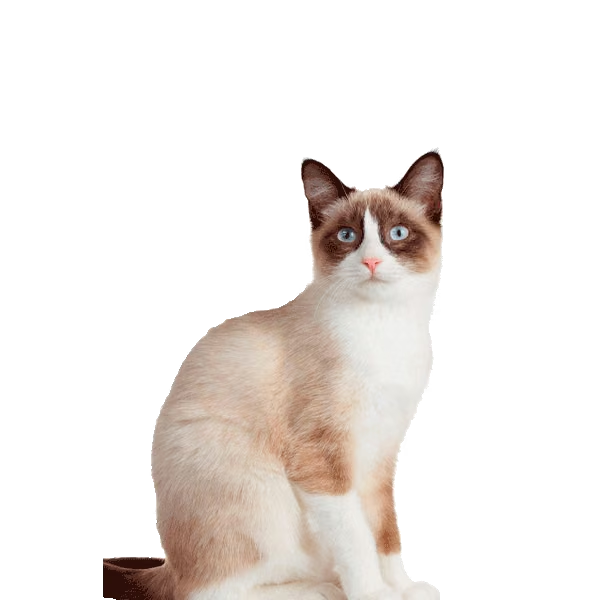
Snowshoe
The Snowshoe is an affectionate, intelligent breed known for its distinctive white feet and devoted, people-loving nature.
- Size
- Medium
- Lifespan
- 14–19 years
- Origin
- United States
- Temperament
- Affectionate
- Standard colors
- White, Blue and Lilac and 9 more
Characteristics
Coat and grooming
How the Snowshoe coat is built, and what that means when you groom it.
- Coat layers
- Single coat
- Coat texture
- Smooth
- Coat length
- Short
- Shedding
- Moderate shedding
Snowshoe colors and patterns
What each club's breed standard says about every Snowshoe color and pattern. Point at a ruling to see the club's own wording.
Breed standards describe the Snowshoe in White, Blue, Lilac, Silver, Chocolate, Seal, Cinnamon, Caramel, Red, Cream, Fawn and Apricot. Standard patterns: Bicolour, Pointed, Tabby, Tortoiseshell, Calico, Torbie, Smoke, Mitted and Caliby.
| Color or pattern | TICA | FIFE | GCCF |
|---|---|---|---|
| White | Standard | Standard (“white”) | Standard (“white”) |
| Blue | Standard | Standard (“blue”) | Standard (“Blue Point”) |
| Lilac | Standard | Standard (“lilac”) | Standard (“Lilac Point”) |
| Silver | Standard (“Silver”) | No ruling | No ruling |
| Chocolate | Standard | Standard (“chocolate”) | Standard (“Chocolate Point”) |
| Seal | Standard | Standard (“Seal”) | Standard (“Seal Point”) |
| Cinnamon | Standard | Standard (“cinnamon”) | Standard (“Cinnamon Point”) |
| Caramel | No ruling | No ruling | Standard (“Caramel Point”) |
| Red | Standard | Standard (“red”) | Standard (“Red Point”) |
| Cream | Standard | Standard (“cream”) | Standard (“Cream Point”) |
| Fawn | Standard | Standard (“fawn”) | Standard (“Fawn Point”) |
| Apricot | No ruling | No ruling | Standard (“Apricot Point”) |
| Patterns | |||
| Bicolour | Standard (“Bi-color”) | No ruling | Alternate (“Bi-Colour Snowshoe”) |
| Pointed | Standard (“Pointed”) | Standard (“pointed”) | Standard (“pointing”) |
| Tabby | Standard (“Tabby point/white”) | Standard (“tabby”) | Standard (“Tabby Points”) |
| Tortoiseshell | No ruling | Standard (“tortie”) | Standard (“Tortie Points”) |
| Calico | Standard (“Tortie Point/white”) | No ruling | No ruling |
| Torbie | No ruling | Standard (“tortie tabby”) | Standard (“Tortie Tabby Points”) |
| Smoke | Standard (“Smoke Point/white”) | No ruling | No ruling |
| Mitted | Standard (“Mitted”) | No ruling | Standard (“Classic Pattern SNO 05 Snowshoe”) |
| Caliby | Standard (“Tortie Point/white”) | No ruling | No ruling |
| Harlequin | No ruling | No ruling | Alternate (“Harlequin”) |
| Van | No ruling | No ruling | Alternate (“van pattern”) |
| Mink | Not recognised | No ruling | No ruling |
| Sepia | Not recognised | No ruling | No ruling |


| Color or pattern | TICA | FIFE | GCCF |
|---|---|---|---|
| Blue | Standard (“Any shade of blue”) | Standard (“blue”) | Standard (“definite blue”) |
| Aqua | No ruling | No ruling | Fault (“Turquoise”) |
| Color or pattern | TICA | FIFE | GCCF |
|---|---|---|---|
| Blue | No ruling | No ruling | Standard (“blue”) |
| Lilac | No ruling | No ruling | Standard (“pinkish/faded lilac”) |
| Slate | No ruling | No ruling | Standard (“slate grey”) |
| Chocolate | No ruling | No ruling | Standard (“chocolate”) |
| Seal | No ruling | No ruling | Standard (“dark seal brown”) |
| Cinnamon | No ruling | No ruling | Standard (“cinnamon brown”) |
| Fawn | No ruling | No ruling | Standard (“pinkish fawn”) |
| Pink | Standard (“flesh tone”) | Standard (“pink / flesh tone”) | Standard (“pink”) |
| Color or pattern | TICA | GCCF |
|---|---|---|
| Blue | No ruling | Standard (“blue”) |
| Lilac | No ruling | Standard (“lilac”) |
| Chocolate | No ruling | Standard (“chocolate”) |
| Seal | No ruling | Standard (“seal brown”) |
| Cinnamon | No ruling | Standard (“cinnamon brown”) |
| Fawn | No ruling | Standard (“pinkish fawn”) |
| Pink | Standard (“flesh tone”) | Standard (“pink”) |
What the rulings mean
- Standard
- Described by the club's breed standard.
- Alternate
- Registrable with the club but not described by its breed standard, such as an AKC alternate colour.
- Fault
- Named by the club's breed standard as a fault: the animal can be shown but is penalised.
- Not recognised
- The club does not accept this colour or pattern for the breed.
Color changes
How a Snowshoe's colors can change over its life.
Tabbychanges toSolid
Coat · With age · from 0 to 39 weeks
Whitechanges toShaded
Coat · With age
Whitechanges toChinchilla
Coat · With age
Tabbychanges toShaded
Coat · With age · from 0 to 6 weeks
Tabbychanges toChinchilla
Coat · With age · from 0 to 6 weeks
Bluechanges toTortoiseshell
Coat · With age
Whitechanges toPointed
Coat · With age · from 1 to 52 weeks
Bluechanges toGreen
Eyes · With age · from 4 to 17 weeks
Bluechanges toYellow
Eyes · With age · from 4 to 17 weeks
Bluechanges toGold
Eyes · With age · from 4 to 17 weeks
Bluechanges toCopper
Eyes · With age · from 4 to 17 weeks
Bluechanges toOrange
Eyes · With age · from 4 to 17 weeks
Bluechanges toHazel
Eyes · With age · from 4 to 17 weeks
Bluechanges toAmber
Eyes · With age · from 4 to 17 weeks
Pinkchanges toSeal
Nose · With age · from 1 to 52 weeks
Pinkchanges toBlue
Nose · With age · from 1 to 52 weeks
Pinkchanges toChocolate
Nose · With age · from 1 to 52 weeks
Pinkchanges toLilac
Nose · With age · from 1 to 52 weeks
Pinkchanges toSeal
Paw pads · With age · from 1 to 52 weeks
Pinkchanges toBlue
Paw pads · With age · from 1 to 52 weeks
Pinkchanges toChocolate
Paw pads · With age · from 1 to 52 weeks
Pinkchanges toLilac
Paw pads · With age · from 1 to 52 weeks


Sources
Each ruling comes from the club's published breed standard or color list.
About the Snowshoe cat
The Snowshoe is a medium-sized American cat known for its white feet, colourpoint coat, blue eyes, and affectionate, people-oriented personality.
The Snowshoe is a medium-sized domestic cat that brings together the pointed colouring of the Siamese with white markings on the feet and, quite often, the face. Its name comes from those charming white paws, as though the cat has walked through a fresh fall of Irish rain-turned-sleet. Most Snowshoes have clear blue eyes and a coat that darkens at the ears, mask, legs, and tail while staying pale across the body.
The breed was developed in the United States and remains comparatively uncommon in Ireland. Snowshoes are chatty, warm-natured cats that stay closely bonded to their people. They follow household members around, ask for attention, and insert themselves into daily routines with great enthusiasm. Many learn to fetch and answer to their names.
In weight a Snowshoe usually falls between about 3 and 5.5 kilograms, with males larger than females. The build is moderate: not as fine-boned as a modern Siamese, not as heavy as a cobby breed. With good care a Snowshoe commonly lives 14 to 19 years.
| Attribute | Detail |
|---|---|
| Origin | United States |
| Size | Medium (approx. 3 to 5.5 kg) |
| Lifespan | 14 to 19 years |
| Group / role | Pedigree companion cat |
| Good with | Families, attentive owners, other cats and cat-friendly dogs |
Who the breed suits
The Snowshoe fits a home where someone is around for much of the day. Ireland's mild Atlantic climate means these cats live comfortably indoors year-round. They reward owners who enjoy interaction, play sessions, and a vocal, expressive companion. Ireland's cat fancy community is smaller than the UK's, but the Irish Cat Fancy and associated clubs can point prospective owners towards reputable breeders.
History of the Snowshoe cat
The Snowshoe began in Philadelphia in the 1960s when a Siamese breeder noticed kittens with white feet, and the breed later gained recognition from several cat registries.
The Snowshoe originated in the United States in the 1960s. A Siamese breeder in Philadelphia, Dorothy Hinds-Daugherty, noticed that a litter from her cats included three kittens with white feet. She liked the markings and set out to reproduce them deliberately.
To fix the white feet and achieve the body type she wanted, she crossed Siamese cats with the American Shorthair. This combination gave the pointed pattern of the Siamese together with white markings and a sturdier frame.
Early progress was slow. The white pattern proved hard to reproduce consistently, and the original breeder eventually stepped back from the programme. Other breeders, including Vikki Olander, carried the work forward and kept the small population going through the 1970s.
The breed gained acceptance from cat associations over the following decades and earned championship status with several registries. The Snowshoe remains a comparatively rare breed, including in Ireland, where a small number of dedicated enthusiasts maintain the bloodlines.
Snowshoe appearance
The Snowshoe is a medium, moderately built cat with a pointed coat, white feet, blue eyes, and frequently a white inverted-V marking on the face.
The Snowshoe has a balanced, moderate body. It is muscular and longer than it looks at first glance, with the back roughly level and the build sitting between the slim Siamese and the stockier American Shorthair. The head is often described as a modified wedge, with medium to large ears.
The signature features are the white feet and the colourpoint pattern. Points appear at the ears, mask, legs, and tail, while the body stays lighter. Many Snowshoes also carry a white inverted V across the muzzle, though the exact white pattern varies from cat to cat and is difficult to breed precisely.
| Feature | Description |
|---|---|
| Height | About 20 to 25 cm at the shoulder |
| Weight | About 3 to 5.5 kg; males larger than females |
| Coat | Short, smooth, close-lying single coat |
| Colours | Pointed patterns, commonly seal point and blue point, with white feet |
| Eyes | Blue, usually bright and oval to round |
Coat and colours
The coat is short and lies close to the body, which makes grooming simple. Kittens are born pale and develop their points and darker shading as they mature, so adult colouring takes time to settle. Seal point and blue point are the most familiar colours. The contrast between the white feet, the white facial markings, and the darker points gives the breed its distinctive look.
Snowshoe temperament
Snowshoes are affectionate, intelligent, and vocal cats that bond strongly with their people and dislike being left alone for long periods.
The Snowshoe is a people-oriented cat with a good deal of warmth and charm about it. It tends to attach closely to its household, sometimes favouring one person in particular, and it looks for company and lap time. These cats are vocal, though their voice is usually softer and less piercing than the Siamese. They use it to greet, to comment, and to ask for attention.
With family the breed is warm and involved. Snowshoes often greet visitors with curiosity rather than caution, and most settle well with other cats and with dogs that accept cats. Their intelligence shows in problem solving and play; many learn to fetch, open simple latches, and respond to their names.
The main caution is loneliness. A Snowshoe left alone for long hours can become bored and unsettled. Company, whether human or another sociable pet, is what the breed needs most.
| Trait | Rating |
|---|---|
| Affection | 5 |
| Energy | 4 |
| Trainability | 4 |
| Vocalness | 4 |
| Shedding | 2 |
Snowshoe care
The Snowshoe needs little grooming but plenty of company and daily play, with a home environment that keeps it mentally and physically active.
Day-to-day care for a Snowshoe is light on grooming and more demanding on attention and company. The short coat needs little maintenance, but the breed's social nature means time and interaction matter as much as physical upkeep.
Grooming
- Brush once a week to remove loose hair and keep the coat smooth.
- Trim claws every few weeks.
- Check ears and clean gently when needed.
- Introduce regular tooth brushing to support dental health.
Exercise
- Schedule one or two active play sessions each day.
- Use wand toys, balls, and puzzle feeders to engage the mind.
- Teach fetch and simple tricks, which many Snowshoes enjoy.
- Provide climbing space such as a cat tree or shelves.
Environment
The Snowshoe is best suited to an indoor or supervised home where it has company for much of the day. Ireland's damp climate is not a concern for a fully indoor cat, but the breed does need enrichment and company. A second cat or cat-friendly dog helps when people are out. Provide scratching posts, perches near windows, and toys that rotate to keep interest fresh.
Snowshoe nutrition
Snowshoes do well on a complete, protein-led cat diet fed in measured meals, with portions adjusted to age, weight, and activity.
The Snowshoe has no unusual dietary needs and does well on a complete, balanced cat food appropriate to its life stage. As an obligate carnivore, the cat needs a diet built around animal protein. Choose food that meets a recognised nutritional standard and feed measured portions rather than leaving food out all day, which helps prevent weight gain in a breed that can be food-motivated.
| Life stage | Amount per day | Meals |
|---|---|---|
| Kitten (to 12 months) | Per package guidance, fed to appetite | 3 to 4 |
| Adult (1 to 7 years) | About 200 to 300 kcal, by weight and activity | 2 |
| Senior (8 years and older) | Adjusted to weight and health | 2 |
Treats and supplements
Keep treats to a small share of daily calories, no more than roughly ten percent. A cat on a complete diet usually needs no extra supplements unless a vet advises them for a specific condition. Discuss any change in food, supplements, or feeding routine with your vet, especially for kittens, seniors, or cats with health issues.
Snowshoe health
The Snowshoe is generally healthy with a typical lifespan of 14 to 19 years, though it shares some conditions seen in its Siamese ancestry.
The Snowshoe is generally a healthy, hardy breed and commonly lives 14 to 19 years with good care. Because the Siamese is part of its background, the breed can share a few conditions seen in pointed cats. Routine veterinary care, a steady weight, and dental attention support a long life. Buying from a breeder who screens their cats reduces the chance of inherited problems.
| Condition | Signs | Note |
|---|---|---|
| Crossed eyes (strabismus) | Eyes that turn inward | Cosmetic in many cats; inherited from Siamese lines |
| Kinked tail | A visible bend in the tail | Usually harmless and cosmetic |
| Dental disease | Bad breath, drooling, reduced eating | Common in cats; prevented with dental care |
| Hypertrophic cardiomyopathy | Lethargy, breathing trouble | A heart condition seen across many cat breeds; vet screening helps |
Preventive care
- Schedule annual veterinary checkups, more often for senior cats.
- Keep vaccinations and parasite control up to date.
- Maintain a healthy weight with measured feeding.
- Brush teeth and arrange dental checks.
- Ask the breeder about health screening of the parents.
Training a Snowshoe
Snowshoes are intelligent and willing learners that respond well to short, reward-based sessions and can pick up tricks such as fetch.
The Snowshoe is one of the more trainable cats. Its intelligence and desire to interact make it receptive to learning, and many enjoy the engagement. Owners can teach name response, fetch, and simple tricks. Short, positive sessions work better than long ones, and consistency matters more than duration.
Basics
- Start with litter training, which most kittens take to quickly with a clean, accessible tray.
- Reward wanted behaviour right away with a treat, praise, or play.
- Keep sessions short, a few minutes at a time, and end on success.
- Use a clicker or a consistent marker word to mark the moment of the correct action.
- Redirect unwanted behaviour, such as scratching furniture, to an appropriate post rather than punishing it.
Snowshoe breeding
Snowshoes reach maturity within the first year, carry litters of around three to five kittens after a roughly nine-week pregnancy, and pass on a white pattern that is hard to reproduce.
Breeding the Snowshoe is demanding because the breed's defining white markings are difficult to reproduce reliably. The pattern depends on a combination of genes, and even well-matched pairings can produce kittens with too little or too much white. This is one reason the breed stays uncommon in Ireland.
Cats reach sexual maturity within the first year, though responsible breeders wait until a cat is physically mature and health-checked before mating. Pregnancy lasts about 63 to 67 days, and litters usually number around three to five kittens. Newborns are pale and develop their points and white markings as they grow.
Raising young calls for a quiet, warm space, good nutrition for the mother, and steady handling so kittens grow up well socialised. Ireland's cat fancy community is close-knit, and breeders often know one another; seeking a mentor through the Irish Cat Fancy is a sensible first step for anyone new to the breed.
| Metric | Value |
|---|---|
| Sexual maturity | Within the first year |
| Gestation | About 63 to 67 days |
| Typical litter size | 3 to 5 kittens |
| Weaning | Around 8 to 10 weeks |
| Coat development | Points and markings appear with age |
Your Snowshoe registered and chipped, sorted for good
No law covers cat chips in Ireland, which makes a free United Pet Club record the only thing standing behind your Snowshoe's number.
Registering a Snowshoe in Ireland
Cats sit outside the 2015 chipping law, so whatever record your Snowshoe has is the one you make yourself. Make it a free one: the United Pet Club profile carries your details, her photo, and her chip number for the whole of her life. Registering your cat costs nothing, now or ever.
A chip under her skin with no record behind it is a riddle nobody can solve. Lodge the number with United Pet Club instead: free for life, any brand at all, updates that never cost a cent, and a record that answers scans at home or abroad. Register the microchip, then the free account finishes the profile.
How do I register my Snowshoe in Ireland?
Open a free United Pet Club account, put in her name, colouring, and a photo, and save the profile. It stays live for the whole of her life at no cost, and a chip is not needed to begin.
How do I register my Snowshoe's microchip?
Lodge the fifteen digit number from the vet's paperwork in your free account with your current contact details. The lifetime plan never asks for a penny, not for the record and not for updates.
Do cats have to be chipped in Ireland?
No, the 2015 chipping law covers dogs only. That is exactly why a registered chip matters for a Snowshoe: without your record, there is nothing at all connecting her number to your phone.
What does it cost to register a Snowshoe?
Nothing whatsoever. United Pet Club's lifetime plan takes care of the profile, the chip record, and every amendment, free for the whole of her life.
Snowshoe frequently asked questions
Common questions about the Snowshoe cat cover its size, temperament, care needs, lifespan, suitability, and availability.
How big does a Snowshoe cat get?
The Snowshoe is a medium-sized cat, usually weighing about 3 to 5.5 kilograms, with males larger than females. The build is moderate and muscular, between the slim Siamese and the stockier American Shorthair.
What is the Snowshoe's temperament like?
Snowshoes are affectionate, intelligent, and people-oriented. They bond closely with their households, stay vocal but with a softer voice than the Siamese, and look for company and play.
Is the Snowshoe easy to care for?
Grooming is easy thanks to the short coat, which needs only weekly brushing. The bigger commitment is company. The breed dislikes long periods alone and needs daily interaction and play.
How long do Snowshoe cats live?
With good care a Snowshoe commonly lives 14 to 19 years. Routine veterinary care, a healthy weight, and dental attention all support a long life.
Is a Snowshoe a good family cat?
Yes. Snowshoes suit families and homes where someone is around much of the day. They generally get on well with children, other cats, and cat-friendly dogs, and they enjoy being part of daily activity.
Are Snowshoe cats rare in Ireland?
Yes. The Snowshoe is an uncommon breed in Ireland. The Irish Cat Fancy can help connect interested owners with reputable breeders, and a waiting list is not unusual.
Do Snowshoe cats shed a lot?
Shedding is low to moderate. The short, close coat sheds modestly, and weekly brushing keeps loose hair under control.
From the community
Ask about the SnowshoeNo questions about the Snowshoe yet. Be the first to ask.
Browse Cat breeds