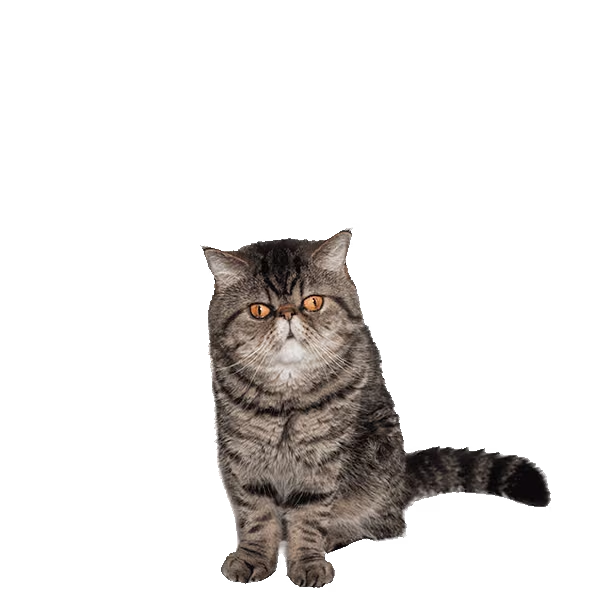
The Exotic Shorthair is a gentle, calm breed loved as the easy-care, plush-coated cousin of the Persian with a sweet, laid-back nature.
How the Exotic Shorthair coat is built, and what that means when you groom it.
Critical: A Exotic Shorthair should not be shaved.
The undercoat keeps heat out as well as in, and the outer coat shields the skin from sun and insect bites. Clipping the whole coat off removes both. It often grows back patchy, soft or a different colour, and in some animals the guard hairs never return properly. Brush the undercoat out instead of cutting it off.
The Exotic Shorthair is a medium-sized, gentle cat with the round face and stocky body of the Persian, set off by a short, plush coat that needs far less grooming.
Across Europe, the welfare of flat-faced cat breeds has come under increasing scrutiny, and Ireland is part of that conversation. The Irish Cat Association (ICA) recognises the Exotic Shorthair and the breed appears at Irish cat shows, yet Irish vets are alert to the breathing difficulties, eye tearing and dental crowding that a brachycephalic skull can cause. Responsible breeders in Ireland work toward open nostrils and good respiratory function rather than the most extreme flat profile.
For owners in Dublin, Cork and other urban centres, the Exotic Shorthair's temperament is well suited to apartment living: it stays close to its family, keeps a soft voice that will not disturb neighbours, and has no need for outdoor access. The breed is affectionate without being demanding, and it fits easily into a calm household routine.
Anyone looking for an Exotic Shorthair in Ireland should ask the breeder about health testing for brachycephalic airway syndrome, polycystic kidney disease (PKD) and hypertrophic cardiomyopathy (HCM) before committing to a kitten.
| Attribute | Detail |
|---|---|
| Origin | United States |
| Size | Medium |
| Lifespan | 12 to 15 years |
| Role | Companion and lap cat |
| Good with | Families, seniors, calm households, indoor homes |
The Exotic Shorthair suits quiet homes, apartments and families in Ireland looking for a gentle indoor companion. Its calm nature works well for older owners and for households that are out during the day, as it does not need constant activity. People taken with the Persian look who cannot commit to daily coat care often go for this breed instead.
The Exotic Shorthair was created in the United States over the 1950s and 1960s when breeders crossed Persians with American Shorthairs, and it was recognised as its own breed in 1967.
The Exotic Shorthair began in the United States during the 1950s. American Shorthair breeders crossed their cats with Persians, partly to improve coat texture and body type. The unexpected result was a cat with the Persian's round head and cobby build but a short, dense coat.
Through the late 1950s and the 1960s, breeders worked to fix this short-coated, Persian-type cat as a recognised line. Crosses with the Burmese and the Russian Blue also played a part in the early development before the gene pool was narrowed back towards the Persian.
The Cat Fanciers' Association recognised the breed in 1967 under the name Exotic Shorthair. Its standard was written to match the Persian standard in every respect bar coat length, so the two breeds share the same conformation goals. In Ireland the breed is registered through bodies such as TICA and the Irish Cat Association (ICA).
Across later decades, continued outcrossing to Persians held the type close to the long-haired parent. A short-haired Exotic can still carry the long-hair gene, so litters sometimes include long-coated kittens that look like Persians.
The Exotic Shorthair is a cobby, medium-sized cat with a round flat face, large round eyes and a short, very dense double coat that stands out from the body.
The Exotic Shorthair has a heavy, rounded body set on short, thick legs. The head is broad and round with full cheeks, small rounded ears set wide and low, and a short nose with a clear stop. Its large, round eyes sit far apart and give the breed its open, sweet expression. The overall look is the same as the Persian, the one difference being coat length.
| Trait | Standard |
|---|---|
| Height | About 25 to 30 cm at the shoulder |
| Weight | 3.5 to 6 kg |
| Coat | Short, dense, plush double coat that stands off the body |
| Colours | Wide range, including solid, tabby, bicolour, calico, smoke and pointed |
| Eyes | Large and round; colour matched to coat (copper, blue, green or odd-eyed) |
The coat is short but clearly thicker than that of most shorthaired cats. A dense undercoat gives it a soft, plush feel and makes the cat look rounded. Since the Exotic shares the Persian colour standard, almost every Persian colour and pattern is accepted. This includes solid colours such as white, black, blue, red and cream, together with tabby, tortoiseshell, calico, smoke, shaded and colour-point varieties. Eye colour is expected to suit the coat, so pointed cats have blue eyes while many solid cats have copper eyes.
The Exotic Shorthair is calm, affectionate and good-natured, happy to follow its owner quietly and settle on a lap rather than look for constant activity.
The Exotic Shorthair is one of the more placid cat breeds. It is affectionate and likes to stay near its owner, often following from room to room and settling close by. Gentle and patient by nature, it usually makes a good fit for families with children who handle cats kindly.
With strangers the Exotic tends to hang back rather than take fright, warming up at its own pace. It generally gets along with other cats and with calm dogs, and it rarely shows aggression. The voice is soft and used sparingly, so the breed is quiet by cat standards.
Energy is moderate to low. Exotics enjoy short play sessions and a favourite toy, but they are content to spend much of the day at rest. They are people-oriented and can become lonely if left without company for long stretches, so they do best in homes where someone is around for part of the day.
| Trait | Rating |
|---|---|
| Affection | 5 |
| Energy | 2 |
| Trainability | 3 |
| Vocalness | 1 |
| Shedding | 3 |
The Exotic Shorthair needs only weekly brushing and routine eye cleaning, plus light play, which makes it one of the easier flat-faced breeds to look after.
The Exotic Shorthair is an indoor cat that prefers a calm, stable home. Its flat face makes it sensitive to heat, so it should be kept in cool, well-ventilated rooms during warm spells. A quiet corner with a soft bed suits its restful nature. The breed adapts well to apartments and does not need outdoor access.
The Exotic Shorthair does well on a complete, protein-rich cat food fed in measured portions, with attention to weight control because the breed is prone to obesity.
The Exotic Shorthair needs a complete, balanced cat food with animal protein as the main ingredient. Because the breed is calm and not very active, it puts on weight easily, so portions should be measured rather than left out all day. A mix of wet and dry food helps with hydration and keeps the cat interested in meals. The flat face can make it harder for some cats to pick up certain kibble shapes, so a kibble sized and shaped for short-faced breeds can help.
| Life stage | Amount per day | Meals |
|---|---|---|
| Kitten (2 to 12 months) | Per package, fed to appetite | 3 to 4 |
| Adult (1 to 7 years) | 55 to 75 g dry, or equivalent wet | 2 |
| Senior (7+ years) | Adjusted for weight and activity | 2 |
Treats should make up no more than about ten percent of daily calories. Most cats on a complete diet do not need supplements, but a vet may suggest omega-3 fatty acids for coat condition or a joint supplement for older cats. Fresh water should always be available, and a wide, shallow bowl suits the flat face better than a deep one.
The Exotic Shorthair lives about 12 to 15 years and is generally sturdy, but its flat face brings breathing and tear-duct issues, and it shares some inherited conditions with the Persian.
The Exotic Shorthair is generally a sturdy cat with a typical lifespan of 12 to 15 years. Most of its health concerns come back to the flat face it shares with the Persian, which can affect breathing, tear drainage and dental alignment. The breed also carries some of the same inherited diseases as the Persian, so buying from breeders who screen their cats lowers the risk.
| Condition | Signs | Note |
|---|---|---|
| Brachycephalic airway issues | Noisy breathing, snoring, reduced heat tolerance | Linked to the short, flat face |
| Polycystic kidney disease (PKD) | Increased thirst, weight loss, poor appetite | Inherited; DNA testing available |
| Hypertrophic cardiomyopathy (HCM) | Lethargy, breathing trouble | Most common feline heart disease |
| Excessive tearing | Wet fur and staining below the eyes | From the shortened tear ducts |
| Dental crowding | Bad breath, trouble eating | Caused by the compact jaw |
The Exotic Shorthair is moderately trainable and responds well to short, reward-based sessions for litter habits, handling and simple tricks.
The Exotic Shorthair is intelligent and willing but easygoing, so training works best in short, low-pressure sessions. Litter training is usually simple, as the breed takes to a clean tray quickly. Its calm temperament makes the cat easy to handle for grooming, nail trims and carrier use, all worth practising early. Many Exotics learn to come when called and to perform simple tricks such as sit or fetch when food rewards are used.
Exotic Shorthairs reach maturity around one year, carry litters for about 63 to 67 days, and produce roughly two to four kittens, some of which may be long-haired.
Exotic Shorthairs generally reach breeding maturity around 10 to 14 months, though responsible breeders often wait until the cat is fully grown and health-tested. Mating follows the normal feline cycle, with queens coming into season seasonally. Gestation lasts about 63 to 67 days and produces an average of two to four kittens.
A central point in breeding this cat is the long-hair gene. Because Persians are used in the breeding programme, a short-haired Exotic can carry a recessive long-hair gene. When two carriers are mated, some kittens are born with long coats and are classed as Persians or long-haired Exotics, depending on the registry.
Kittens are born helpless and depend fully on the queen. Eyes open around one to two weeks, weaning begins near four to five weeks, and kittens are usually ready to leave for new homes at twelve to sixteen weeks once they are litter trained, socialised and vaccinated. Breeders should screen parents for PKD and HCM and keep an eye on nostril and jaw conformation to avoid worsening flat-face problems.
| Metric | Value |
|---|---|
| Breeding maturity | About 10 to 14 months |
| Gestation | 63 to 67 days |
| Average litter size | 2 to 4 kittens |
| Eyes open | 1 to 2 weeks |
| Weaning | 4 to 5 weeks |
| Ready for new home | 12 to 16 weeks |
No law covers cat chips in Ireland, which makes a free United Pet Club record the only thing standing behind your Exotic Shorthair's number.
The whole of cat registration is a form: her name, her colouring, a photo, your phone number, save. Free for life with United Pet Club, chip or no chip, indoors or out.
A chip under her skin with no record behind it is a riddle nobody can solve. Lodge the number with United Pet Club instead: free for life, any brand at all, updates that never cost a cent, and a record that answers scans at home or abroad. Register the microchip, then the free account finishes the profile.
Open a free United Pet Club account, put in her name, colouring, and a photo, and save the profile. It stays live for the whole of her life at no cost, and a chip is not needed to begin.
Lodge the fifteen digit number from the vet's paperwork in your free account with your current contact details. The lifetime plan never asks for a penny, not for the record and not for updates.
No, the 2015 chipping law covers dogs only. That is exactly why a registered chip matters for an Exotic Shorthair: without your record, there is nothing at all connecting her number to your phone.
Nothing whatsoever. United Pet Club's lifetime plan takes care of the profile, the chip record, and every amendment, free for the whole of her life.
Common questions about the Exotic Shorthair cover its size, temperament, grooming needs, lifespan, suitability, and how easy it is to find.
It is a medium-sized cat. Adults usually weigh between 3.5 and 6 kg, with a stocky, heavy-boned build that makes them feel solid for their size.
Calm, gentle and affectionate. The breed stays close to its owner, enjoys laps, has a soft voice, and prefers a quiet home to a busy, active one.
The Irish Cat Association (ICA) recognises the Exotic Shorthair, and the breed is shown at events affiliated with TICA and local Irish clubs. At European level, there is growing discussion among veterinary bodies and some member states about tightening breed standards to reduce extreme brachycephalic features. Irish vets follow these debates and can give guidance on what to look for in a health-tested kitten. Choosing a breeder who tests for open nostrils and good respiratory function is the practical step an Irish buyer can take.
Most live about 12 to 15 years with good care, a healthy weight and regular veterinary checkups.
Yes. Its patient, even temper suits families with gentle children, seniors and calm households, and it usually gets along with other cats and quiet dogs.
They are a popular breed, but quality kittens come from a limited number of dedicated breeders and often have waiting lists. Expect to allow time to find one from a breeder who health-tests their cats.
Because Persians are used in the breeding line, many Exotics carry a hidden long-hair gene. When two carriers are bred, some kittens are born with long coats.
